


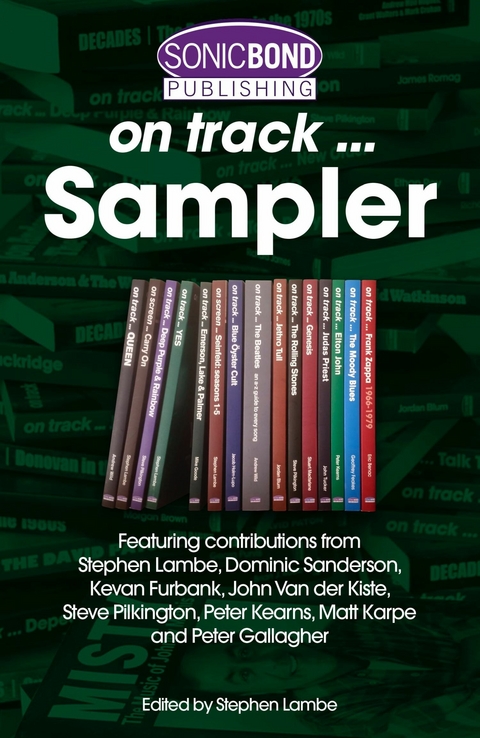
The Sonicbond On Track Sampler (eBook)
64 Seiten
Sonicbond Publishing (Verlag)
978-1-78952-496-3 (ISBN)
When Sonicbond Publishing produced its first books in 2018, we didn't expect that by 2024, we would have published over 120 new titles in our flagship On Track series. To celebrate we are pleased to present our very first printed, pocket-sized sampler. This represents a brief dive into eight of our titles in the series across a wide range of music genres, including progressive rock, indie, classic rock, folk rock, singer-songwriter and metal.
Yes' seminal Fragile album finds the band rushing to take advantage of their first success, while The Good Son by Nick Cave and The Bad Seeds, sees the much-lauded singer-songwriter and his band relocate from London to Brazil. Fairport Convention's 1969 album Unhalfbricking, featuring the Sandy Denny classic 'Who Knows Where The Time Goes', is dissected, while we also discuss early Eagles on One Of These Nights. Led Zeppelin's controversial Houses Of The Holy gets a detailed examination, followed by a look at Joni Mitchell's exquisitely tender Blue. To complete the book, we discuss Tool's 1996 epic Ænima and The Sensational Alex Harvey Band's astonishing 1975 album Tomorrow Belongs To Me.
We hope you enjoy this little dive into just a few of our many books in the In Track series and beyond. Why not investigate further at www.sonicbondpublishing.com
Yes – Fragile (1971) by Stephen Lambe
Personnel:
Jon Anderson: vocals
Bill Bruford: drums and percussion
Steve Howe: electric and acoustic guitars, vocals
Chris Squire: bass guitars and vocals
Rick Wakeman: organ, grand piano, electric piano, harpsichord, Mellotron, synthesiser
Produced at Advision, September 1971 by Yes and Eddie Offord.
Engineered by Eddie Offord, assisted by Gary Martin
UK Release date: December 1971.
US release date: January 1972
Highest chart places: UK: 7, USA: 4
Running time: 41:10
Fragile saw another line-up change – and a crucial one at that – with Tony Kaye replaced by Strawbs (and session) keyboard player Rick Wakeman. Kaye had begun to sound out of his depth on The Yes Album, and while it does actually contain a fair amount of synthesiser, his performance was still largely organ-based. There is also a suggestion of a personality clash between the hard-partying Kaye and the more reserved Howe, but in the end, Squire and Anderson wanted something a little more orchestral, and Wakeman – who had already played Mellotron on David Bowie’s ‘Space Oddity’ as early as 1969 – seemed perfect. His virtuosity was somewhat misplaced and underutilised in his current band, The Strawbs – as a listen to their excellent Just A Collection Of Antiques And Curios live album testifies.
The new lineup began rehearsing immediately after Kaye’s departure and worked up new material for an album which – label Atlantic and the band hoped – would capitalise quickly on the considerable success of The Yes Album. The material was very strong, but only one problem remained. There wasn’t enough of it. As a result, each member of the group contributed a solo track with varying degrees of success. Howe’s ‘Mood For A Day’, for instance, is a delightful classical piece – in contrast to the Country pickin’ of ‘Clap’, while Squire and Anderson’s pieces also have a lot of charm. Wakeman’s ‘Cans And Brahms’ is hampered by his contract with A&M Records, which prevented him from contributing a self-penned piece, and Bruford’s track feels a little pointless. However, the band-created pieces are astonishing. In particular, Wakeman’s parts on this (and Close To The Edge) are his most imaginative and integrated contributions to the Yes catalogue. Alongside his florid virtuosity and undoubted talents with multiple keyboards, his classical training enhanced the band’s ability to transition between sections within a single track. All four of the full-band pieces have remained in the band’s live set – more on than off – since the album was released. Yet the solo tracks blight the album just a little. Another month spent on the record might have removed the need for these pieces and produced the classic that was not to arrive for a few months with Close To The Edge.
This was the first Yes album to make use of the skills of Roger Dean, an elegant and amiable Englishman whose unique fantasy paintings have become so synonymous with the band’s music. Note that the band’s famous snake-like logo had not yet arrived – but the other-worldly nature of the artwork fitted perfectly with the ambiguous nature of Anderson’s lyrics. The vinyl version of the album came complete with a gatefold sleeve and a booklet – reproduced in miniature in the 2016 Definitive Edition CD. Clearly, neither the band nor Atlantic were taking any chances.
‘Roundabout’ (Anderson, Howe)
This iconic rocker remains the perfect calling card to the ‘classic’ version of the band. Howe’s classical guitar introduction leads into the main song, which emphasises Squire’s mobile bass and Wakeman’s terrific organ arpeggios. It is possible to imagine Kaye playing this – but not with quite such effortless fluidity. Bruford’s cymbal work – as usual – is first-rate in the middle section, which also includes some unusual organ chords that Kaye could not have contributed, plus the first of the characteristic vocal harmony sections so beloved of the band. Listen out, too, for the casual virtuosity of Wakeman’s playing – low in the mix – over the acoustic guitar reprise before the first Mellotron appearance on a Yes album and that great organ/guitar dual before the final reprise of the main theme. The track lays out the sound palette of the album both instrumentally and tonally. The 1960s have gone entirely by this point and any of the clean sterility that might have – slightly – blighted The Yes Album has been replaced by a warm, natural and – it has to be said – even more modern sound. If you are reading this, Eddie Offord, take a bow.
This most perfect of up-tempo Yes pieces has developed a life of its own, of course. An edited version of the song was a big – and unexpected – hit single in the USA, which – in turn – has led to it being played as an encore in almost every Yes show since. Sometimes – particularly when there is another guitarist alongside Howe (e.g. Trevor Rabin or Billy Sherwood) playing in the band, a full version has been performed with Howe playing acoustic for the first couple of minutes of the track. At other times, various edits have been used – usually to preserve that full-tilt ‘encore’ vibe. On the 2004 world tour, the song was relegated to the acoustic section and played – entertainingly – as a shuffle. There are various alternative versions on the 2003 Rhino re-master and 2016 Definitive Edition (including the US single edit, which I had never heard before), and countless live versions, but the original on Fragile still takes some beating.
‘Cans And Brahms’ (Brahms Arr: Wakeman)
This is a slight piece – albeit a pleasant listen – and had it not been placed on such a famous album, it would never have warranted the attention it still gets to this day. Indeed, it has a bit of a ‘Switched on Bach’ feel to it, which may be intentional. However, as a calling card for Wakeman’s ability, it does say a couple of things. Firstly: ‘The classics are important to me’ and secondly: ‘look at how many keyboards I have’. Both these may seem obvious to us 50-plus years on, but given that most keyboard players were still rhythm and blues organists, it sends an important message to the Yes-buying public. When the band toured playing Fragile in its entirety in 2015, the track – played by Geoff Downes – seemed completely pointless.
‘We Have Heaven’ (Anderson)
‘Tell the Moondog, tell the March hare’. Originally planned as an a capella piece, this Anderson solo track has a bit more about it than Wakeman’s, with Anderson building up layered vocals over a very basic acoustic guitar, bass and drums backing. A longer version and an a capella mix can be found on the Steven Wilson Definitive Version Blu-ray. The song – like Wakeman’s track, rather short – foreshadows Anderson’s great solo album Olias Of Sunhillow in 1976 with its joyous tone and beautifully crafted backing vocals. Footsteps – panning nicely over the stereo – lead into the next piece, which is ...
‘South Side Of The Sky’ (Anderson, Squire)
This full-band track is the first to use strong non-musical atmospherics on a Yes album, with rolls of thunder and swirls of wind introducing us to another rocker with Howe soloing hard and Anderson’s double-tracked vocals wailing over a complex and powerful riff played by guitar, bass and organ in unison at times. After this hard-rocking section, the piece takes an unexpected turn with its neo-classical piano solo – again, the first of its type on a Yes album – and the following vocal section with Chris Squire dominant (rather than Anderson) and guitar almost completely absent. This is wonderfully done and lifts the track to something very special. Bruford gets the chance to use his jazz chops here before a reprise of the hard rock section and a further swirl of wind close the track and, indeed, the first side of the album. There’s a fantastic feeling of ‘space’ on this track. I love, for instance, the way that the final low piano note of Wakeman’s solo section is allowed to resonate and swirl across the stereo before the next section. It’s spectacular and confident stuff.
This great track was tried out as a live piece on the Fragile Tour but dropped quickly, as it didn’t seem to gel. It may simply have been that the technology – particularly the live sonic reproduction of the grand piano, so critical to the piece – just did not work at the time. However, it was attempted successfully in 2003, when digital samples had made reproduction of a grand piano in a live rock setting much easier, and seemed to work so well it has been part of many live sets since. Played by the band of 2003-4, which included Howe and Wakeman, it was extended to include a thrilling guitar/ Minimoog duel.
‘Five Per Cent For Nothing’ (Bruford)
Bruford’s 35-second instrumental track – played by the whole band – is somewhat throwaway due to its brevity. Seeing the band in late middle age having to play this piece in a live setting due to a commitment to playing the complete album is...
| Erscheint lt. Verlag | 19.12.2025 |
|---|---|
| Sprache | englisch |
| Themenwelt | Kunst / Musik / Theater ► Musik ► Musikgeschichte |
| Schlagworte | Alex Harvey • Fairport Convention • Joni Mitchell • Led Zeppelin • Nick Cave • Yes band |
| ISBN-10 | 1-78952-496-2 / 1789524962 |
| ISBN-13 | 978-1-78952-496-3 / 9781789524963 |
| Informationen gemäß Produktsicherheitsverordnung (GPSR) | |
| Haben Sie eine Frage zum Produkt? |
 EPUB (Ohne DRM)
Digital Rights Management: ohne DRM
Dieses eBook enthält kein DRM oder Kopierschutz. Eine Weitergabe an Dritte ist jedoch rechtlich nicht zulässig, weil Sie beim Kauf nur die Rechte an der persönlichen Nutzung erwerben.
Dateiformat: EPUB (Electronic Publication)
EPUB ist ein offener Standard für eBooks und eignet sich besonders zur Darstellung von Belletristik und Sachbüchern. Der Fließtext wird dynamisch an die Display- und Schriftgröße angepasst. Auch für mobile Lesegeräte ist EPUB daher gut geeignet.
Systemvoraussetzungen:
PC/Mac: Mit einem PC oder Mac können Sie dieses eBook lesen. Sie benötigen dafür die kostenlose Software Adobe Digital Editions.
eReader: Dieses eBook kann mit (fast) allen eBook-Readern gelesen werden. Mit dem amazon-Kindle ist es aber nicht kompatibel.
Smartphone/Tablet: Egal ob Apple oder Android, dieses eBook können Sie lesen. Sie benötigen dafür eine kostenlose App.
Geräteliste und zusätzliche Hinweise
Buying eBooks from abroad
For tax law reasons we can sell eBooks just within Germany and Switzerland. Regrettably we cannot fulfill eBook-orders from other countries.
aus dem Bereich


