


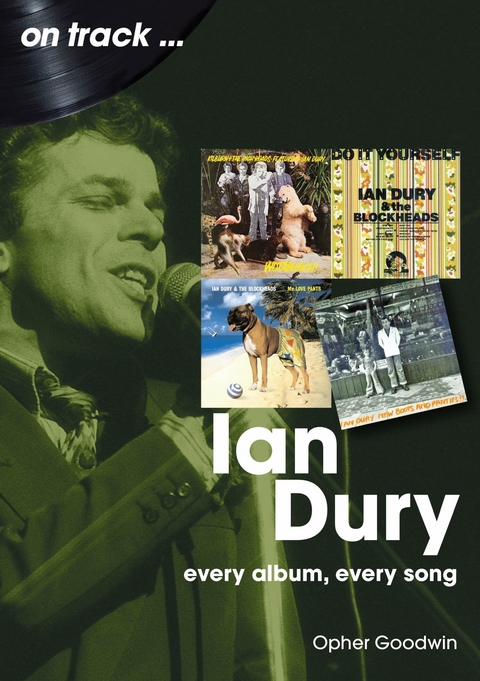
Ian Dury (eBook)
144 Seiten
Sonicbond Publishing (Verlag)
978-1-78952-495-6 (ISBN)
We only ever get glimpses of Ian Dury; nothing is as it seems. From irascible rogue to national treasure, pop star to social commentator, cockney geezer to artist, he was a man greater than the sum of his parts. Part teddy boy, part punk, part vaudeville act; he was unique. The music that emanates from this powerful personality echoes the heart and drive of its complex creator.
Dury began his career as a frontman with post-punk outfit Kilburn And The High Roads, but had his greatest success with backing band The Blockheads, which featured Chis Jankel and Wilko Johnson at various times. He found true commercial success with the albums New Boots And Panties and Do It Yourself. Dury went on to a critically acclaimed solo career and worked with The Blockheads again on the 1997 album Mr Love Pants. He also had a slew of non-album hits, especially the UK number one 'Hit Me With Your Rhythm Stick'.
In this book, Opher Goodwin dissects his albums and songs to tease out their spirit and reveal the inspirations behind them.
This is Ian Dury: a Blockhead, a genius.
Opher Goodwin is the author of many books on rock music and science fiction and taught the first History Of Rock Music classes in the UK. He was fortunate to spend the sixties in London, the epicentre for the underground explosion of rock music and culture, where he was able to see everyone from Pink Floyd, Hendrix and Cream to The Doors, Captain Beefheart and Roy Harper. He now lives happily in East Yorkshire, UK.
Handsome (1975) – Kilburn And The High Roads
Personnel:
Ian Dury: vocals
Keith Lucas: guitar, production
Rod Melvin: piano, vocals on ‘Broken Skin’ and ‘Thank You Mum’
Russel Hardy: keyboards on the 1974 Capital Radio broadcast
Charles Sinclair: bass
David Newton-Rohoman: drums
Louis Larose or George Butler: drums on the 1974 Capital Radio broadcast
Davey Payne: saxophone, flute
Clare Torry, Tina Charles: backing vocals
Recorded at Pye Studios, London, in November 1974
Produced by Hugh Murphy and Chris Thomas (on single ‘Rough Kids’ and ‘Billy Bentley (Promenades Himself In London)’)
Engineered by Larry Bartlett and Phil Chapman
Photography: Poundcake
Cover painting: Elizabeth Rathmell (‘The Kilburns Near Tower Bridge’)
Graphics: Gordon House
Label: Dawn
Running time: 40.10
Chart position: failed to chart
Although this was technically their first album, it was really their second. At least we could say that Handsome and Wotabunch were different versions of the same album. Ian commented in the booklet for the Reasons To Be Cheerful compilation:
The Kilburns made two albums, but they were both the same. The second one was to try and stop the first one coming out! In fact, it didn’t prevent them because Warner Bros. Records waited until I had some success, and then they put out that album called Wotta Bunch (sic).
The Raft label recordings were made in January 1974. When the Raft label folded, and Warner Brothers, who had taken Raft over, did not want the band, the tapes remained unreleased.
The Kilburns then signed to the Dawn label and went into the Pye studios in November to record the same set of songs again. The songs that made up this album. Including the recording of the demos, this was the third time the songs had been recorded. They hoped they would get them right this time. But once again, they failed. The blame was laid at the producer Hugh Murphy’s feet. Ian’s view was that he had taken the Kilburns’ raw pub rock and polished it until it lost its vitality.
The album was going to be called No Hand Signals, but for some reason, the label vetoed that. They considered it too obscure and uncommercial. Playing on the eccentricity of the band’s appearance and in keeping with the cockney theme, they settled on Handsome for the title.
The Kilburns had been greatly successful on the live pub scene, but that failed to ignite into commercial success, and, despite all their hopes and expectations, surprisingly, the album sold poorly. Despite its undeniable quality, showing off Ian’s highly original writing talents, it lacked the punch and cutting edge of the live performances and failed to attract wider attention. Their promising career faltered.
‘The Roadette Song’ (Ian Dury, Russell Hardy)
A few echoey piano notes launch us into the joys of Dury. A fluid keyboard and chunky guitar riff have Ian, in a more restrained vocal than in later years, spitting out his rhyming couplets that were inspired by the Canterbury Arts students Germaine and Genevieve Dolan, who, in their home-made costumes, had danced furiously on stage at the Kilburns’ first and subsequent gigs. It became a term used to describe the dancing fans who used to follow the band around from gig to gig. They didn’t like to talk much – just dance provocatively.
Diction very bad, friction double rich
Brazen little hussy, rock ‘n’ rolling bitch
Ian had christened them roadettes. When Denise Roudette heard the song at the first Kilburn’s gig she went to, she thought there was some weird paranormal happening and that Ian was singing about her.
The track motors along and then settles into a smoother chorus as Ian cajoles an interested young man not to hustle and bustle but rather join in with the physicality of the dance.
Slow down your hustle bustle
You can take your time, young man
Some of this is muscle
We’re off to a good start.
‘Pam’s Moods’ (Ian Dury, Russell Hardy)
The music changes to a 1930s jazz mood with an ethereal wafting chorus, strings and delicious sax. There is even a Django-esque bit of guitar. Not exactly pub rock but very entertaining with oodles of humour and risky lyrics. He’s on dodgy ground to start with when addressing female hormones and disposition. Not many dare.
The piano intro, with background strings, starts the piece as Ian recites the opening scene. When Pam and Ian are good, they are brilliant, but when they argue, it’s the pits. The whole piece is incarcerated in an envelope of humour as Ian firmly lays the blame for the bitter quarrels on Pam and her emotional fluctuations.
She gives me the business, I lose all self-control
The curse of fifty witches making wormwood of my soul
A life of broken china and sneering yellow hate
Ooh, derision and contusion and things that nauseate
It slips into a divine mellow chorus as Ian croons about ‘Pam’s moods’. One is left with the feeling that Pam probably had good grounds for her turbulent eruptions. The song ends with an angelic female chorus.
‘Crippled With Nerves’ (Ian Dury, Russell Hardy)
Released as a single (with B-side ‘Huffety Puff’) in February 1975
The versatility of the band shines through as the Kilburns transform into the Kilburn Hillbillies for a country & western-tinged exposition, complete with Elvis Presley impersonations and a very raspy saxophone courtesy of Davey. Ian relates the sad story of his unrequited love. He desperately wanted to have and to hold the subject of his bottomless desire, but couldn’t because he was crippled by nerves.
‘Broken Skin’ (Ian Dury, Rod Melvin)
We’re back to a mellow ballad as Ian relates the depths of his pain. Throughout his life, he has suffered many afflictions from the ravages of polio and subsequent isolation from home, to the experience in Chailey School, and then the breakup of his family and estrangement from his father. We all have broken skin, but with Ian, the wounds run deep and never heal. It’s a delicate, heartfelt song; Ian’s vocal is full of subdued melancholy as the female chorus milk the emotions with their plaintive vocals over softly swelling strings.
‘Upminster Kid’ (Ian Dury, Russell Hardy)
Ian’s offering us a slab of Gene Vincent’s rock ‘n’ roll as the Kilburns launch into the song with an upbeat groove. The bass throbs as they capture the 1950s feel of the Blue Caps, complete with a rockabilly guitar solo. Ian half recites, half sings the lyrics – the first of his homages to his hero Gene Vincent.
The female chorus wail in the background as Ian romanticises the spectacle of his larger-than-life version of his existence as a hard, rebellious 15-year-old teddy boy. The attention to detail is immaculate. Ian is dressed to the nines in his black crepe jacket with sideboards down to his chin, 12” bottomed stardust flares with dazzling green socks, driving around in a two-tone zephyr. His older friend Friar is also suitably fitted out in his powder blue suit with criss-cross lurex thread. The people step aside when the Upminster kid walks through. All great, except that he actually wasn’t from Upminster, and I can’t see too many people stepping out of the way as the 15-year-old wannabe hobbles past. But Ian’s fantasy lives.
While the track is well-produced, it somehow lacks the energy of their live performances and falls short of its potential. He’d revisit it later in his career.
‘Patience (So What?)’ (Ian Dury, Russell Hardy)
The drums set up a speedy pace, complete with chirping guitar and chirruping bass for this 1950s-style rocker. The female backing vocals interject in the chorus with ‘So What’ in the correct places. It’s a bouncy, fun song that rides a jaunty pace with sprightly piano and some rasping brass.
This cheeky number has Ian infatuated with a girl called Patience Eames, but seemingly, she’s not interested. In a stream of rhymes, he paints the scenes of how he dreams, dresses up and plays in the band and tries to impress, but she’s impervious. Still, he dreams of them snuggling up and getting it on. Another number with humorous couplets and cheeky lines:
He’s got the sex technique to make your eyeballs squeak – so what?
‘Father’ (Ian Dury, Charles Sinclair)
The bass burbles along as the band set up a rapid pace for this comical soap opera music hall rendition. The song paints a scene reminiscent of domestic bliss in an East End council tenement. Father, a quasi-Alf Garnet, entrenched in his armchair, pronounces on...
| Erscheint lt. Verlag | 19.12.2025 |
|---|---|
| Reihe/Serie | On Track |
| Sprache | englisch |
| Themenwelt | Kunst / Musik / Theater ► Musik ► Musikgeschichte |
| Schlagworte | apples • Chaz jankel • New Boots and Panties • Sex and Drugs and Rock n Roll • The Blockheads |
| ISBN-10 | 1-78952-495-4 / 1789524954 |
| ISBN-13 | 978-1-78952-495-6 / 9781789524956 |
| Informationen gemäß Produktsicherheitsverordnung (GPSR) | |
| Haben Sie eine Frage zum Produkt? |
 EPUB (Ohne DRM)
Digital Rights Management: ohne DRM
Dieses eBook enthält kein DRM oder Kopierschutz. Eine Weitergabe an Dritte ist jedoch rechtlich nicht zulässig, weil Sie beim Kauf nur die Rechte an der persönlichen Nutzung erwerben.
Dateiformat: EPUB (Electronic Publication)
EPUB ist ein offener Standard für eBooks und eignet sich besonders zur Darstellung von Belletristik und Sachbüchern. Der Fließtext wird dynamisch an die Display- und Schriftgröße angepasst. Auch für mobile Lesegeräte ist EPUB daher gut geeignet.
Systemvoraussetzungen:
PC/Mac: Mit einem PC oder Mac können Sie dieses eBook lesen. Sie benötigen dafür die kostenlose Software Adobe Digital Editions.
eReader: Dieses eBook kann mit (fast) allen eBook-Readern gelesen werden. Mit dem amazon-Kindle ist es aber nicht kompatibel.
Smartphone/Tablet: Egal ob Apple oder Android, dieses eBook können Sie lesen. Sie benötigen dafür eine kostenlose App.
Geräteliste und zusätzliche Hinweise
Buying eBooks from abroad
For tax law reasons we can sell eBooks just within Germany and Switzerland. Regrettably we cannot fulfill eBook-orders from other countries.
aus dem Bereich


