


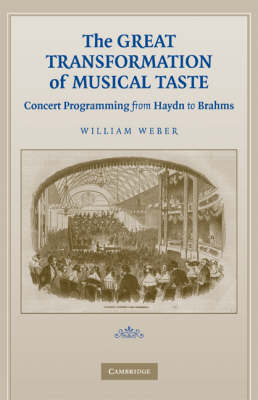
The Great Transformation of Musical Taste
Concert Programming from Haydn to Brahms
Seiten
2008
Cambridge University Press (Verlag)
978-0-521-88260-6 (ISBN)
Cambridge University Press (Verlag)
978-0-521-88260-6 (ISBN)
Tracing the evolution of musical taste in European concert programs from 1750 to 1870, William Weber demonstrates how separate worlds arose around classical music, popular songs, and opera selections. The book includes over a hundred transcriptions of programs, enabling the reader to follow the analysis in detail.
Grounded in knowledge of thousands of programs, this book examines how musical life in London, Leipzig, Vienna, Boston, and other cities underwent a fundamental transformation in relationship with movements in European politics. William Weber traces how musical taste evolved in European concert programs from 1750 to 1870, as separate worlds arose around classical music and popular songs. In 1780 a typical program accommodated a variety of tastes through a patterned 'miscellany' of genres, held together by diplomatic musicians. This framework began weakening around 1800 as new kinds of music appeared, from string quartets to quadrilles to ballads, which could not easily coexist on the same programs. Utopian ideas and extravagant experiments influenced programming as ideological battles were fought over who should govern musical taste. More than a hundred illustrations or transcriptions of programs enable readers to follow Weber's analysis in detail.
Grounded in knowledge of thousands of programs, this book examines how musical life in London, Leipzig, Vienna, Boston, and other cities underwent a fundamental transformation in relationship with movements in European politics. William Weber traces how musical taste evolved in European concert programs from 1750 to 1870, as separate worlds arose around classical music and popular songs. In 1780 a typical program accommodated a variety of tastes through a patterned 'miscellany' of genres, held together by diplomatic musicians. This framework began weakening around 1800 as new kinds of music appeared, from string quartets to quadrilles to ballads, which could not easily coexist on the same programs. Utopian ideas and extravagant experiments influenced programming as ideological battles were fought over who should govern musical taste. More than a hundred illustrations or transcriptions of programs enable readers to follow Weber's analysis in detail.
William Weber is Professor of History at California State University, Long Beach.
Introduction; Part I. Miscellany and Collegiality, 1750–1800: 1. Concepts and contexts; 2. Variations on miscellany; Part II. Crisis and Experiment, 1800–48: 3. Musical idealism and the crisis of the old order; 4. The rise of the chamber-music concert; 5. Convention and experiment in benefit and virtuoso concerts; 6. Toward classical-music orchestral concerts; 7. Promenade concerts: rise of the 'pops'; Part III. Founding a New Order, 1848–75: 8. Classical music achieves hegemony; 9. Vocal music for the general public; 10. Epilogue: state of the musical community in 1914.
| Erscheint lt. Verlag | 28.5.2008 |
|---|---|
| Verlagsort | Cambridge |
| Sprache | englisch |
| Maße | 158 x 234 mm |
| Gewicht | 720 g |
| Themenwelt | Kunst / Musik / Theater ► Musik ► Klassik / Oper / Musical |
| ISBN-10 | 0-521-88260-5 / 0521882605 |
| ISBN-13 | 978-0-521-88260-6 / 9780521882606 |
| Zustand | Neuware |
| Informationen gemäß Produktsicherheitsverordnung (GPSR) | |
| Haben Sie eine Frage zum Produkt? |
Mehr entdecken
aus dem Bereich


aus dem Bereich
Essays und Gespräche
Buch | Hardcover (2025)
Wallstein Erfolgstitel (Verlag)
CHF 29,90


