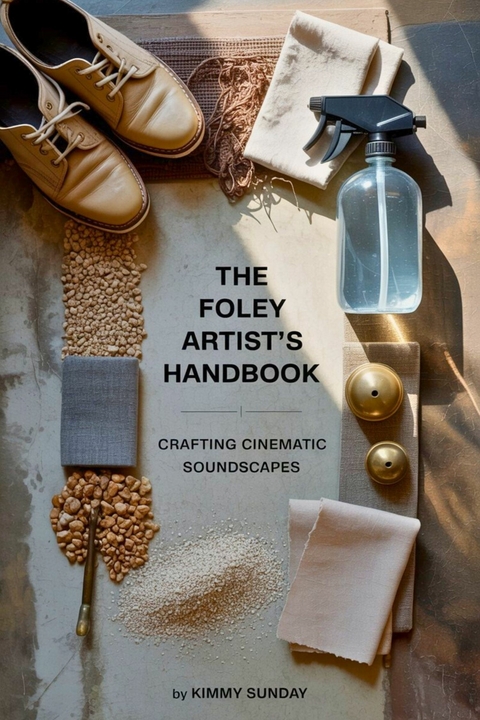
The Foley Artist's Handbook (eBook)
128 Seiten
JNR Publishing (Verlag)
978-0-00-112179-9 (ISBN)
Unlock the Secrets of Cinematic Sound!
Ever wondered why some movies sound so real, so immersive, you feel like you're right there in the scene? The answer lies in the hidden art of Foley.
Beyond dialogue and music, it's the Foley artist who adds the crucial layer of everyday sound-footsteps, rustling clothes, squeaking doors, and shattering glass-that breathes life into the visual world.
In The Foley Artist's Handbook: Crafting Cinematic Soundscapes, seasoned sound professional Kimmy Sunday pulls back the curtain on this essential post-production craft.
Whether you're an aspiring sound designer, a filmmaker on a budget, or simply fascinated by how movie magic is made, this comprehensive guide provides the knowledge and practical skills you need to create compelling audio that elevates any project.
What You'll Discover Inside:
Master the Core Techniques: Learn how to perfectly recreate sounds for footsteps, movements, and objects.
Explore Genre-Specific Approaches: Understand how Foley techniques differ for horror, action, fantasy, and sci-fi.
Integrate Foley Seamlessly: Discover how to balance your sound effects with dialogue and music for a professional mix.
Adapt to Modern Media: Get insights into interactive and dynamic sound design for games and VR.
Set Up Your Own Studio: Learn the essential equipment and acoustic treatments for a high-quality recording space.
Troubleshoot Common Issues: Gain practical solutions for technical challenges in Foley recording and editing.
This book isn't just theory; it's a practical workshop in print, filled with exercises and drills to hone your skills. You'll learn the psychology behind effective sound design and develop the habits of a successful audio professional.
Ready to make your projects sound incredible? Ready to step into the world of professional audio post-production?
Get your copy of The Foley Artist's Handbook today and start crafting unforgettable soundscapes!
TAGS: Foley art, sound design, audio post production, film sound, game audio, video editing, audio engineering, sound effects, cinematic soundscapes, recording techniques, audio mixing, film production, game development, audio engineering handbook, foley techniques, sound for animation, audio restoration, sound studio setup, field recording, audio middleware
Chapter 1: Understanding Foley Art
What Exactly Is Foley?
Let's start with a confession: most people have no idea what Foley is, and that's exactly how we like it. When Foley is done well, it's completely invisible. You hear a character's footsteps and never question whether they were recorded on set or added later. You hear the rustle of clothing and assume it happened naturally during filming. You hear a sword being drawn from its sheath and your brain simply accepts that this is the sound that action makes.
Foley is the art of performing and recording everyday sound effects that are added to films, television shows, video games, and other audio-visual media during post-production. Named after Jack Foley, a pioneering sound editor who developed many of the techniques we still use today, Foley involves creating and recording sounds that replace or enhance the audio captured during filming.
But that clinical definition barely scratches the surface of what Foley actually involves. Think of it this way: Foley artists are part detective, part performer, and part magician. We're detectives because we analyze every visual element to determine what sounds it should make. We're performers because we must act out these sounds with precise timing and emotional resonance. We're magicians because we create auditory illusions that make audiences believe in worlds that don't exist.
The Three Pillars of Foley
Professional Foley work traditionally falls into three main categories, each requiring different skills and approaches:
Footsteps and Movement - This is often where beginners start, and for good reason. Footsteps are fundamental to character development and scene atmosphere. A confident character walks differently than a nervous one. A tired character moves differently than an energetic one. Heavy boots on concrete tell a different story than bare feet on grass. Mastering footsteps means understanding not just the mechanics of walking, but the psychology of movement.
The challenge with footsteps extends beyond simply matching the visual rhythm. You must consider the character's emotional state, physical condition, and story context. Is this character trying to be stealthy? Are they injured? Confident? Drunk? Each of these states requires subtle adjustments to timing, weight, and sound character that can make or break a scene's effectiveness.
Props and Hard Effects - This category covers every object a character touches, moves, or interacts with. Opening doors, handling weapons, moving furniture, typing on keyboards, shuffling papers – if you see it happen on screen, it probably needs a corresponding sound. This is where creativity really shines, because often the actual object used in filming doesn't create the ideal sound for the story.
I once spent an entire week creating the perfect sound for a character opening a futuristic door. The actual prop was silent, so I had to build the sound from scratch using everything from pneumatic tools to the sound of my refrigerator opening. The final sound used seventeen different elements layered together, but it sold the illusion completely.
Cloth and Fabric Movement - Often overlooked by newcomers, fabric sounds are crucial for creating realistic character movement. Every time a character moves, their clothing moves too. A leather jacket sounds different from a cotton shirt, which sounds different from a silk dress. Period costumes require historically appropriate fabric sounds. Superhero costumes might need otherworldly fabric characteristics.
Fabric work requires extreme subtlety. Too little and characters seem disconnected from their physical presence. Too much and the clothing becomes distracting. The best fabric Foley supports the performance without drawing attention to itself.
Why Foley Matters More Than Ever
You might wonder why Foley is necessary at all. After all, don't the microphones on set capture all these sounds naturally? The reality is more complex than you might expect.
Modern film and television production prioritizes dialogue clarity above all else. Microphones are positioned and configured to capture clean speech, often at the expense of environmental sounds. Additionally, many scenes are shot with multiple camera angles, requiring several takes that may not match acoustically. Background noise, crew movement, and technical equipment create an audio environment that's far from ideal for capturing subtle sound effects.
Post-production also involves extensive audio processing. Dialogue is cleaned, enhanced, and sometimes completely replaced through ADR (Automated Dialogue Replacement). Music and sound effects are layered in complex mixes. In this heavily processed audio landscape, the original on-set sound effects often don't integrate well or lack the clarity and impact needed for the final mix.
Furthermore, contemporary audiences have developed sophisticated expectations for audio quality. We're accustomed to pristine, cinematic soundscapes that feel hyperreal. Natural sounds, captured in uncontrolled environments, often feel thin or unconvincing compared to carefully crafted Foley effects.
The Psychology of Sound
Understanding Foley requires understanding how our brains process audio information. Sound reaches our consciousness faster than visual information, and it carries powerful emotional and psychological weight. The right sound can increase tension, provide comfort, suggest danger, or create intimacy.
Consider the difference between hearing footsteps approaching in a horror film versus a romantic comedy. The actual physical action might be identical, but the sound design tells us how to interpret what we're seeing. Heavy, irregular footsteps with ominous reverb suggest a threat. Light, rhythmic footsteps with warm acoustic characteristics suggest someone we should welcome.
This psychological component is why Foley artists must be storytellers first and technicians second. Every sound choice contributes to the narrative. Every timing decision affects the emotional rhythm of a scene. Every textural choice influences how audiences connect with characters and situations.
Foley in Different Media
While film and television remain the primary applications for Foley artistry, the principles and techniques apply across a wide range of media formats.
Video Games present unique challenges because sounds must respond dynamically to player actions. A footstep system for a game character needs to work whether the player is walking, running, sneaking, or jumping. It must adapt to different surfaces, environmental conditions, and equipment states. This requires creating modular sound systems rather than linear sound tracks.
Virtual and Augmented Reality applications demand even more sophisticated approaches. Sounds must be spatially accurate and respond to head movement and environmental changes in real-time. The margin for error is smaller because users can focus their attention on specific sound sources in ways that traditional media doesn't allow.
Podcasts and Audio Drama rely entirely on sound to create their worlds. Foley work for these formats often needs to be more pronounced and clearly defined because there are no visual cues to support the audio information.
Animation and Motion Graphics often require stylized or exaggerated Foley that matches the visual style. A realistic footstep might not work for a cartoon character, but a more pronounced, rhythmic sound might perfectly complement the animation style.
The Art of Invisible Perfection
The ultimate goal of professional Foley work is to achieve what I call "invisible perfection." The sounds should feel so natural and appropriate that audiences never question their authenticity. They should enhance the storytelling without drawing attention to themselves as added elements.
This requires a deep understanding of how real-world objects actually sound, combined with the creative insight to enhance those sounds for dramatic effect. A real sword drawn from a real scabbard might make a subtle scraping sound. A cinematic sword draw might need additional metallic resonance and a sharp attack to sell the drama of the moment.
Achieving invisible perfection also requires technical precision. Sounds must be synchronized perfectly with visual cues. They must be balanced appropriately within the overall audio mix. They must maintain consistent characteristics throughout a scene or sequence.
Building Your Foley Mindset
Developing as a Foley artist begins with changing how you listen to the world around you. Start paying attention to the sounds that accompany everyday actions. How does your footstep sound different on carpet versus hardwood? What's the acoustic difference between opening a heavy wooden door and a light aluminum door? How does the sound of fabric change when you move quickly versus slowly?
This analytical listening extends to media consumption as well. When watching films or television, try to identify which sounds were likely added in post-production. Notice how sound choices affect your emotional response to scenes. Pay attention to how different genres use sound to support their storytelling goals.
Most importantly, start experimenting with...
| Erscheint lt. Verlag | 12.12.2025 |
|---|---|
| Sprache | englisch |
| Themenwelt | Kunst / Musik / Theater ► Film / TV |
| ISBN-10 | 0-00-112179-0 / 0001121790 |
| ISBN-13 | 978-0-00-112179-9 / 9780001121799 |
| Informationen gemäß Produktsicherheitsverordnung (GPSR) | |
| Haben Sie eine Frage zum Produkt? |
 EPUB (Adobe DRM)
Größe: 2,4 MB
Kopierschutz: Adobe-DRM
Adobe-DRM ist ein Kopierschutz, der das eBook vor Mißbrauch schützen soll. Dabei wird das eBook bereits beim Download auf Ihre persönliche Adobe-ID autorisiert. Lesen können Sie das eBook dann nur auf den Geräten, welche ebenfalls auf Ihre Adobe-ID registriert sind.
Details zum Adobe-DRM
Dateiformat: EPUB (Electronic Publication)
EPUB ist ein offener Standard für eBooks und eignet sich besonders zur Darstellung von Belletristik und Sachbüchern. Der Fließtext wird dynamisch an die Display- und Schriftgröße angepasst. Auch für mobile Lesegeräte ist EPUB daher gut geeignet.
Systemvoraussetzungen:
PC/Mac: Mit einem PC oder Mac können Sie dieses eBook lesen. Sie benötigen eine
eReader: Dieses eBook kann mit (fast) allen eBook-Readern gelesen werden. Mit dem amazon-Kindle ist es aber nicht kompatibel.
Smartphone/Tablet: Egal ob Apple oder Android, dieses eBook können Sie lesen. Sie benötigen eine
Geräteliste und zusätzliche Hinweise
Buying eBooks from abroad
For tax law reasons we can sell eBooks just within Germany and Switzerland. Regrettably we cannot fulfill eBook-orders from other countries.
aus dem Bereich