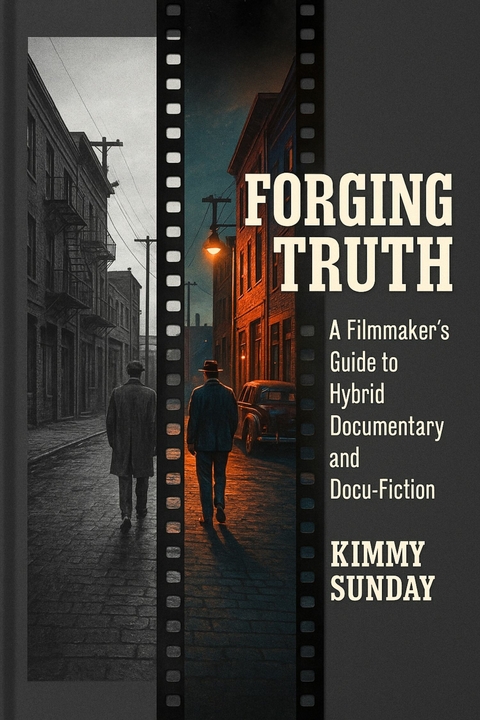
Forging Truth (eBook)
333 Seiten
JNR Publishing (Verlag)
978-0-00-112176-8 (ISBN)
Are you ready to tell true stories that transcend the limits of traditional documentary?
Ever watch a groundbreaking film like Waltz with Bashir or American Animals and wonder not just 'How did they do that?' but 'How can I do that?'
Welcome to the thrilling, boundary-pushing world of docu-fiction and hybrid documentary, the cinematic space where verifiable fact and imaginative fiction collide to create a deeper, more resonant truth.
In Forging Truth, author and filmmaking mentor Kimmy Sunday demystifies this exciting genre, providing the definitive, step-by-step masterclass for aspiring and experienced filmmakers alike.
A Practical, Actionable Guide Forget dry academic texts. This isn't just a book of theory; it is a practical, actionable guide packed with insider techniques, ethical considerations, and real-world case studies designed to empower you to tell unforgettable stories.
With a witty, engaging, and deeply knowledgeable voice, this guide walks you through the entire filmmaking process, from finding your unique concept to navigating the festival circuit. You will move beyond simply recording reality to actively shaping it with purpose and integrity.
Inside, you will master:
Subject Selection: The art of finding real-life subjects with explosive dramatic potential and deciding which elements to script versus capture spontaneously.
Rigorous Research: Fact-checking techniques to build an unshakable foundation of truth for your creative interpretations.
Directing Hybrid Performances: The nuanced skill of directing actors to portray real figures with respect and emotional authenticity, utilizing improvisation to fuse real dialogue with dramatic flow.
Advanced Aesthetics: Cinematography and sound design techniques to visually and aurally signal the difference between fact and fiction, creating a cohesive and immersive world.
Editing Secrets: Methods like crosscutting to build tension, create irony, and maintain a powerful narrative drive.
Ethical Frameworks: Crucial strategies for handling sensitive material, portraying trauma responsibly, and avoiding exploitation to ensure your bold vision is also a responsible one.
Forging Truth is more than a filmmaking guide-it's your trusted partner in creative rebellion. It will challenge you, inspire you, and equip you with the tools to tell the stories only you can tell.
Scroll up and click 'Buy Now' to start forging your own cinematic truth today!
CHAPTER 2: IDENTIFYING YOUR DOCU-FICTION CONCEPT
Alright, you've successfully navigated the definitional maze of hybrid documentaries from Chapter 1! You now understand that these aren't just films that couldn't make up their minds whether to be fact or fiction; they are deliberate artistic endeavors that harness the power of both. You get the difference between a docu-fiction that reconstructs memory and a mockumentary that deconstructs reality with a grin. Now, the real adventure begins: unearthing your story, your concept. This is the thrilling, sometimes terrifying, leap from theory to practice. Identifying a compelling idea is the bedrock upon which your entire film will be built. It’s not just about finding any topic; it's about discovering a subject that truly sings to the unique strengths and possibilities of the docu-fiction form.
2.1 Selecting a Real Event or Subject with Dramatic Potential
Let's be clear: the engine of most powerful docu-fiction is a real event, a genuine subject, or an authentic human experience. This factual core provides the anchor, the tether to a world your audience recognizes and can invest in. But – and this is a crucial distinction – not every slice of reality is inherently cinematic, nor does every true story possess the necessary ingredients for a compelling hybrid film. Your Uncle Barry’s meticulous photographic catalog of every garden gnome he’s ever owned? A testament to dedication, certainly. A riveting docu-fiction? Perhaps not, unless those gnomes are involved in a clandestine international smuggling ring, and Barry is their unwitting accomplice. (Actually, note to self: The Gnome Conspiracy… could work!)
What you're prospecting for is a real event or subject that radiates dramatic potential. Now, "dramatic" doesn't always mean Shakespearean tragedy or Michael Bay-level explosions (though, hey, if your subject naturally involves those, run with it!). Dramatic potential can be found in:
-
Internal and External Conflict: Are there opposing forces, desires, or ideologies at play? Is your subject battling themselves, another person, society, or even nature? Conflict is the heartbeat of drama.
-
Mystery and Unanswered Questions: Is there an enigma to be unraveled, a truth to be sought, a puzzle with missing pieces? The human mind is wired to crave resolution, making mystery a powerful hook.
-
High Stakes and Emotional Resonance: What is at risk for the people involved? Their lives, livelihood, reputation, relationships, beliefs? Do their struggles evoke universal emotions – love, loss, fear, hope, betrayal, redemption?
-
Moral Ambiguity and Complexity: Are the lines between right and wrong, good and bad, blurred? Characters or situations that defy easy categorization are often the most fascinating and thought-provoking.
-
Unique Perspectives or Hidden Worlds: Does the subject offer a glimpse into a little-known subculture, a forgotten piece of history, or an extraordinary individual whose experience challenges our assumptions?
As you begin your conceptual treasure hunt, ask yourself these kinds of prodding questions:
-
What News Stories or Historical Snippets Nag at Your Curiosity? Are there events you’ve read about or seen on the news that left you with a lingering sense of "But what really happened?" or "What were they thinking?" That itch of curiosity is often the first sign of a story worth digging into. For instance, a brief news report about a small town divided by a bizarre local dispute could be a goldmine.
-
Are There Echoes of Larger Issues in Personal Stories? Sometimes a seemingly small, personal story can serve as a powerful microcosm for broader social, political, or cultural concerns. The story of one family struggling with the impact of an environmental disaster, for example, can speak volumes about corporate responsibility and climate change.
-
What Forgotten Histories or Local Legends Deserve a New Spotlight? Every community has its overlooked tales, its eccentric characters from the past, its pivotal moments that have faded from collective memory. These can provide incredibly rich, often untapped, material. Imagine a docu-fiction about a forgotten local inventor whose radical ideas were dismissed at the time but now seem prescient.
-
Who Are the People Whose Lives Defy Easy Explanation? Are there individuals, past or present, whose actions, beliefs, or transformations seem contradictory, mysterious, or profoundly challenging? The gaps and ambiguities in their stories are fertile ground for the kind of empathetic and speculative exploration that docu-fiction excels at. Think about the life of a reclusive artist, a controversial political figure, or someone who underwent a radical change in identity.
Once a few potential ideas surface, the next crucial step is preliminary research. Dive in! Read articles, books, historical accounts. Watch existing footage if any exists. Talk to people, if appropriate at this early stage. The more you understand the factual terrain of your subject, the better you'll be able to identify its dramatic contours – the peaks of conflict, the valleys of mystery, and the hidden pathways for narrative exploration. This initial research will also help you start thinking about where the "fact" might need the helping hand of "fiction" to truly come alive.
Examples of Subjects Brimming with Docu-Fiction Potential:
-
A "Cold Case" Re-examined: Take an unsolved crime from decades ago. The known facts (police reports, news articles, witness testimonies if available) form your documentary base. The "fiction" could involve re-enacting the crime from different perspectives based on conflicting theories, scripting imagined conversations between suspects, or even creating a fictional investigator who becomes obsessed with the case, allowing the audience to journey through the mystery with them.
-
The Story of a Contentious Social Experiment: Imagine a real-life, controversial social or psychological experiment from the past (like the Stanford Prison Experiment, though that's heavily covered). You have the documented methodology and results. The docu-fiction could use actors to re-enact the experiment, not just to show what happened, but to explore the internal experiences and ethical erosion of the participants and experimenters, perhaps intercutting with real interviews with ethicists or surviving participants.
-
A Forgotten Artist or Innovator: Unearth the story of a brilliant but overlooked painter, musician, or inventor whose work was ahead of their time. Archival materials, if they exist, and expert interviews can provide the facts. Scripted scenes could bring to life their creative process, their personal struggles, and their interactions with contemporaries, painting a richer portrait than a purely historical account might allow.
-
The Rise and Fall of a Local Cult or Eccentric Community: Many towns have stories of unique, sometimes infamous, groups that once thrived. Documenting their known history, interviewing former members or locals who remember them, could be combined with dramatized scenes depicting their internal dynamics, rituals, and the reasons for their eventual demise.
The key is to look for subjects where the known facts are compelling, but where there are also tantalizing gaps, unanswered questions, or deep human experiences that invite – and can be enriched by – the thoughtful application of fictional techniques. You're looking for a story that makes you, and ultimately your audience, say, "Tell me more."
2.2 Determining What Elements to Script vs. Capture Spontaneously
So, you’ve found it! Your concept is gleaming with dramatic potential, a perfect candidate for the docu-fiction treatment. Now, you face one of the most artistically demanding and creatively rewarding challenges in this genre: deciding what to meticulously plan and script, and what to leave to the exhilarating, unpredictable dance of spontaneous, in-the-moment capture. This is where your filmmaker’s intuition, your understanding of your story’s needs, and your vision for the final film truly come to the fore.
Think of it like being a jazz musician. You have the chord chart (your research and overall plan), but the magic often happens in the improvisation, the unexpected riffs, the interplay between musicians (or in your case, between your planned elements and the unfolding reality). If you script every single beat, every line of dialogue, every glance, you risk creating a film that feels airless, artificial, and devoid of the serendipitous moments that lend documentaries their unique spark of life. Your re-enactments might look too polished, your interviews might feel like interrogations rather than conversations.
On the other...
| Erscheint lt. Verlag | 12.12.2025 |
|---|---|
| Sprache | englisch |
| Themenwelt | Kunst / Musik / Theater ► Film / TV |
| ISBN-10 | 0-00-112176-6 / 0001121766 |
| ISBN-13 | 978-0-00-112176-8 / 9780001121768 |
| Informationen gemäß Produktsicherheitsverordnung (GPSR) | |
| Haben Sie eine Frage zum Produkt? |
 EPUB (Adobe DRM)
Größe: 3,3 MB
Kopierschutz: Adobe-DRM
Adobe-DRM ist ein Kopierschutz, der das eBook vor Mißbrauch schützen soll. Dabei wird das eBook bereits beim Download auf Ihre persönliche Adobe-ID autorisiert. Lesen können Sie das eBook dann nur auf den Geräten, welche ebenfalls auf Ihre Adobe-ID registriert sind.
Details zum Adobe-DRM
Dateiformat: EPUB (Electronic Publication)
EPUB ist ein offener Standard für eBooks und eignet sich besonders zur Darstellung von Belletristik und Sachbüchern. Der Fließtext wird dynamisch an die Display- und Schriftgröße angepasst. Auch für mobile Lesegeräte ist EPUB daher gut geeignet.
Systemvoraussetzungen:
PC/Mac: Mit einem PC oder Mac können Sie dieses eBook lesen. Sie benötigen eine
eReader: Dieses eBook kann mit (fast) allen eBook-Readern gelesen werden. Mit dem amazon-Kindle ist es aber nicht kompatibel.
Smartphone/Tablet: Egal ob Apple oder Android, dieses eBook können Sie lesen. Sie benötigen eine
Geräteliste und zusätzliche Hinweise
Buying eBooks from abroad
For tax law reasons we can sell eBooks just within Germany and Switzerland. Regrettably we cannot fulfill eBook-orders from other countries.
aus dem Bereich