


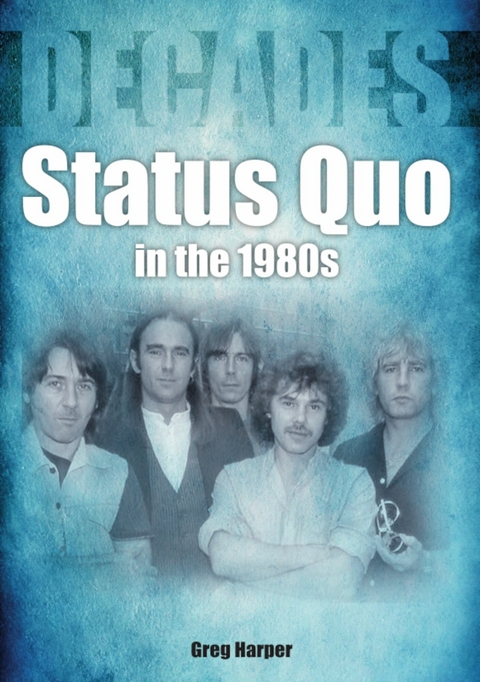
Status Quo: In The 1980s (eBook)
144 Seiten
Publishdrive (Verlag)
978-1-78952-491-8 (ISBN)
Status Quo are a British institution with an epic 50-year career. Although their heyday was the 1970s, the hits kept coming through the 1980s along with breakups, lawsuits, line-up changes, substance abuse and a high-profile, highly successful comeback after calling it a day in 1984. While much has been written about the 'glory years', Quo's difficult but triumphant struggle through the 1980s is a much more exciting story with twists, turns and a sense of peril that feels like it could go any way at any time.
This is a celebration of Quo's music at its most vulnerable and experimental, at a time when the band lost old fans, gained new ones and made some of the most varied and creative recordings of their career. Their hits in the decade included 'What You're Proposin'', 'Marguerita Time' and the far from typical 'In The Army Now'. They even opened the 1985 Live Aid concert.
No stone has been left unturned in this book, with several members of the band, including Francis Rossi, John Coghlan and John 'Rhino' Edwards contributing stories and anecdotes from their own perspectives that should leave even the most knowledgeable of fans feeling like they've learned something new about the band.
Gregory Harper (B.A. Hons, PGCE, MA) is a professional bassist, composer, arranger and educator based in Manchester, UK, where he lives with his partner Abigail and their two cats Gizmo and Liza. He performs all around the world and has composed for film and TV. A lifelong fan of Status Quo, combined with his passion for musicology and music theory, has resulted in this, his first book for Sonicbond Publishing.
Status Quo are a British institution with an epic 50-year career. Although their heyday was the 1970s, the hits kept coming through the 1980s along with breakups, lawsuits, line-up changes, substance abuse and a high-profile, highly successful comeback after calling it a day in 1984. While much has been written about the 'glory years', Quo's difficult but triumphant struggle through the 1980s is a much more exciting story with twists, turns and a sense of peril that feels like it could go any way at any time.This is a celebration of Quo's music at its most vulnerable and experimental, at a time when the band lost old fans, gained new ones and made some of the most varied and creative recordings of their career. Their hits in the decade included 'What You're Proposin'', 'Marguerita Time' and the far from typical 'In The Army Now'. They even opened the 1985 Live Aid concert.No stone has been left unturned in this book, with several members of the band, including Francis Rossi, John Coghlan and John 'Rhino' Edwards contributing stories and anecdotes from their own perspectives that should leave even the most knowledgeable of fans feeling like they've learned something new about the band.Gregory Harper (B.A. Hons, PGCE, MA) is a professional bassist, composer, arranger and educator based in Manchester, UK, where he lives with his partner Abigail and their two cats Gizmo and Liza. He performs all around the world and has composed for film and TV. A lifelong fan of Status Quo, combined with his passion for musicology and music theory, has resulted in this, his first book for Sonicbond Publishing.
Prologue
Status Quo’s illustrious career can be loosely divided up into several different periods. The first of these being the hippy, trippy far-out years of ‘Pictures of Matchstick Men’ and frilly shirts starting around 1967 and ending in 1970. 1970 to 1972 was the grungy, underground, heads-down boogie years which saw the band totally reinvented as a hard rock and blues outfit – a couple of hit singles but no real hit albums to speak of, but releases from this period are well loved by the hard-core fans. This period served to expand the fanbase and slowly build Quo’s reputation for live performance. Third, we get the glory years – 1972-1979 – a period of number one albums, a number one single and a reputation on a global level, but to shrink the career of such a British institution down to a singular chapter seems inconsiderate; but down to a single paragraph, unforgivably churlish.
Formed in 1962 at Sedgehill Comprehensive School in Lewisham, ‘The Scorpions’ previously known for a few weeks as ‘The Paladins’ were a band made up of Francis Rossi on guitar and vocals, Alan Lancaster on bass guitar and vocals, Jess Jaworski on keyboards and Alan Key on drums. Rossi, Lancaster and Key had met in the school orchestra before deciding to form their own group.
In 1963, a chance encounter with air cadet drummer John Coghlan had him replacing Key after Rossi and Lancaster were taken with his technique on a snare drum. The band soon changed their name to ‘The Spectres’. After a small number of local appearances, they were approached by local gas fitter Pat Barlow who offered to manage the band. The boys left school in 1965 and with that, Jaworski decided to also leave the group and was promptly replaced by organist Roy Lynes.
Another chance encounter was to be the most important in the history of the band. Guitarist and vocalist Rick Parfitt was playing with a trio called The Highlights at a summer season at Butlins and came in to listen to the Spectres who were also working at the Minehead resort at the time. Parfitt and Rossi became the best of friends during their time together and promised to work with each other after the season was over in one capacity or another.
Now writing original material and scoring a recording contract in 1966, the band rebranded for a short while as ‘Traffic’ but soon changed it again to Traffic Jam to prevent any confusion with Steve Winwood’s band at the time. A handful of singles were released as both The Spectres and Traffic/ Traffic Jam but to no commercial success.
By 1967, manager Barlow insisted on recruiting Parfitt to the band to provide another lead voice to balance the ensemble out and, soon after, the group changed their name to ‘The Status Quo’ after liking the sound of the name but not really caring about its meaning.
The Status Quo’s breakout hit came in the form of ‘Pictures of Matchstick Men’ – a piece of pure psychedelia scoring the band a number seven hit on the UK singles charts. After the follow-up ‘Black Veils of Melancholy’ reached only number 51, a Ronnie Scott and Marty Wilde-penned tune called ‘Ice in the Sun’ gave the band another hit at number eight but soon, the success dried up and wouldn’t come back around for two years.
Becoming fed up with chasing the fashionable sounds and images of the fickle psychedelia scene, the band began to embrace their own newly evolving musical tastes for blues-inflected boogie music. Ditching their flower-power image, the band rebels against their previous success to reinvent themselves as ‘Status Quo’ – a hard rock and blues outfit. Through arduous touring and relearning how to make records that sounded how they wanted them to sound, Quo built up a new following – of long-haired, denim-toting rockers and students; eager for the laid-back grooves of ‘Umleitung’ and the frantic shuffles of ‘Gotta Go Home’. Organist Lynes eventually left the band after falling in love on the road and his slightly older age was already instilling in him a desire to settle down with a steadier income.
Chart success for albums was a slow burner, but early singles in their new bluesy style like ‘Down the Dustpipe’ and ‘In My Chair’ hit number 12 and number 21, respectively, in 1970. Quo’s first studio album to break into the top 40 was 1972’s Piledriver and from there, Quo became an ‘albums band’ and as a result, singles also began selling in their hundreds of thousands. Although now working quite well as a quartet that would eventually become known as the ‘Frantic Four’ by fans, Rossi was insistent on using keyboards on some studio recordings and so Andrew Bown was drafted in during the Hello! album to contribute some piano to ‘Blue Eyed Lady’ and later ‘Ease Your Mind’ and ‘Mad About the Boy’ for the 1976 album Blue For You. Bown had met the band while working with The Herd and Rossi, Parfitt and Lancaster had struck up a friendship with the multi-instrumentalist, although only Rossi really saw the band as having a permanent space for keyboards. Among The Herd’s crew was also Robert ‘Bob’ Young; he was also soon swiped by Rossi as a songwriting partner, harmonicist to the band and later, as a tour manager.
To all intents and purposes, Quo only had one final mountain to climb by the mid-1970s. They had done almost everything else with their hit records and sell-out tours but Quo had yet to crack America. From the 1972 Piledriver album to (most of) Blue For You in 1976, Quo had been largely producing their own records and had been doing a very good job of it too. Quo’s management felt that American audiences had a more refined taste for pop production and began insisting on the band using outside but experienced producers to not only help the band make records but teach them the most up-to-date techniques for them to make their own.
Enter Pip Williams, a guitarist, producer and arranger of fine pedigree, having worked with Mud, The Walker Brothers, Catherine Howe and Graham Bonnet, among others. Brought in by Quo’s then label Vertigo, and the band’s manager (Colin Johnson) to break away from their successful and established but raw and unrefined sound, Pip’s only mission was to make Quo’s brand of rock palatable for the conservative American taste. Pip specialised in multi-tracking guitars, pristine vocal capture and arranging & overdubbing instruments that were not native to the Quo brand, such as horn sections and auxiliary percussion. Furthermore, he worked hard to tidy up the overall sound – putting the vocals higher in the mix and recording the basic rhythm tracks with as little microphone ‘bleed’ as possible. The first resulting album was Rockin’ All Over the World in 1977.
The album was a huge turning point for Quo – the title track (perhaps Quo’s best known although penned by CCR’s John Fogerty) was released as a single and reached number three in the UK singles chart. The album itself peaked at number five on the UK album chart and many of the tracks found their way into Quo’s live sets ever since.
Although much more polished than previous efforts, the record also suffered from a lack of ‘bottom end’ (bass frequencies), meaning many fans were confused and disappointed by Quo’s new sound. The lack of ‘thump’ from the record may be down to the fact that the record was mixed down on a pair of Auratone speakers – small cones that emulated the sound of American AM radios at the time. Despite the domestic and European success, the Americans still were not taking the bait. Williams thinks this may be due to Quo’s reluctance to build their reputation from scratch through arduous touring at the bottom of the bill in the States, but this is pure conjecture on the producer’s part.
Pip produced Quo’s next album, If You Can’t Stand the Heat… released in 1978 and hitting number three on the UK album chart. Unfortunately, there were still no USA hits to speak of. The album featured the David Katz Horns (most notably on ‘Let Me Fly’) and female backing vocalists Stevie Lange, Joy Yates and Jackie Sullivan – a first for the band.
In a last-ditch effort to secure a US hit, the 1979 Whatever You Want album was released with two different mixes. The original Pip Williams mix made it to number four on the UK chart, while the Steve Klein mix was released as Now Hear This in 1980 in the USA but did not trouble the Billboard chart in any meaningful way. Williams seemed to have suppressed his passion for auxiliary arranging here as the album went back to Quo’s guitar-heavy sound, albeit more restrained with considered lead guitar breaks.
Then, things inevitably begin to change. Frictions in the band emerge and decisions become harder to make as the democratic strands unravel. The 1980s saw all of this and more for Status Quo. Perhaps more than any other decade, the band saw the highest peaks and the lowest troughs in both their professional and personal lives. With the decade coming to a close, Quo were still riding high in Europe but were becoming increasingly frustrated with the lack of traction across the pond. Their management would soon begin to throw the kitchen sink at trying to break America from afar, with the band growing increasingly ambivalent towards building a following there.
With Williams having taught the band a little about production over the last three albums, they were to set out on their own to keep costs down and now...
| Erscheint lt. Verlag | 10.12.2025 |
|---|---|
| Reihe/Serie | Decades |
| Sprache | englisch |
| Themenwelt | Kunst / Musik / Theater ► Musik ► Musikgeschichte |
| Kunst / Musik / Theater ► Musik ► Pop / Rock | |
| Schlagworte | Alan Lancaster • Francis Rossi • Jeff Rich • Rhino Edwards • Rick Parfitt |
| ISBN-10 | 1-78952-491-1 / 1789524911 |
| ISBN-13 | 978-1-78952-491-8 / 9781789524918 |
| Informationen gemäß Produktsicherheitsverordnung (GPSR) | |
| Haben Sie eine Frage zum Produkt? |
 EPUB (Ohne DRM)
Digital Rights Management: ohne DRM
Dieses eBook enthält kein DRM oder Kopierschutz. Eine Weitergabe an Dritte ist jedoch rechtlich nicht zulässig, weil Sie beim Kauf nur die Rechte an der persönlichen Nutzung erwerben.
Dateiformat: EPUB (Electronic Publication)
EPUB ist ein offener Standard für eBooks und eignet sich besonders zur Darstellung von Belletristik und Sachbüchern. Der Fließtext wird dynamisch an die Display- und Schriftgröße angepasst. Auch für mobile Lesegeräte ist EPUB daher gut geeignet.
Systemvoraussetzungen:
PC/Mac: Mit einem PC oder Mac können Sie dieses eBook lesen. Sie benötigen dafür die kostenlose Software Adobe Digital Editions.
eReader: Dieses eBook kann mit (fast) allen eBook-Readern gelesen werden. Mit dem amazon-Kindle ist es aber nicht kompatibel.
Smartphone/Tablet: Egal ob Apple oder Android, dieses eBook können Sie lesen. Sie benötigen dafür eine kostenlose App.
Geräteliste und zusätzliche Hinweise
Buying eBooks from abroad
For tax law reasons we can sell eBooks just within Germany and Switzerland. Regrettably we cannot fulfill eBook-orders from other countries.
aus dem Bereich


