


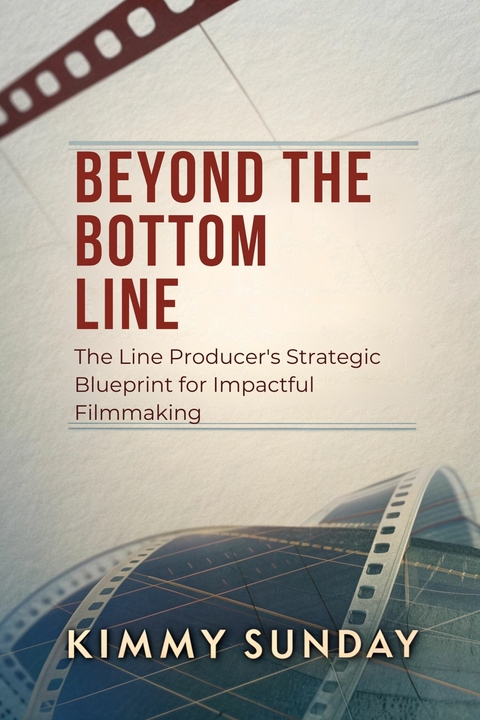
Beyond the Bottom Line (eBook)
112 Seiten
JNR Publishing Group (Verlag)
9780001119468 (ISBN)
ARE YOU READY TO TRANSFORM YOUR FILM PRODUCTIONS FROM MANAGED PROJECTS TO IMPACTFUL CINEMATIC EXPERIENCES?
Go Beyond the Bottom Line!
The film industry is in constant flux. Streaming giants demand content faster, global co-productions are the new norm, and technology like virtual production is reshaping how movies are made. Is your understanding of line producing stuck in the past?
'Beyond the Bottom Line: The Line Producer's Strategic Blueprint for Impactful Filmmaking' is your essential guide to mastering the modern art and science of line producing, transforming you from a mere operational manager into an indispensable strategic leader.
Kimmy Sunday demystifies the contemporary line producer's role, revealing how these unsung heroes navigate creative chaos, orchestrate global logistics, and integrate cutting-edge technology-all while fostering an environment where creativity thrives. This isn't just about keeping costs down; it is about elevating entire productions and making impactful cinema.
INSIDE, YOU WILL DISCOVER HOW TO:
Master Financial Fluency Beyond Budgeting: Understand revenue models, distribution economics, and financing structures.
Lead Without Authority: Effectively manage diverse creative teams and personalities under pressure.
Implement Strategic Problem Solving: Anticipate failures and develop contingency plans for complex scenarios.
Navigate the Streaming Revolution: Manage global audience analytics and international content regulations.
Integrate Technology Strategically: Leverage virtual production, cloud collaboration, and data analytics.
Excel in Global Production: Handle multi-currency budgets, international labor laws, and cultural nuances.
Oversee the Full Lifecycle: Extend your influence from pre-production through post-production to distribution.
Packed with real-world examples, practical exercises, and invaluable checklists, 'Beyond the Bottom Line' is a career-defining roadmap for aspiring and veteran line producers alike. Stop just managing the numbers and start shaping the future of filmmaking.
Unlock the secrets to impactful filmmaking. Grab your copy of 'Beyond the Bottom Line' today and become the strategic line producer the modern film industry demands!
3
Chapter 2: Essential Skills Mastery - The Line Producer's Toolkit
Leadership Without Authority
Here’s one of the great paradoxes of line producing: you’re responsible for leading a team of highly skilled professionals, but you’re rarely anyone’s direct boss. The cinematographer doesn’t report to you, the production designer has their own creative relationship with the director, and the lead actors definitely don’t take orders from you. Yet somehow, you need to coordinate all of these people toward a common goal while maintaining budgets, schedules, and sanity.
This requires a different kind of leadership than traditional management roles. You can’t rely on hierarchical authority because you don’t have it. Instead, you need to develop what we might call “influence-based leadership”—the ability to guide and coordinate through expertise, relationship-building, and strategic thinking rather than formal power.
The most effective line producers become the person everyone turns to when they need information, resources, or solutions. They build their influence by being consistently helpful, reliably informed, and strategically focused on what’s best for the production rather than what’s best for themselves.
The Communication Expertise Requirement
Line producers are professional translators. Not in the literal sense (although that skill can be useful on international productions), but in the sense that they need to facilitate understanding between people who speak different professional languages and have different priorities.
When a cinematographer tells you they need “more space for the techno,” they’re not talking about dance music. They’re talking about the technical equipment required for their shot. When a studio executive asks about “above-the-line exposure,” they’re not worried about sunburn. They’re concerned about cost escalation from key talent.
Effective communication for line producers involves several distinct skill sets:
Technical Translation: You need to understand enough about each department’s work to communicate intelligently with specialists while being able to explain technical requirements and limitations to non-technical stakeholders.
Emotional Intelligence: Film productions are high-stress environments where creative people are pushing themselves to deliver their best work under significant pressure. Line producers need to be able to read the emotional temperature of individuals and groups, identify when someone is struggling, and provide appropriate support.
Conflict Resolution: When disagreements arise—and they always do—line producers often find themselves mediating between parties with different priorities and perspectives. This requires understanding not just what people are saying, but what they really need and what they’re willing to compromise on.
Upward Communication: Managing relationships with financiers, distributors, and other stakeholders requires a different communication style than managing relationships with crew members. Line producers need to be able to provide accurate, timely information to decision-makers while advocating for the production’s needs.
Crisis Communication: When things go wrong—equipment fails, weather interferes, someone gets injured—line producers need to communicate quickly and clearly with multiple parties while managing the flow of information to prevent confusion and rumors.
Financial Acumen Beyond Accounting
Traditional line producer training focuses heavily on budget management, which is absolutely essential. But modern line producers need to understand finance in a broader context. They need to think like business analysts, not just accountants.
This means understanding how different financing structures affect production decisions. A film financed entirely by a single studio has different constraints and opportunities than a film financed through a combination of equity investment, tax incentives, and pre-sales to international distributors.
It means understanding how revenue models affect production choices. A film destined for traditional theatrical release has different economic requirements than a film being produced for a streaming platform or a series intended for international syndication.
It means being able to analyze the financial implications of creative decisions in real-time. When a director wants to add a scene that requires an additional location, the line producer needs to quickly assess not just the direct costs (location fees, transportation, additional shooting days) but the indirect costs (overtime implications, scheduling ripple effects, potential impact on other scenes).
The Strategic Thinking Difference
What separates good line producers from great ones is the ability to think strategically about every decision. This means considering not just immediate implications, but second and third-order effects.
For example, when choosing between two potential shooting locations, a tactical thinker might focus on immediate costs and logistics. A strategic thinker considers how each location choice affects scheduling, crew morale, transportation costs, backup options if weather interferes, potential for additional coverage if opportunities arise, and implications for post-production workflow.
Strategic thinking also involves understanding the broader context of each production. A line producer working on a filmmaker’s breakthrough project thinks differently about resource allocation than a line producer working on an established franchise. A line producer working on a film intended to launch a streaming series approaches problems differently than one working on a standalone feature.
Risk Assessment and Management
Every production decision involves risk, and line producers need to become expert at identifying, evaluating, and managing different types of risk. Some risks are obvious—shooting outdoors in a location known for unpredictable weather. Others are subtle—scheduling a complex sequence late in the production when the crew will be tired and the budget will be tight.
Effective risk management starts with comprehensive risk assessment during pre-production. This involves systematically examining every aspect of the planned production to identify potential points of failure, then developing strategies to prevent problems or minimize their impact when they occur.
But risk management continues throughout production. Line producers need to constantly reassess risks as circumstances change and new information becomes available. They need to be able to make real-time decisions about when to implement contingency plans, when to accept additional risk in service of creative goals, and when to modify approaches based on changing conditions.
Technology Integration Without Technology Obsession
The modern line producer needs to be comfortable with technology without becoming enslaved by it. The goal isn’t to become a technical expert, but to become fluent enough to make informed decisions about technological tools and approaches.
This means understanding the capabilities and limitations of different production technologies well enough to evaluate when they’re appropriate and when they’re not. Virtual production can solve certain problems elegantly, but it’s not automatically better than traditional approaches, and it introduces its own complexities and costs.
It means becoming proficient with the collaboration and management tools that have become standard in modern production. Cloud-based dailies, real-time collaboration platforms, and digital workflow management aren’t optional anymore—they’re basic professional requirements.
It means developing relationships with technology vendors and service providers who can provide expertise and support when needed, while maintaining enough personal knowledge to ask intelligent questions and evaluate recommendations.
People Skills in a Temporary Organization Context
Film productions are unique organizational structures. You’re building a temporary company that needs to function at maximum efficiency from the first day, composed of people who may have never worked together before and may never work together again after the production ends.
This creates specific challenges for people management. You can’t rely on long-term relationship building to smooth over conflicts or motivate performance. You can’t use traditional career development incentives. You can’t assume that people will be patient with organizational growing pains because there’s no time for growing pains.
Instead, successful line producers become expert at quickly building effective working relationships with diverse groups of professionals. They learn to identify each person’s...
| Erscheint lt. Verlag | 9.12.2025 |
|---|---|
| Sprache | englisch |
| Themenwelt | Kunst / Musik / Theater ► Malerei / Plastik |
| ISBN-13 | 9780001119468 / 9780001119468 |
| Informationen gemäß Produktsicherheitsverordnung (GPSR) | |
| Haben Sie eine Frage zum Produkt? |
 EPUB (Adobe DRM)
Größe: 2,1 MB
Kopierschutz: Adobe-DRM
Adobe-DRM ist ein Kopierschutz, der das eBook vor Mißbrauch schützen soll. Dabei wird das eBook bereits beim Download auf Ihre persönliche Adobe-ID autorisiert. Lesen können Sie das eBook dann nur auf den Geräten, welche ebenfalls auf Ihre Adobe-ID registriert sind.
Details zum Adobe-DRM
Dateiformat: EPUB (Electronic Publication)
EPUB ist ein offener Standard für eBooks und eignet sich besonders zur Darstellung von Belletristik und Sachbüchern. Der Fließtext wird dynamisch an die Display- und Schriftgröße angepasst. Auch für mobile Lesegeräte ist EPUB daher gut geeignet.
Systemvoraussetzungen:
PC/Mac: Mit einem PC oder Mac können Sie dieses eBook lesen. Sie benötigen eine
eReader: Dieses eBook kann mit (fast) allen eBook-Readern gelesen werden. Mit dem amazon-Kindle ist es aber nicht kompatibel.
Smartphone/Tablet: Egal ob Apple oder Android, dieses eBook können Sie lesen. Sie benötigen eine
Geräteliste und zusätzliche Hinweise
Buying eBooks from abroad
For tax law reasons we can sell eBooks just within Germany and Switzerland. Regrettably we cannot fulfill eBook-orders from other countries.
aus dem Bereich


