


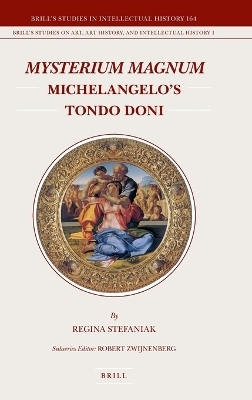
Mysterium Magnum: Michelangelo's Tondo Doni
Seiten
2008
Brill (Verlag)
978-90-04-16544-1 (ISBN)
Brill (Verlag)
978-90-04-16544-1 (ISBN)
Drawing on the fifteenth century theology of Saint Joseph, classical visual sources, Ficino’s commentary on the Phaedrus and Symposium, and Dante’s rime petrose, this book interprets Michelangelo’s Tondo Doni as a model of Ephesians’ ‘great sacrament’ of marriage for the new Florentine republic.
This study presents the Tondo Doni to the new Florentine republic as a model of the 'great sacrament' of marriage from the New Testament book of Ephesians. Following fifteenth-century theology, Michelangelo portrayed Mary as a humble wife dominated and possessed by a virile guardian Joseph, the couple united as if ‘two in one flesh’. To compensate for their symbolic propinquity, the painter cast her as a paragon of virginity, a muscular mulier fortis. In order to keep this virago in her place, Michelangelo coupled the Virgin in spiritual union with Christ, maenad-Psyche to bacchic Eros, attempting to mystify her social subordination into self-sacrificing love via Ficinian commentary and Saint Paul. Then, firing the Doni infant’s vehemence with a distinctly violent strain of Christian love, the painter turned to Dante’s rime petrose to continue the implied action and authorize a new painterly style, a sculptural stile aspro.
Brill's Studies on Art, Art History, and Intellectual History, vol. 1
This study presents the Tondo Doni to the new Florentine republic as a model of the 'great sacrament' of marriage from the New Testament book of Ephesians. Following fifteenth-century theology, Michelangelo portrayed Mary as a humble wife dominated and possessed by a virile guardian Joseph, the couple united as if ‘two in one flesh’. To compensate for their symbolic propinquity, the painter cast her as a paragon of virginity, a muscular mulier fortis. In order to keep this virago in her place, Michelangelo coupled the Virgin in spiritual union with Christ, maenad-Psyche to bacchic Eros, attempting to mystify her social subordination into self-sacrificing love via Ficinian commentary and Saint Paul. Then, firing the Doni infant’s vehemence with a distinctly violent strain of Christian love, the painter turned to Dante’s rime petrose to continue the implied action and authorize a new painterly style, a sculptural stile aspro.
Brill's Studies on Art, Art History, and Intellectual History, vol. 1
Regina Stefaniak, Ph.D. (1989) in History of Art, University of California at Berkeley, is an independent scholar in Berkeley, California. She has published extensively on fifteenth- and sixteenth-century Italian art in its cultural context, including essays on such artists as Donatello, Leonardo, Raphael, Correggio, Rosso Fiorentino and Parmigianino.
List of Illustrations
Acknowledgements
Introduction
1. Prime nozze: Generation
2. Seconde nozze: Regeneration
3. Così nel mio parlar vogli’ esser aspro
Illustrations
Bibliography
Index
| Erscheint lt. Verlag | 27.3.2008 |
|---|---|
| Reihe/Serie | Brill's Studies on Art, Art History, and Intellectual History ; 164/1 |
| Zusatzinfo | 2 Illustrations, color; 39 Illustrations, black and white |
| Verlagsort | Leiden |
| Sprache | englisch |
| Maße | 160 x 240 mm |
| Gewicht | 452 g |
| Themenwelt | Kunst / Musik / Theater ► Kunstgeschichte / Kunststile |
| Kunst / Musik / Theater ► Malerei / Plastik | |
| ISBN-10 | 90-04-16544-4 / 9004165444 |
| ISBN-13 | 978-90-04-16544-1 / 9789004165441 |
| Zustand | Neuware |
| Informationen gemäß Produktsicherheitsverordnung (GPSR) | |
| Haben Sie eine Frage zum Produkt? |
Mehr entdecken
aus dem Bereich

aus dem Bereich
kleine Kulturgeschichte einer brillanten Allianz
Buch | Softcover (2025)
Iudicium (Verlag)
CHF 33,90


