


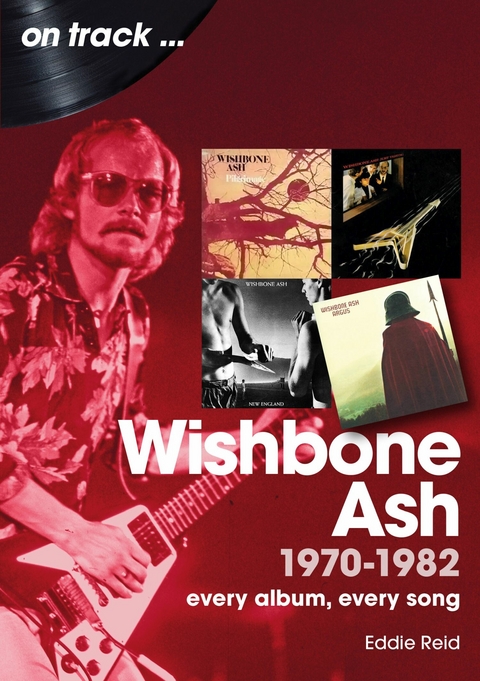
Wishbone Ash 1970-1982 (eBook)
128 Seiten
Sonicbond Publishing (Verlag)
978-1-78952-483-3 (ISBN)
Wishbone Ash were formed in London in 1969 by Andy Powell, Martin Turner, Steve Upton and Ted Turner. They spent the 1970s touring constantly, creating a distinctive, original sound, with twin lead guitars often playing in harmony. They are best known for the music recorded by the band's original members from 1970 to 1973, known as 'Mark One', and Argus, released in 1972, is often considered their finest album. 'Mark Two' of the band, which saw original guitarist Ted Turner replaced by Laurie Wisefield, continued their success until 1980. A developing musical landscape in the early 1980s led to further changes in personnel and musical direction, including the departure of original bassist and lead vocalist Martin Turner.
Combining original interpretation and analysis with historical research, this book explores the twelve studio albums and significant live albums that Wishbone Ash released from 1970 to 1982, along with all the bonus material which has since been issued from that era. It references the background, inspiration, and milestones that have shaped the band's musical journey, so whether you are already a fan or someone who would like to find out more about the band and their rich, expressive, and inspiring legacy, this book is for you.
Eddie Reid is a writer, visual artist and musician. He has been obsessed with rock music for over 40 years, has attended many gigs, including seeing the Wishbone Ash 'Mark Two' lineup, and maintains an extensive album collection. Over the years, he has played as a guitarist in several bands. Since 2017, he has been writing an A-Z blog about rock music. This is his first book. He lives on the east coast of the Scottish Borders, UK, with his wife and family.
Introduction
Wishbone Ash earned their place in rock music during the 1970s, forging their own approach to songwriting and playing. During that decade, numerous rock bands from the United Kingdom achieved critical and commercial success, and the band created a distinctive, original sound, which was no mean feat. The 1970s was a groundbreaking era that shaped the evolution of rock music. Rooted in the idealistic 1960s, the music of the 1970s transitioned, creating innovative new sounds, genres and larger-than-life rock stars. Socially and politically, the 1970s was a volatile period filled with tensions. A climate of dissent and anti-establishment attitudes was reflected in the music. The rise of the counterculture and drug experimentation, evident in the 1960s, continued and influenced the emergence of new subgenres. Bands from the UK that were active at that time included Deep Purple, Free, Genesis, Jethro Tull, King Crimson, Led Zeppelin, Pink Floyd, Queen, Roxy Music, Uriah Heep and Yes. These acts became labelled under subgenres such as ‘hard rock’ and ‘progressive rock’. The niches ‘glam rock’ and ‘heavy metal’ also began to flourish, and by the second half of the decade, ‘punk rock’ would emerge. Some of the elements that made Wishbone Ash’s sound distinctive, when compared to their contemporaries, were their twin lead guitar parts, their lead and backing vocal harmonies and their incorporation of rock, blues and English folk music influences. They are best known for the music recorded by the original members (known as the ‘Mark One’ lineup), from 1970 to 1973, and the ‘Mark Two’ lineup, from 1974 to 1980. This book focuses on that decade and the years from 1980 to 1982, during which major changes took place.
Wishbone Ash were formed from the nucleus of the band The Empty Vessels, a name which bassist and vocalist Martin Turner (born in Torquay, England, in 1947) coined in 1965 from the phrase ‘empty vessels make the most noise’ to rename the band he was in at the time with his brother Glenn, who was two years younger than him, in their hometown of Torquay on the coast of Devon, England. Martin and Glenn’s first band had been called The Torinoes, playing the music of The Shadows, Johnny Kidd, Chuck Berry, the Everly Brothers, Little Richard, Ray Charles and Wayne Fontana. They recruited Steve Upton (born in Wrexham, Wales, in 1946) as drummer in 1966, then, in 1967, moved from Torquay to Exeter, a short distance north, where Steve Upton had been living. Martin Turner and Steve Upton bonded from the day he joined the band. Steve Upton’s first band was The Scimitars, who played covers of Shadows hits. Thereafter, the drummer formed a five-piece blues band called The Devarks. The Empty Vessels’ only recorded release was the 1969 single ‘My Son John’, with ‘Low Toby’ on the B-side. The A-side was a cover of the single by New Zealand psychedelic band The Rebels, also known as Larry’s Rebels, from their Madrigal album, and was penned by the songwriting duo Fletcher & Flett (Australian Doug Flett and Englishman Guy Fletcher). The Empty Vessels recorded their version, considered to be in the ‘psychedelic pop’ genre, for German label Metronome. As the band developed their style to take on board sounds from the likes of The Who, Fleetwood Mac and Led Zeppelin, they decided they needed to ‘rebrand’ themselves. The band changed their name to Tanglewood in 1969, thereafter relocating to London to turn professional. Glenn left soon after to return to the West Country, under pressure from a girl he was in love with. He quickly realised that leaving the band was a mistake and tried to reinstate himself, but to no avail. In the capital, Martin and Steve met expatriate American Miles Copeland III, who became their manager and helped them rebuild the group, initiating recruitment of two lead guitarists, Ted Turner (no relation to Martin, born in Birmingham, England, in 1950), who was living in Birmingham, and Andy Powell (born in London, England, in 1950) who was originally from East London and grew up in Hemel Hempstead, north west of London. What would become the ‘classic’ lineup came together.
In an interview with KBSU Radio, Boise, Idaho, US, released on From The Archives Volume One in 1998, Miles Copeland explained how he became involved with the band:
I was in England in 1969 and decided that the rock ‘n’ roll business was for me – It’s a long story of why that happened, but anyway. I went to a club and I saw a couple of the guys – Steve and Martin – in a band, and I thought they were great. After the show, I went up to them, and it turned out it was their last show with that lineup, and anyway, we got to be friends, and I agreed to help rebuild a new band. Then, we put an ad in the paper, and pretty soon we found Ted and Andy, and we were in business.
In his autobiography, Eyes Wide Open: True Tales Of A Wishbone Ash Warrior, Andy Powell recalled that he was on holiday in Wales when he answered an advert in a prominent UK music paper, Melody Maker, the wording resonating with him:
Wanted – Lead guitarist: Positive thinking, creative and adaptable, for strongly backed group with great future.
Powell recalled that he made a call from a public phone box in Wales in response to the ad and was told that he should come to Marlborough Place in St. John’s Wood, North London, where the band were rehearsing at their manager’s parents’ house. He went to the audition with his home-made guitar and was met by Miles Copeland, who took him down to the basement to meet the others. Powell remembered that, at that initial encounter, Steve Upton came across as from a higher-class background and as seeming to have had a hand in leading the band, whereas Martin Turner didn’t stop talking. Powell remembered that Ted Turner was also there the next time that the group got together, and that the seed of Wishbone Ash was sown:
There really was positivity – the beginnings of a team and people who were committed to making something happen. In the end, both Ted and I got the gig, and there we were: a four-piece with two lead guitarists and a very unusual man with a plan (Miles Copeland) – specifically, to be a millionaire before he reached the age of 30.
According to Andy Powell, before the final decision was made, there were two keyboard players also in the running for a position in the band, along with one or other of the two guitar players (himself or Ted Turner), confirming these as Matthew Fisher of English rock band Procol Harum, who would play as a guest musician on the first song on the debut Wishbone Ash album, and Hugh Banton of English progressive rock pioneers Van der Graaf Generator. Martin Turner does confirm, in his autobiography No Easy Road – My Life And Times With Wishbone Ash And Beyond, that they did wonder about bringing a keyboard player on board as well as a guitarist, but notes that they rejected that idea and never got as far as auditioning any keyboard players.
In an interview with KBSU Radio on From The Archives Volume One, Martin Turner recalled the recruitment:
When my brother left the original three-piece lineup, we needed someone to replace him. During the audition sessions, we liked both Andy and Ted it was very difficult to decide at that point who should replace my brother so we figured, ‘Well, wait a minute, why don’t we investigate the possibilities of having these guys who are both good lead guitar players play together and maybe we could establish some kind of new musical style’, which I think we did.
Martin Turner told Classic Rock magazine in 2018 that he was responsible for the genesis of the band’s twin guitar sound:
I came up with the idea of two guitars – harmony guitars, lead guitars together. Not an entirely original concept, but I’d invited Ted Turner and Andy Powell to come back for a second audition together, and it was absolutely obvious that it was gonna work.
In No Easy Road, Ted Turner was very positive in his description of the initial musical chemistry of the band:
Mart and Steve were a great team. They were very together and connected. This was evident from the first time we played music together. Both had command of their instruments. Andy played guitar very well in an articulate and clean manner. The conversation between us was easy regarding music because, essentially, we had the same influences. The harmony guitar idea was a natural flow out of our mutual appreciation of bands like Blossom Toes and Fleetwood Mac. Musically, the Wishbone sound was fresh, interesting, melodic and exciting, and expressed with great passion. The harmony guitars soared. Andy and I were tight.
The recollections offered by the various band members over the years do differ, but in any case, the band definitely recruited both guitarists and developed their sound from there. After auditioning ‘every guitar player that was available in London’, as Martin Turner told Classic Rock in 2018, Andy Powell was selected as the first choice for the guitarist role. Given the job of calling Ted Turner to give him the bad news, Martin Turner was persuaded by Ted’s Mum to give him another chance, which the band did, and subsequently hired him, too.
At the gig where Miles met Steve and Martin, in the Country Club in Haverstock Hill, North...
| Erscheint lt. Verlag | 21.11.2025 |
|---|---|
| Reihe/Serie | On Track |
| Sprache | englisch |
| Themenwelt | Kunst / Musik / Theater ► Musik ► Musikgeschichte |
| Schlagworte | Andy Powell • Argus • Front Page News • Laurie Wisefield • Martin Turner • Steve Upton • Ted Turner |
| ISBN-10 | 1-78952-483-0 / 1789524830 |
| ISBN-13 | 978-1-78952-483-3 / 9781789524833 |
| Informationen gemäß Produktsicherheitsverordnung (GPSR) | |
| Haben Sie eine Frage zum Produkt? |
 EPUB (Ohne DRM)
Digital Rights Management: ohne DRM
Dieses eBook enthält kein DRM oder Kopierschutz. Eine Weitergabe an Dritte ist jedoch rechtlich nicht zulässig, weil Sie beim Kauf nur die Rechte an der persönlichen Nutzung erwerben.
Dateiformat: EPUB (Electronic Publication)
EPUB ist ein offener Standard für eBooks und eignet sich besonders zur Darstellung von Belletristik und Sachbüchern. Der Fließtext wird dynamisch an die Display- und Schriftgröße angepasst. Auch für mobile Lesegeräte ist EPUB daher gut geeignet.
Systemvoraussetzungen:
PC/Mac: Mit einem PC oder Mac können Sie dieses eBook lesen. Sie benötigen dafür die kostenlose Software Adobe Digital Editions.
eReader: Dieses eBook kann mit (fast) allen eBook-Readern gelesen werden. Mit dem amazon-Kindle ist es aber nicht kompatibel.
Smartphone/Tablet: Egal ob Apple oder Android, dieses eBook können Sie lesen. Sie benötigen dafür eine kostenlose App.
Geräteliste und zusätzliche Hinweise
Buying eBooks from abroad
For tax law reasons we can sell eBooks just within Germany and Switzerland. Regrettably we cannot fulfill eBook-orders from other countries.
aus dem Bereich


