


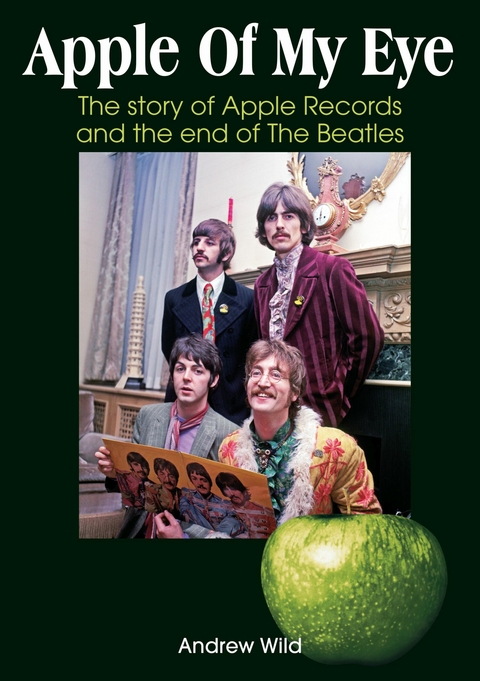
Apple Of My Eye (eBook)
160 Seiten
Sonicbond Publishing (Verlag)
978-1-78952-482-6 (ISBN)
The Beatles pioneered so much in the recording studio during their short time together that it's easy to forget that they formed their own record company in April 1968. Their business plan was to find and fund new musical talent. By the end of the year, Apple had signed James Taylor and struck lucky with Mary Hopkin. The much-admired Badfinger followed, along with albums by obvious associates including Billy Preston, Ravi Shankar and Yoko Ono and the not-so-obvious like John Tavener, Modern Jazz Quartet and Radha Krishna Temple, with mixed financial and artistic success.
But The Beatles were not businessmen and the early optimism of shiny newness soon soured into chaos as major acts such as 10cc and Crosby, Stills & Nash slipped through their fingers. Allen Klein was appointed to sort out the mess, but disenfranchised nearly everybody. Paul left The Beatles and sued the others and in 1975, The Beatles' partnership was legally terminated and Apple Records, a vanity label in all but name, was quietly put to sleep.
Apple Of My Eye revisits each of the albums and singles released by Apple between 1968 and 1975, underpinned by the business and legal context of the last days of the world's greatest band.
Andrew Wild is a British writer, collector and long-time Beatles fan who recalls hearing the Red and Blue albums in the mid-1970s and has been in love with their music ever since. He has copies of every known Beatles outtake and live concert recording. His thorough and exhaustive study of every song performed or recorded by the band Four Sides Of The Circle was republished in 2024 and he has written numerous music-related books, including several in the On Track series, about artists as diverse as The Allman Brothers Band, Phil Collins and Dire Straits. He lives in Rainow, Cheshire, UK.
Introduction
Brian Epstein’s death in August 1967 changed everything. When The Beatles’ manager died, he had plans in place to set up a small group of companies to keep his clients busy and to create a tax-effective business structure for their earnings. The top rate of income tax was 95%, or 19 shillings in the pound:
Let me tell you how it will be, there’s one for you, nineteen for me,
Cause I’m the Taxman, yeah, I’m the Taxman.
Should five per cent appear too small be thankful I don’t take it all,
Cause I’m the Taxman, yeah, I’m the Taxman.
The Beatles, ‘Taxman’ (1966)
Beatles & Co. had been established in April 1967. This was an ‘umbrella’ company set up to channel all of the band’s income, with the exception of songwriting royalties. Each of the four Beatles took 5% of Beatles & Co. A new corporation, collectively owned and called Apple, would control the remainder. The name was suggested by Paul McCartney, who was inspired by Le Jeu De Mourre, a painting by René Magritte that shows a green apple with the words ‘au revoir’.
In parallel, Epstein encouraged diversification of The Beatles’ business activities. The first of these, Apple Publishing, was headed by Terry Doran, a Liverpool friend and business associate of Epstein, ‘the man from the motor trade’. Apple Publishing, with offices in Curzon Street, London, wanted to find and contract songwriters who would not only have their own successes as recording artists but also be able to place songs with others. The first of these, songwriters Paul Tennant and Dave Rhodes, met Paul McCartney by chance in May 1967. They had been given Terry Doran’s number, and Apple funded a number of demos. Brian Epstein was keen for them to form a band as a vehicle for their material and told them he wanted them to be called Focal Point. Their sole single, ‘Love You Forever’, was released on Deram in May.
Initially, Apple business was conducted from Nems Enterprises’ office or at Apple Publishing’s office on Curzon Street. Towards the end of June 1967, they paid £76,500 (£1.5m today) for a four-storey building at 94 Baker Street, London. Apple Publishing took up residence.
Re-grouping after Brian Epstein’s death, the original plan was for Apple and Nems Enterprises to work closely together, but Clive Epstein was not as close to The Beatles as his late brother. As Ringo Starr explained in a 1970 interview with Melody Maker, ‘We tried to form Apple with Clive Epstein, but he wouldn’t have it ... he didn’t believe in us, I suppose ... he didn’t think we could do it. He thought we were four wild men and we were going to spend all his money and make him broke. But that was the original idea of Apple – to form it with Nems ... we thought, now Brian’s gone, let’s really amalgamate and get this thing going; let’s make records and get people on our label and things like that.’
The matter was clouded by the involvement of Robert Stigwood, who had merged his management agency with Nems Enterprises earlier in 1967. The plan was for Epstein to continue to manage The Beatles and Cilla Black, and Stigwood would look after the rest of the Nems Enterprises roster, as well as bringing in his own clients, including Cream and The Bee Gees. As part of the deal, Brian Epstein had made a provisional agreement to sell a controlling interest in Nems Enterprises to Stigwood. This was valid until September 1967. The Beatles had no interest in working with Stigwood, and Stigwood did not want to buy Nems Enterprises without The Beatles. Backing out, he formed his own Robert Stigwood Organisation, taking Cream and The Bee Gees with him.
Apple Publishing signed more songwriters as 1967 moved into 1968. George Alexander was the older brother of Angus and Malcolm Young, later of AC/DC, and had an unnamed group along with John Perry, a former member of Tony Rivers And The Castaways, and brothers Geoff and Pete Swettenham. They were signed to Apple Publishing and were given the name Grapefruit by John Lennon, who, with Paul McCartney, attended the band’s first recording session at IBC Studios in London on 24 November 1967. As Apple didn’t yet have a record company, the single ‘Dear Delilah’ was licensed to other labels and, to promote the release, Apple introduced the group to the press at a reception on 18 January 1968. ‘Dear Delilah’, the first release by an Apple artist, reached number 21 in the UK in March 1968 during a nine-week spell in the charts. A second single, ‘Elevator’, was less successful, despite a promo film directed by Paul McCartney, but a cover of The Four Seasons’ ‘C’mon Marianne’ reached number 35 later that summer. RCA subsequently dropped the band, and they were released from their Apple contracts in November 1968. Other songwriters who were contracted to Apple Publishing included Jackie Lomax, an old friend from Liverpool who was managed by Nems Enterprises, three sets of partners – Paul Tennant and Dave Rhodes, Alan Morgan and Steve Webber, and Benny Gallagher and Graham Lyle – and Dave Lambert, who later joined The Strawbs. Gallagher and Lyle would provided several songs for Mary Hopkin. Ultimately, they formed a band with their friends Tom McGuinness and Hughie Flint, but there was seemingly no discussion of McGuinness Flint signing to Apple Records in a period when new acts were not sought for The Beatles’ record company. McGuinness Flint’s debut single, ‘When I’m Dead And Gone’, and accompanying album, McGuinness Flint, would both be top ten hits in 1970. But not for Apple.
In the meantime, Apple Films produced the Magical Mystery Tour TV feature. The resultant 52-minute programme originally aired on BBC1, in black-and-white, on 26 December 1967. A colour transmission followed two weeks later.
And, in a tale that’s hard to believe, The Beatles opened their own clothing shop, the Apple Boutique, on 7 December 1967 on the ground floor of their Baker Street office. Clive Epstein’s original suggestion was to set up a chain of shops that sold greetings cards. This was changed to focus on records, but the idea was rejected as it would involve selling the products of their rivals.
Clothing was the next best option. The Apple boutique was modelled on the hugely successful Biba in Kensington, opened in 1964 and run by the Polish-born designer Barbara Hulanicki and her husband Stephen Fitz- Simon. The Beatles’ shop opened in December 1967 and was managed by John Lennon’s old school friend Pete Shotton, who had been running a small supermarket. Perhaps an early warning was that the exterior mural was far more interesting than the clothing lines.
George Harrison in Anthology: ‘The painting on the side of the Baker Street shop looked amazing, but everything went wrong. A couple of nearby shopkeepers decided they didn’t like the tone of the building, although others liked it because it brought a lot of attention, and Baker Street suddenly became somewhere worth talking about. Before that, other than Sherlock Holmes, Baker Street was nothing; nobody went there except to catch a bus. Now, suddenly, it was really happening. But because of the complaints, the landlord or whoever owned the lease made us paint it out and get rid of it. Once we were told we had to get rid of the painting, the whole thing started to lose appeal.’
The next step was to establish a record company. In December 1967, The Beatles Ltd, formed in June 1963, was re-established as Apple Music Ltd. Apple Music Ltd owned 80% of The Beatles & Co. This arrangement allowed accumulated royalties to be paid to The Beatles as a business, attracting a lower corporate tax rate, rather than as individuals. The original directors were: Clive Epstein, Brian’s brother and director of Nems Enterprises; Alistair Taylor, Brian’s former PA; and Geoffrey Ellis, a solicitor and accountant.
The Beatles had big ideas. They wanted Apple to be more than simply a tax shelter. It was founded to cover several diverse disciplines: retail, publishing and film production were already operating. A record company would be next. To give a more inclusive name to these different divisions, Apple Music Ltd changed its name again on 12 January 1968, this time to Apple Corps Ltd. Apple Corps controlled Apple Records Ltd, Apple Films Ltd, Apple Music Publishing Ltd and Apple Electronics Ltd, soon to be joined by others. The Apple name was trademarked in most countries, and this foresight paid off many years later when Apple Computers launched the iPod and moved into music distribution. A series of lawsuits netted The Beatles many millions for copyright infringement.
Neil Aspinall, their long-time aide-de-camp, was appointed managing director. ‘A lot of people were nominated or put themselves forward,’ he told Paul du Noyer of Mojo, ‘But there didn’t seem to be any unanimous choice here. So, I said to them, foolishly, I guess, Look, I’ll do it until you find somebody that you want to do it. We didn’t have a single piece of paper. No contracts. The lawyer, the accountants and Brian, whoever, had that. Maybe The Beatles had been given copies of various contracts, I don’t know. I know that when Apple started, I didn’t have a single piece of paper. I didn’t know what the contract was with EMI, or with the film people or the publishers or anything at all. So, it was a case of building up the filing system, finding out...
| Erscheint lt. Verlag | 21.11.2025 |
|---|---|
| Sprache | englisch |
| Themenwelt | Kunst / Musik / Theater ► Musik ► Musikgeschichte |
| Schlagworte | 10cc • Abbey Road • George Harrison • James Taylor • John Lennon • Paul McCartney • ringo star |
| ISBN-10 | 1-78952-482-2 / 1789524822 |
| ISBN-13 | 978-1-78952-482-6 / 9781789524826 |
| Informationen gemäß Produktsicherheitsverordnung (GPSR) | |
| Haben Sie eine Frage zum Produkt? |
 EPUB (Ohne DRM)
Digital Rights Management: ohne DRM
Dieses eBook enthält kein DRM oder Kopierschutz. Eine Weitergabe an Dritte ist jedoch rechtlich nicht zulässig, weil Sie beim Kauf nur die Rechte an der persönlichen Nutzung erwerben.
Dateiformat: EPUB (Electronic Publication)
EPUB ist ein offener Standard für eBooks und eignet sich besonders zur Darstellung von Belletristik und Sachbüchern. Der Fließtext wird dynamisch an die Display- und Schriftgröße angepasst. Auch für mobile Lesegeräte ist EPUB daher gut geeignet.
Systemvoraussetzungen:
PC/Mac: Mit einem PC oder Mac können Sie dieses eBook lesen. Sie benötigen dafür die kostenlose Software Adobe Digital Editions.
eReader: Dieses eBook kann mit (fast) allen eBook-Readern gelesen werden. Mit dem amazon-Kindle ist es aber nicht kompatibel.
Smartphone/Tablet: Egal ob Apple oder Android, dieses eBook können Sie lesen. Sie benötigen dafür eine kostenlose App.
Geräteliste und zusätzliche Hinweise
Buying eBooks from abroad
For tax law reasons we can sell eBooks just within Germany and Switzerland. Regrettably we cannot fulfill eBook-orders from other countries.
aus dem Bereich


