


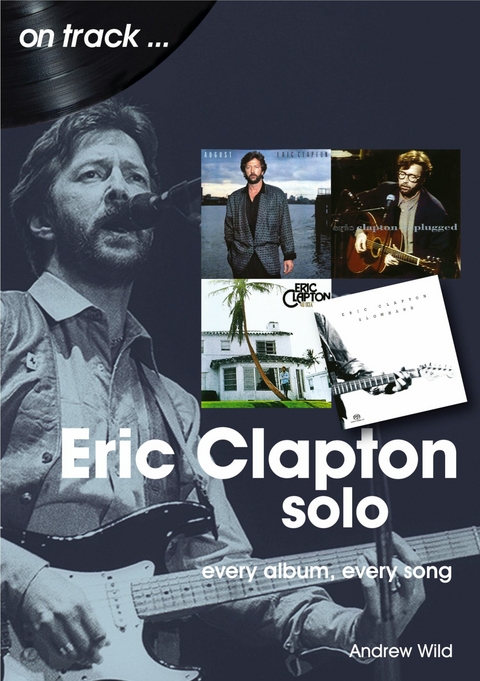
Eric Clapton Solo (eBook)
144 Seiten
Sonicbond Publishing (Verlag)
978-1-78952-475-8 (ISBN)
Of all of the 'classic' British rockers who came to prominence in the 1960s, only a very few have achieved significant, sustained success through to the present day. A list that comprises Paul McCartney and The Rolling Stones should also include Eric Clapton. His critical and commercial accomplishments with John Mayall's Bluesbreakers, Cream, Blind Faith and his first solo album between 1965 and 1970 was followed by the inexplicable failure of the Layla album. Clapton withdrew into addiction for several years.
In 1974, his 'comeback' album, 461 Ocean Boulevard, returned him to the top three in both the UK and America. Always a strong concert draw, Clapton has released another sixteen top twenty albums since. Even 'Layla' returned to the charts in 1982.
Eric Clapton Solo reviews and analyses all of Clapton's studio albums since 1974, as well as successful collaborations with BB King and JJ Cale. It's been a long, varied journey: the laid-back rocker of the 1970s; the commercial sheen of the 1980s; the polished, acoustic yuppie music and hard blues of the 1990s; the slick R & B stylings of the 2000s and the roots homages of the 2010s. All of this was underpinned by the skill and talent of Britain's greatest blues guitarist and a hugely underrated vocalist.
Andrew Wild is an experienced writer, music collector and film buff with many books to his name including recent publications about Queen, Pink Floyd and Dire Straits. His comprehensive study of every song recorded and performed by the Beatles between 1957 and 1970 was published by Sonicbond in 2019. He lives in Rainow, Cheshire, UK.
Eric Clapton Before 1974
‘Eric Clapton is God’, the walls of London read in the mid-1960s, if you believe the hype.
Certainly, by 1974 and the release of 461 Ocean Boulevard, Eric Patrick Clapton–born in Ripley, Surrey, on 30 March 1945–had made his mark as a guitar player of rare skill and attack.
‘It was just graffiti,’ Clapton told Rolling Stone in 1988. ‘It didn’t have any deep meaning. It was just a kind of accolade. They could have said anything, ‘Clapton is fantastic….’ It was nice, and I didn’t argue with it. I have never yet understood what the fuss was about.’ Eric, interviewed by Alex Coletti in 2007:
The first guitar I ever had was a gut-string Spanish guitar, and I couldn’t really get the hang of it. I was only thirteen, and I talked my grandparents into buying it for me. I tried and tried and tried but got nowhere with it. I finally gave up after a year and a half. I started getting interested in the guitar again after hearing Muddy Waters because it sounded like it was easier–wrong! I wanted an electric guitar and, again, I talked my grandparents into buying me one. And, actually, within a very short period of time, I got somewhere with it. I bumped into people who had the same interests–who liked Muddy Waters, Little Walter, Big Bill Broonzy, Robert Johnson. And those people were the original Yardbirds; we used to play together a lot at parties and ended up forming an official band.
He joined The Yardbirds in October 1963, aged eighteen, after short spells in local bands. The Yardbirds tried very hard to be authentic, even touring as the backing band for American blues wailer Sonny Boy Williamson, but had little commercial success initially.
Clapton riled against The Yardbirds’ plan to release a pop single; he abruptly left the band on 25 March 1965, the day ‘For Your Love’ was released. ‘Totally disillusioned,’ Clapton wrote later, ‘I was at that point ready to quit the music business altogether.’
The Yardbirds recruited Jeff Beck, then Jimmy Page, but despite the post- Clapton hit singles ‘Heart Full of Soul’, ‘Shapes of Things’ and ‘Over Under Sideways Down’, failed to find a strong identity. They would eventually mutate into Led Zeppelin.
But it was the B-side of ‘For Your Love’ that gave Clapton the direction he sought. ‘Got To Hurry’ is a ground-breaking, blues-based guitar instrumental. No one in the UK played guitar like this in 1965. Eric, to Rolling Stone in 1988:
You can count on one hand how many white guitar players were playing the blues at the time. I’m not going to say Keith Richards and Brian Jones weren’t doing it, but they were more into Chuck Berry and Bo Diddley. I wanted to be more like Freddy King and B. B. King. So I had no competition.
As John Mayall said to Guitar World in 2020:
I saw Eric very early on with The Yardbirds a couple of times. He was the only one in the band that was any use at all – to my ears anyway. Eric was the only one I’d heard in England who had any idea of what the blues was about. The others didn’t have what Eric had – but then nobody [else] has what Eric had.
By early 1965, John Mayall, already 32, was one of the most successful musicians on the British blues circuit. He had a recording contract with Decca, and a permanent professional band, The Bluesbreakers, which included future Fleetwood Mac bassist John McVie. As Eric told Classic Rock in 2016:
John [Mayall] was a blues archivist. He had the best collection of blues forty- fives – Chicago blues, everything – I’d ever seen in my life. He was a scholar. When he offered me the job [in his band] he offered me a place to live too, in Lee Green. So I stayed with him almost the entire time that I was working with him. And during the day, I would just have all these records out on the floor, putting them on the turntable, learning, learning, learning. And that was all I did. I just studied. Because I realised right away that I was in the perfect environment. He only wanted to play blues. Sometimes it would get a bit jazzy. But he wasn’t impressed by rock’n’roll; he didn’t want to be famous; he just wanted to play clubs and have it be ‘real’. And I thought, ‘this is heaven’. I just listened and played and listened and played.
Mayall and Clapton cut a couple of tracks for a single, ‘I’m Your Witchdoctor’ and ‘Telephone Blues’, but in August, Clapton left for a jaunt to Greece with a bunch of friends. Mayall soldiered on with a series of guitarists, including Peter Green, who would permanently replace Clapton the following year. Clapton returned in November 1965; the crucially important album Blues Breakers With Eric Clapton was recorded the following spring. Remarkably, this British take on American blues was very successful. The album was Mayall’s commercial breakthrough, rising to number six on the British albums chart. Clapton’s loud, aggressive, piercing guitar solos still have the power to surprise the listener. Clapton himself, however, was getting restless again. Eric, in his memoirs:
Though I was happy with The Bluesbreakers, I was also nurturing somewhere inside me thoughts of being a frontman, which had been evolving ever since I had first seen Buddy Guy playing at the Marquee. Even though he was accompanied by only a bass player and a drummer, he created a huge, powerful sound, and it blew me away. As I was watching, I was thinking, ‘I can do that’. So when [drummer] Ginger Baker came to see me and talked about forming a new band, I knew exactly what I wanted to do.
The knowingly named Cream, with Clapton, Baker and bassist/vocalist Jack Bruce, combined both commercially successful hit singles such as ‘I Feel Free’, ‘Sunshine of Your Love’, ‘Badge’, and ‘Strange Brew’, with devastating musical dexterity. They were a major concert draw and one of the most important British bands of 1966-1968. Antagonism between Bruce and Baker created tensions in the band, however, and the expectation of having to play long improvised solos night after night both fuelled their fame and set the band up to self-destruct. The final straw was a review in Rolling Stone that called Clapton ‘a master of all the blues clichés of the post-WWII blues guitarists’ and later suggested that ‘while he has a vast creative potential as a guitarist, he hasn’t yet begun to fulfil it. He is a virtuoso at performing other people’s ideas.’
Deeply disillusioned, Clapton jumped sideways into Blind Faith, a supergroup featuring the precocious Steve Winwood, still only twenty years old, and a rhythm section of Ginger Baker and ex-Family bassist Ric Grech. Eric in 2016:
In its infancy, it was extremely good when we were rehearsing and recording, but once we hit the road, we all got just, like, rabbit-in-the-headlights syndrome. We just panicked. I panicked. We got the same thing [as Cream]: it was ‘Supergroup II’ – and I think that’s the kiss of death. If you really want to kill a band, call it a supergroup and watch it disappear up its own arsehole.
Despite attracting over one hundred thousand people to their first gig, Blind Faith imploded after an American tour in July and August 1969. Their sole self- titled album was commercially very successful – it was a number one in both the US and the UK–and captured the band’s unique mix of Cream’s hard rock and Winwood’s R&B/gospel vocals.
Not quite knowing what to do next, Clapton performed and recorded with John Lennon and the Plastic Ono Band in September 1969, then hooked up with Delaney and Bonnie Bramlett, who had supported Blind Faith on tour. The album On Tour With Eric Clapton was recorded in December 1969 and features fine playing from everyone involved. Clapton’s first solo album was recorded during this period. It was produced by Delaney Bramlett with many of the Friends band, along with Leon Russell, Stephen Stills and The Crickets.
From April 1970, Clapton and the keyboard player Bobby Whitlock wrote several songs together and played a small tour of British clubs during August with the Friends’ rhythm section. Preferring to maintain a low-key image, Clapton named this band Derek and the Dominos. The subsequent album, Layla and Other Assorted Love Songs remains his high point as a musician. A follow-up remained incomplete, as Clapton withdrew from public life following depression after the death of Jimi Hendrix, his infatuation with George Harrison’s wife, and debilitating addiction to drugs and alcohol. A three-year career hiatus from spring 1971 to spring 1974 was interrupted by just three concert appearances.
Ultimately, Clapton restored his health by working for several weeks on the Shropshire farm of Frank Gore, the brother of a past girlfriend. Eric in his memoirs:
I took with me an acoustic guitar and some of my record collection, and since Frank turned out to be a huge music fan, that immediately gave us something in common. He was a great person to listen to music with and bounce ideas off of, and he became my sounding board as to how I was going to get back into playing. We were living in a tiny cottage with a couple of bedrooms, a kitchen, and a living room. It was...
| Erscheint lt. Verlag | 20.11.2025 |
|---|---|
| Reihe/Serie | On Track |
| Sprache | englisch |
| Themenwelt | Kunst / Musik / Theater ► Musik ► Musikgeschichte |
| Schlagworte | Behind the Mask • George Harrison • i shot the sheriff • Slowhand • Unplugged |
| ISBN-10 | 1-78952-475-X / 178952475X |
| ISBN-13 | 978-1-78952-475-8 / 9781789524758 |
| Informationen gemäß Produktsicherheitsverordnung (GPSR) | |
| Haben Sie eine Frage zum Produkt? |
 EPUB (Ohne DRM)
Digital Rights Management: ohne DRM
Dieses eBook enthält kein DRM oder Kopierschutz. Eine Weitergabe an Dritte ist jedoch rechtlich nicht zulässig, weil Sie beim Kauf nur die Rechte an der persönlichen Nutzung erwerben.
Dateiformat: EPUB (Electronic Publication)
EPUB ist ein offener Standard für eBooks und eignet sich besonders zur Darstellung von Belletristik und Sachbüchern. Der Fließtext wird dynamisch an die Display- und Schriftgröße angepasst. Auch für mobile Lesegeräte ist EPUB daher gut geeignet.
Systemvoraussetzungen:
PC/Mac: Mit einem PC oder Mac können Sie dieses eBook lesen. Sie benötigen dafür die kostenlose Software Adobe Digital Editions.
eReader: Dieses eBook kann mit (fast) allen eBook-Readern gelesen werden. Mit dem amazon-Kindle ist es aber nicht kompatibel.
Smartphone/Tablet: Egal ob Apple oder Android, dieses eBook können Sie lesen. Sie benötigen dafür eine kostenlose App.
Geräteliste und zusätzliche Hinweise
Buying eBooks from abroad
For tax law reasons we can sell eBooks just within Germany and Switzerland. Regrettably we cannot fulfill eBook-orders from other countries.
aus dem Bereich


