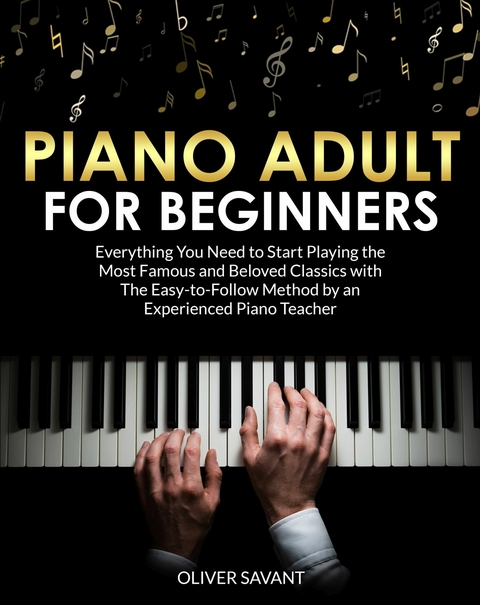
Piano Adult for Beginners (eBook)
138 Seiten
Publishdrive (Verlag)
978-1-970797-30-5 (ISBN)
PIANO TEACHER WHO HAS TAUGHT MORE THAN 300 STUDENTS CREATES A SIMPLE GUIDE TO LEARNING THIS FASCINATING INSTRUMENT
Have you always dreamed of playing the piano but didn't know where to start? Do you want to learn how to play the most famous classical pieces and cherish the art of music?
If you answered yes, then you are in the right place!
Playing the piano can be one of the most rewarding experiences, but many people give up starting because they fear they are too old and will not be in time to learn. Nothing is more wrong than thinking it is too late to start today!
That's why I made 'Piano Adult for beginners', the guide that will allow you to unlock the beauty of this instrument and play your favorite classical pieces effortlessly. Here is what you will find inside:
-The basics you must know of piano playing, including hand positioning, reading sheet music, and understanding musical notation;
-Step-by-step guidance on how to play popular classical pieces, such as Beethoven's 'Moonlight Sonata' and Debussy's 'Clair de Lune';
-The 3 techniques that enabled my students to learn the most difficult songs in a very short time, playing them like real masters;
-7 expert's secret tips and tricks for mastering advanced techniques, including arpeggios and the dreaded scales;
-More than 37 exercises and practice routines to help you improve your playing and build your confidence
- Helpful videos to assist in your growth
AND MUCH, MUCH MORE!
Whether you are a complete beginner, you can experience the joy of playing the piano and make beautiful music that will last a lifetime! What are you waiting for?
Chapter 1:
Music Theory Fundamentals
Understanding The Piano
The first step to playing the piano is understanding the way that it is organized. It doesn’t matter whether you have a Grand piano, upright piano, electric keyboard, electronic synthesizer or whether you’re playing a software synth on your computer or smartphone, every keyboard is built the same way and shares the following features:
- The piano has white keys and black keys (sometimes the black keys may appear gray or brown, but they are still considered ‘black’ keys)
- On the piano, the lowest notes are to the far left. When I say low, I’m referring to pitch. So, the farther to the left you move, the “lower” the note sounds - the notes have more bass - they are notes that fill up more of the lower frequency sounds. As you move to the right along the piano, the notes get “higher”. The notes have more treble or high frequency sounds.
- As a quick exercise, press the highest note on your piano and now the lowest note. Can you hear the difference?
This is the first important concept that you should grasp because understanding the pattern of the black keys will make it very easy for you to find the different notes on the piano.
The Musical Alphabet
Just like English has an alphabet, music has an alphabet. And each note on the piano is identified by a particular letter of the musical alphabet. Now, while the English alphabet has 26 letters (A through Z), the musical alphabet only has 7 (A through G). You might be wondering, if a full-size piano has 88 keys and each key is identified by a letter, how are there only 7 letters in the musical alphabet? That’s a great question. Keep reading.
On the keyboard, the alphabet letters are assigned to the white keys (we’ll ignore the names of the black keys for now). As you move up the white keys one at a time, the notes increase by one letter (see Fig 4.1). So, what happens when you reach the 7th letter ‘G’? Actually, after you reach G, the notes start back at the beginning of the alphabet. So, the note after ‘G’ is another ‘A’. It sounds just like the first ‘A’ that we marked except it sounds like a higher version of it. From then on, the notes continue to cycle from A to G from the lowest note of the piano up to the highest.
It should be noted that on most full size keyboards, A is the first note. This makes it easy to learn all the rest because you can just start from A and proceed up one letter at a time. However, some smaller keyboards start on different notes (usually C). If you’re confused about what note your keyboard starts with, keep reading. The next section will show you how to identify the notes on your keyboard regardless of which key is first.
Finding the notes on the piano
At this point, you’ve learned two important facts:
- The musical notes run along the white keys in alphabetical order from A to G and then repeat in a continuous cycle (A, B, C, D, E, F, G, A, B, C, D, E, F, G, etc.)
- The black keys are organized on piano in the 2, 3, 2, 3 pattern.
Using these two facts, you can find the location of any note on the piano. Let’s look at how this works for each note in the musical alphabet.
Finding the C’s
Even though A is the first letter of the alphabet, we’ll start with the letter C. We do this because C is a very common musical note. The C scale (which we’ll discuss later) is the most common scale in music. In addition, C is the note that happens to fall in the middle of the piano (you’ve probably heard someone use the term ‘Middle C’).
To find a C on your piano, locate a set of two black keys grouped together. It doesn’t matter whether it's toward the top, middle or bottom of the keyboard. You can use any set of two black keys grouped together. C is going to be the white key immediately to the left of those two black keys
In fact, if you look at all the sets of two black keys on the piano, C is found immediately to the left of all of them. As a practice exercise, try to locate all the C’s on your own piano or keyboard.
Finding the D’s
Remember how we said the white keys are laid out in alphabetical order? So, that means if you locate a C on the keyboard, the next white key will be a D. Take note of where D is located (in terms of the black keys). It sits in the middle of the set of two black keys. In fact, if you find all the sets of 2 black keys on the piano, D is located in the middle of each of them. Try to find all the D’s on your own keyboard as a practice exercise.
Finding the E’s
Now that you can locate a C and a D, remember that the white key immediately after D is an E. (You do remember that the white keys are laid out in alphabetical order, right?) If you try to describe the location of the ‘E’ as it relates to the black keys, you’ll agree that the ‘E’ is located to the right of the 2 black keys. And as with the others, if you locate all the sets of 2 black keys on the piano, E is immediately to the right of each of them. Try to locate all the E’s on your own piano.
At this point, as an exercise, you should try and locate all the C’s, D’s, and E’s on the piano. First, find all the C’s. Then the D’s. Then the E’s. If you can do this, then you are ready to tackle the remaining 4 letters (F, G, A & B).
Finding the F’s
Continuing to move up the keyboard one note at a time, we come to F (which, of course, is right after E). You might notice that (unlike C, D, and E) F is actually closer to the set of 3 black keys than the set of 2 black keys. Actually, it is immediately to the left of the set of 3 black keys. So now, if you locate all the sets of 3 black keys, F will be immediately to the left of each of them. Try this now on your keyboard.
Finding the G’s
Once again, G is the white key which follows F. It is located between the 1st and 2nd of the 3 black keys. Locate all the sets of 3 black keys on your keyboard and identify all the G’s.
Finding the A’s
If you recall, G is the last letter of the musical alphabet. There is no H, I, J, etc. in music. After G, the alphabet cycles back to A. So the note immediately following G on the piano is A. A is located between the 2nd and 3rd of the three black keys. Now, find all the A’s on the piano.
Finding the B’s
Lastly, the B is the next white key after A. It is located to the right of the three black keys. You should be able to easily find all the B’s on the piano.
And of course, the next white key after B is C which brings us back to the note we started on to the left of the set of two black keys. So now, you should be able to find all the notes on the piano with just a little effort. To really drill this in, you should make a regular practice of finding all the notes on the piano. Start with the C’s. Find them all. Then find all the D’s. Then the E’s. etc., etc., until you cover all the letters. If you do this once, twice or even three times a day, in no time you will be able to look at a note on the keyboard and know what letter it is without even thinking about it.
Don’t skim over this point. This one practice exercise will change how you see the piano. Prior to opening this book, a piano just looked like a random collection of black and white keys. It didn’t seem to have any order or sense to it. But now you know that’s not the case. Now you know that the black keys follow a pattern: 2 black keys followed by 3 black keys and repeat. If you commit to doing the above exercise regularly (at least once a day). In a week or two, you will be able to look at the piano and IMMEDIATELY recognize the notes on it.
This fundamental knowledge is the first step in upping your game as a producer or songwriter. Commit to it and you WILL see results. QUICKLY.
Identifying the Black keys
(Accidentals, Sharps & Flats)
Now that you know how to identify all the white keys on the piano, it's time to understand accidents (the sharps and flats that are usually found on the black keys of the piano). Here’s how sharps and flats work:
Take any white key and identify its letter. The next highest note (to the right) is considered its sharp key. So, we’ve labeled Middle C (typically, the C that is in the middle of the piano). The black key to the right is called C# (pronounced C-sharp). In the same diagram, we’ve also labeled the G above middle C. The black key to its right is called G#. Take note that while most accidents are black keys, they don’t have to be. The sharp is always the next highest note whether that note is white or black. So again, we’ve labeled the B above middle C. The white key immediately to its right is considered B#. Now, you’re probably confused because you thought that note would be a C. Well, you’re right. Many of the notes on piano have multiple names. So, the white key to the right of B is considered both B# and C. Now, as an exercise try and locate the E# on the piano. What is the E# also called? [Spoiler alert - did you say F? That is correct!]
Flats are the opposite of sharps. A note’s flat key is the note to its immediate left.
So, the note to the immediate left of D is called Db (pronounced D-flat). “Wait a minute!” you’re saying. “I thought that note was called C#???” Very good observation. Remember how I said that many notes on the piano have two names? Well every black key has two names. Db can also be considered C#. Just like Eb (try and locate it) can also be considered D# (do you see why?)
The Eb is immediately to the left of E (making it Eb) but it's also to...
| Erscheint lt. Verlag | 20.11.2025 |
|---|---|
| Sprache | englisch |
| Themenwelt | Kunst / Musik / Theater ► Musik ► Instrumentenunterrricht |
| Schlagworte | best book on how to learn the piano • how to play the piano • learning how to play the piano • piano eduction • Piano for beginners • piano practice and learning |
| ISBN-10 | 1-970797-30-4 / 1970797304 |
| ISBN-13 | 978-1-970797-30-5 / 9781970797305 |
| Informationen gemäß Produktsicherheitsverordnung (GPSR) | |
| Haben Sie eine Frage zum Produkt? |
 EPUB (Ohne DRM)
Digital Rights Management: ohne DRM
Dieses eBook enthält kein DRM oder Kopierschutz. Eine Weitergabe an Dritte ist jedoch rechtlich nicht zulässig, weil Sie beim Kauf nur die Rechte an der persönlichen Nutzung erwerben.
Dateiformat: EPUB (Electronic Publication)
EPUB ist ein offener Standard für eBooks und eignet sich besonders zur Darstellung von Belletristik und Sachbüchern. Der Fließtext wird dynamisch an die Display- und Schriftgröße angepasst. Auch für mobile Lesegeräte ist EPUB daher gut geeignet.
Systemvoraussetzungen:
PC/Mac: Mit einem PC oder Mac können Sie dieses eBook lesen. Sie benötigen dafür die kostenlose Software Adobe Digital Editions.
eReader: Dieses eBook kann mit (fast) allen eBook-Readern gelesen werden. Mit dem amazon-Kindle ist es aber nicht kompatibel.
Smartphone/Tablet: Egal ob Apple oder Android, dieses eBook können Sie lesen. Sie benötigen dafür eine kostenlose App.
Geräteliste und zusätzliche Hinweise
Buying eBooks from abroad
For tax law reasons we can sell eBooks just within Germany and Switzerland. Regrettably we cannot fulfill eBook-orders from other countries.
aus dem Bereich