


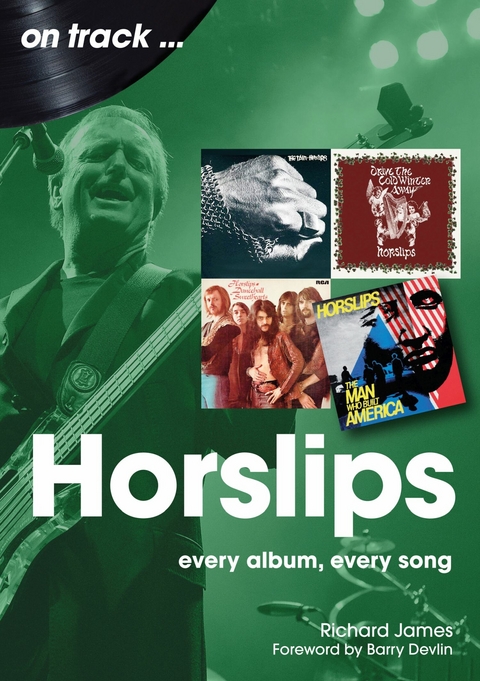
Horslips (eBook)
160 Seiten
Publishdrive (Verlag)
978-1-78952-479-6 (ISBN)
Foreword by Barry Devlin
Five-piece Horslips are arguably the greatest band in Irish rock music history, producing truly special, unique music in the 1970s. By joining literary craft and their cultural heritage with a fusion of traditionally inspired music with rock instrumentation, they created a genre of music which became known as 'Celtic Rock'.
Horslips also pioneered an 'in-house' approach to the rock music business, controlling their stage presentation, graphic design, record pressing and concert promotion. Their finest albums - The Tain, and The Book Of Invasions - adapted legendary and historic texts with compelling music. Elsewhere the life and times of Turlough O'Carolan, The Famine and emigration provided a conceptual backdrop to Dancehall Sweethearts, Aliens, and The Man Who Built America.
But the band broke up in 1980. Reconvening in the next century, after the 'longest tea break in history', they produced a new 'acoustic covers' album, played stadium-filling gigs and television performances, and recorded two live albums. With a foreword by bassist/vocalist Barry Devlin, this book celebrates (and sometimes criticises) the creative waves that Eamon Carr, Barry Devlin, Johnny Fean, Jim Lockhart, and Charles O'Connor gave us.
Richard James immersed himself in music as soon as he got his first real six-string at the age of ten. Previously chained to a desk for a living, he broke free, armed with a music degree from the Open University and a Licentiate Diploma in Classical Guitar from the Royal School of Music, and proceeded to roam the East Midlands as a freelance guitarist and music teacher. He lives with his wife in Leicestershire, UK, and when not involved with music, he enjoys foreign travel and playing chess badly.
Foreword by Barry DevlinFive-piece Horslips are arguably the greatest band in Irish rock music history, producing truly special, unique music in the 1970s. By joining literary craft and their cultural heritage with a fusion of traditionally inspired music with rock instrumentation, they created a genre of music which became known as Celtic Rock .Horslips also pioneered an in-house approach to the rock music business, controlling their stage presentation, graphic design, record pressing and concert promotion. Their finest albums The Tain, and The Book Of Invasions adapted legendary and historic texts with compelling music. Elsewhere the life and times of Turlough O Carolan, The Famine and emigration provided a conceptual backdrop to Dancehall Sweethearts, Aliens, and The Man Who Built America.But the band broke up in 1980. Reconvening in the next century, after the longest tea break in history , they produced a new acoustic covers album, played stadium-filling gigs and television performances, and recorded two live albums. With a foreword by bassist/vocalist Barry Devlin, this book celebrates (and sometimes criticises) the creative waves that Eamon Carr, Barry Devlin, Johnny Fean, Jim Lockhart, and Charles O Connor gave us.Richard James immersed himself in music as soon as he got his first real six-string at the age of ten. Previously chained to a desk for a living, he broke free, armed with a music degree from the Open University and a Licentiate Diploma in Classical Guitar from the Royal School of Music, and proceeded to roam the East Midlands as a freelance guitarist and music teacher. He lives with his wife in Leicestershire, UK, and when not involved with music, he enjoys foreign travel and playing chess badly.
Happy to Meet …
Horslips are the most important band to come out of Ireland. They never attained the broader ‘Classic Rock’ status of Thin Lizzy, nor became a U2-sized global phenomenon, but it wasn’t for lack of trying. The bands significance derives from their invention of a new genre of popular music: ‘Celtic Rock’.
By taking traditional ‘folk’ melodies and using them as the basis for new rock songs, sometimes with unusual or unexpected instrumentation and arrangements, they pioneered a style which continues and evolves to this day. During the 1970s, Horslips broke new ground, and introduced audiences across Britain, Europe and America to music which sounded simultaneously both familiar and yet innovative, new and spellbinding.
They were also the first successful rock act to base their entire career in Ireland. They controlled every aspect of their being; stage presentation, graphic design, record pressing, and concert promotion, before it became fashionable. Their blend of progressive rock arrangements with sometimes centuries-old melodies on conceptual albums sought to explain Ireland’s past to an audience keen to hear rocked-up versions of ancient narratives that took less than 40 minutes to listen to. Horslips had an impact because, for many Irish people, the band energised them and their sense of identity.
The origins of the band date from 1970 and a Dublin advertising agency called Arks. Devlin, a native of Ardloe, County Tyrone, was a recently arrived copywriter. Eamon Carr, originally from Kells, County Meath, was also a copywriter, and Charles O’Connor, a Middlesborough-born designer all worked there. A forthcoming television advert needed a band to mime along to a pre-recorded song, and the three employees were co-opted into performing for the camera. Realising that another musician was needed, Jim Lockhart, a Dubliner and a friend of Devlin’s, was recruited for ‘The Gig’. ‘The Gentle People’, as they were called, duly acted their way through a song promoting Harp lager. Devlin recalled:
There were free drinks and lots of girls and we thought ‘If this is what it’s like being in a pop band maybe we should look into this.
As a consequence, the pretend group decided to become a real band. The four men bonded over a shared love of traditional music, and the newly emerging rock scene. They were aware that a guitarist would be needed if they were to develop as a rock band. Kieron ‘Spud’ Murphy, a photographer at Arks, was swiftly recruited by Devlin to the still-unnamed group, and he is credited with accidentally coming up with the band’s name. What started out as a play on ‘The Four Horsemen of the Apocalypse’ became, after a less than satisfactory rehearsal and a Chinese meal, ‘The Four Poxmen of the Horslypse’, shortening to ‘Horslypse’, before finally arriving at Horslips. The band attracted some attention in October when Spotlight (Ireland’s top music magazine of the time) described them as a ‘new rock-orientated group’. On the DVD Return of the Dancehall Sweethearts, Carr explained the band’s original inspirations:
A lot of the earlier sort of material we were doing had more in common with what bands were doing in San Francisco in the late Sixties than what was coming out of England, although people would say it’s like Steeleye Span, or whatever. I always thought it was much more like The Grateful Dead, or The Joy Of Cooking, or Jefferson Airplane, the bands who mixed up sort of a psychedelic rock thing with Appalachian music, with country blues, with folk and all of that sort of thing.
The band’s first official gig, at the CYMS Hall, Navan, County Meath in November, was cancelled when the local curate withdrew his permission, fearing that the evening was ‘immoral and designed to seduce the girls of Navan’. Turning disappointment into opportunity, and utilising the skills gained in their day jobs, the band managed to get their name into the press. Fortune smiled on them again when Aine O’Connor (no relation), a friend of Devlin and Carr, offered the band the chance to play on a forthcoming new television series, ‘Fonn’ for RTE, Ireland’s national television station.
By December, Murphy had left to become a photographer with ‘Sounds’, a London-based weekly rock music magazine. His role was taken by Declan Sinnott, who had played in Carr’s previous project, Tara Telephone; a group the drummer described as being ‘an Irish version of Pentangle’ (the British folk-jazz band). Devlin described the band’s vision at this stage:
We purposely didn’t try to emulate what Fairport Convention was doing in the sense that they were English folkies playing rock instruments. We realised that we wanted to do something quite different, which was to deconstruct tunes and use them as the basis for new material.
It is this unique approach to their sources that makes Horslips special.
In January 1971, Gene Mulvaney, also formerly of Tara Telephone, joined the band as bassist. The group became the ‘house band’ for ‘Fonn’, performing regularly on its six week run, which aired in February. Devlin recounted:
We were playing a hybrid of traditional Irish airs and rock’n’roll that was warmly but cautiously received by the audience. No one had ever given Irish music this treatment.
Carr added:
It was exciting because we had to come up with a couple of new tunes for each performance. It gave us something to work towards, and by the end of the series, we had cracked a repertoire of sorts.
O’Connor mused on the power of the small screen:
There wasn’t much money involved, but the promise of appearing on television was staggering. We had made this abrupt move from the shallow end into the deep end. We didn’t want to sing Irish songs but take the melodies that were inherently Irish or Celtic and put them into a different sort of music.
By the time ‘Fonn’ had finished its run of shows, the band had honed plenty of material, including ‘The Clergyman’s Lament’, ‘Johnny’s Wedding’, ‘The Musical Priest’, ‘Flower Amang Them All’, and ‘Comb Your Hail And Curl It’, into a gig ready set-list. Unlike the vast majority of new bands, the ‘Fonn’ appearances gave them a national profile, just like that!
By the end of March, Mulvaney had left the group, and bass duties were taken on by Devlin, who moved over from rhythm guitar. The band finally made their first official live debut at Galerie Langlois, Dublin, on 3 April at the same time as the final ‘Fonn’ programme aired. They played as part of a five-hour ‘extravaganza’, grandly titled ‘Portraits and Anthems’. Such was the response that a second event took place on 1 May. The band then appeared at Sligo Sounds Whit Weekend Festival, where Fairport Convention was headlining. A late addition to the bill was a band called Jeremiah Henry, which featured John Fean on guitar. Horslips and Jeremiah Hardy both appeared at the Clare Festival during the summer.
The Highland Festival in September saw promoter Michael Deeny (who was struck by the band’s totally original sound even at this early stage) offering to become their manager. Deeny booked them into Trend Studios in Dublin to record their first track ‘Motorway Madness’ (which would later resurface on Tracks From The Vaults). In October, the band featured on the front cover of Spotlight magazine for the first time. By now Horslips were attracting some serious record company attention, including attempts by Decca, Polydor, Transatlantic, and Charisma to sign them. These were resisted; the band were determined to do business on their own terms, and not jump at the first offer so early in their career.
In January 1972, the band recorded ‘Johnny’s Wedding’, ‘Flower Amang Them All’, and ‘Knockeen Free’ with Fred Meijer acting as producer. As Deeny was finding it difficult to locate a record company which would be the best fit for his new signing, the band instead formed their own record label, Oats Records. Deeny recollects the freshness and originality of such an approach:
Oats gave us immense satisfaction and Horslips really knew their stuff. When you pooled their experience in advertising and graphics, their appreciation of rhythm and blues, and pop, and their knowledge of traditional music, what you had was a real force to be reckoned with. It meant we could do everything. So all we had to do was hire a pressing plant for the records, a printer for the sleeves, and a distributor.
In February, the band received their first significant publicity outside of Ireland when a feature on them appeared in the ‘Daily Express’. On 17 March (St Patrick’s Day), ‘Johnny’s Wedding’ (with ‘Flower Amang Them All’ as the B-side) was released, and Horslips turned professional. The single spent three weeks on the chart, rising to a highpoint of number ten. Carr recalls:
The release of ‘Johnny’s Wedding was the flashpoint. Until then, we’d been this curious, arty collective that had done some TV and a few interesting gigs. But it started to gain momentum. We had started to pick up a following and were regularly hiring an Avis truck to get us to an...
| Erscheint lt. Verlag | 20.11.2025 |
|---|---|
| Reihe/Serie | On Track |
| Sprache | englisch |
| Themenwelt | Kunst / Musik / Theater ► Musik ► Musikgeschichte |
| Kunst / Musik / Theater ► Musik ► Pop / Rock | |
| Schlagworte | Barry Devlin • Irish Rock • The Man Who Built America |
| ISBN-10 | 1-78952-479-2 / 1789524792 |
| ISBN-13 | 978-1-78952-479-6 / 9781789524796 |
| Informationen gemäß Produktsicherheitsverordnung (GPSR) | |
| Haben Sie eine Frage zum Produkt? |
 EPUB (Ohne DRM)
Digital Rights Management: ohne DRM
Dieses eBook enthält kein DRM oder Kopierschutz. Eine Weitergabe an Dritte ist jedoch rechtlich nicht zulässig, weil Sie beim Kauf nur die Rechte an der persönlichen Nutzung erwerben.
Dateiformat: EPUB (Electronic Publication)
EPUB ist ein offener Standard für eBooks und eignet sich besonders zur Darstellung von Belletristik und Sachbüchern. Der Fließtext wird dynamisch an die Display- und Schriftgröße angepasst. Auch für mobile Lesegeräte ist EPUB daher gut geeignet.
Systemvoraussetzungen:
PC/Mac: Mit einem PC oder Mac können Sie dieses eBook lesen. Sie benötigen dafür die kostenlose Software Adobe Digital Editions.
eReader: Dieses eBook kann mit (fast) allen eBook-Readern gelesen werden. Mit dem amazon-Kindle ist es aber nicht kompatibel.
Smartphone/Tablet: Egal ob Apple oder Android, dieses eBook können Sie lesen. Sie benötigen dafür eine kostenlose App.
Geräteliste und zusätzliche Hinweise
Buying eBooks from abroad
For tax law reasons we can sell eBooks just within Germany and Switzerland. Regrettably we cannot fulfill eBook-orders from other countries.
aus dem Bereich


