


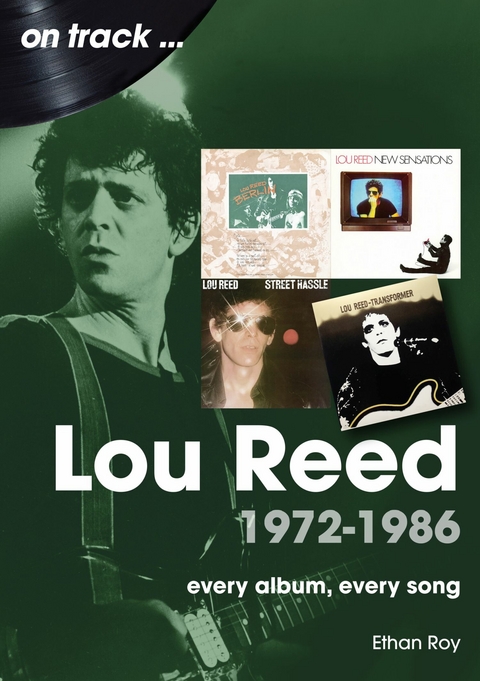
Lou Reed: 1972 - 1986 (eBook)
144 Seiten
Sonicbond Publishing (Verlag)
978-1-78952-476-5 (ISBN)
This book examines the first decade-and-a-half of Lou Reed's work as a solo artist. It would be easy to paint these years with a broad brush; with the ghost of The Velvet Underground in its aftermath gradually gaining cultural influence, this slow-burning legacy would both tether and liberate its key participant. Between the years of 1972 and 1986, Lou Reed would seek, achieve, reject, lament and, once again, pine for professional success while the excesses and extremities of a life lived in public wielded their own unruly impact. While this book seeks to maintain its focus on the music first and foremost, with an artist like Lou Reed, it seems impossible for the personal to stay divorced from the product.
We will see a tentative, crestfallen Lou begin to emerge from his parental Long Island, NY cocoon to test the waters for a solo career. There is worldwide stardom and success, then banishment, followed by his embracing and rejection of various commercial enterprises, to midlife revision and rejuvenation. Multiple partners of influence, both professional and personal, would be accumulated and jettisoned, all leaving lasting traces. Lou did a lot in 14 years, and it's only half of the story.
The author
Ethan Roy is a professor of English Composition at Hudson Valley Community College in Troy, NY. A deep-dish music geek since pre-natal status, at 16 years of age, he dropped out of high school in order to secure full-time employment at what was the best record store in his community, thus affording him a real education of true merit and value. He has played and recorded with various bands over the years and occasionally makes instrumental electronic nonsense under the name, Moon Risk 7. His first tattoo was the image from the front cover of Lou Reed's The Blue Mask LP.
Introduction
To those in the know, Lou Reed is many things. He is the grandfather of this, the progenitor of that. He is the founder of X, he is the proto- of Y. He has been celebrated, denigrated, ignored, re-discovered, lionized, and eulogized, all several times in one lifetime. Even if you have read only this far, you most likely know exactly what I am talking about.
If Lou Reed had never recorded so much as another note after 23 August 1970, we would still have much to discuss; the brief, seminal history of The Velvet Underground deserves and duly receives weighty tomes of its own, a hundred times over. The purpose of this book is to explore and appreciate what came after when Lou Reed took his first tentative steps out of his parents’ Freeport, Long Island home, where he had been resigned to self- exile, and once again began to honor his musical muse. Although some might find it apt to suggest that Lou’s solo career really began with The Velvet Underground’s third album in 1969, our work here begins in 1972 and extends to 1986. A second forthcoming volume picks up in 1989 and lasts to his final release in 2011. All of his solo albums will be considered, as well as major, album-length collaborations, and the live albums that he had a distinct hand in designing, producing, and realizing. At the end, there will be a brief appendix of additional recordings that offer glimpses and tastes of their own.
So, why Lou Reed? Well, for starters, there are the lyrics. Having received a B.A. with Honors from Syracuse University in Creative Writing in 1964, and studying under the troubling, radiant guidance of Delmore Schwartz, certainly places him amongst the refined literary canon, and while his work often reflects the various heights and depths of studied, belabored lines, he is primarily known for, and adept at scribing, some of the ugliest, grittiest, angriest, sexiest rock ‘n’ roll wordplay ever to be set to three (or fewer) chords. It is this duality in language that he is able to straddle so effortlessly and vigorously, song after song, album after album, that produces such vividness in his work. Moments of high and exalted celebration are often tethered to lamentations of vulgar and profound rage, filth, and alienation, typically within the same song. And then there are the points in between; mundanity, whimsicalness, and even triviality causing the listener to once again engage in the guesswork that each true Lou fan comes to expect and enjoy in their search for meaning and essence in the music. Lou does not hold back. He takes you there, every time. Sometimes the honesty, or the intensity of the honesty, can leave the listener almost cringing, unable to pay the fare. Other times, the listener is brought along to an interpersonal ceremony of sorts; a character or situational meditation that transcends the limitations of musical verse.
Then, there is the guitar. Lou Reed will never be included amongst the rapid-fire, all-fingers-of-both-hands, twice-the-speed-of-sound ‘guitar heroes’, and that is of no consequence. He exists in a sphere of one. From his earliest desires to make the guitar sound like the horn of Ornette Coleman or Archie Shepp, and then creating something wholly unique in and of itself, to his more refined, gear-oriented tonal shaping of the later years, Lou’s axe work is his own. While he was never what could be called, either celebratorily or derisively, a virtuoso, the point is moot. His deeply personal and intensive approach to the instrument always suits the music’s purpose in spades, not only in terms of actual notes played but also with regard to the intangible feel such an instrument is still capable of providing. Since his VU days, the guitar has occasionally been sidelined a bit in the place of Lou’s role as singer, frontman, and bandleader, but the instrument, his instrument, is never far.
Your author’s connection with Lou Reed is a bit of a puzzle, as it seems that Lou Reed has never not been there. I don’t wish to suggest that my pre- pubescence was of the precocious sort that saw me studying and parsing the various character studies of abject misery that is Berlin, but as a child of the 1970s, growing up along the Hudson River, two hours and change north of New York City, Lou was there. ‘Walk on the Wild Side’ is deservedly still seen as an anthem of sorts for a number of reasons: the lyrics, the stories within the lyrics, the darker edges that slipped past the censors, the deadpan but deadly serious vocals, the dueling double and electric basses, that sax solo, and just the pure New York-ness of everything in the song. You do not have to set foot in any of the five boroughs to know that this sound is New York. It just feels right. One of the advantages of having intelligent and cultured divorced parents is that during any given school week, you might be informed that you will, in fact, not be going to school this coming Friday, as you and said parent will be boarding the train in Rensselaer, riding into (at the time) Grand Central, to begin the day at The Museum of Natural History to peruse dinosaur bones. This would then be followed by lunch at the Russian Tea Room, then onto a post-repast jaunt through Central Park, and concluding with a look at the Van Gogh exhibit at the Met, or even a Rousseau show at MOMA. To this out-of-town boy, the sights, sounds, smells, tastes, and feels of the place were inextricably captured in Lou’s big hit like an ant in amber. Who knows why – it had to be that way.
A few years later, while hurtling towards the horns of adolescence, the video for ‘Women’ could actually be seen on early-days MTV. Perhaps once. The sparse presentation, with Lou in his omnipresent shades and black Telecaster, and the song itself, buoyed and propelled by Fernando Saunders’ fretless bass, is low-key in the extreme. Yet, even to the initiate, it’s Lou Reed. ‘Hey, that’s Lou Reed’, said one of my two older brothers at the time. Moments later, after the second chorus, where Lou once again declares his amorous fealty, my one older brother chuckled, ‘Yea, right!’ to which my other older brother asked, ‘Lou Reed is gay?’ – ‘Very’, confirmed the first. Despite our assumption being ambiguous at best, Lou’s actual orientation was not a concern to any of us, nor did it color our impression of the artist in any way in the less-than-inclusive 1980s. We then began a spirited debate on the numerous musicians from the 1970s who found it not only fashionable but also lucrative to publicly declare some degree of ‘sexual fluidity’ in those heady times; standard conversation for budding music geeks.
At about the same time, Lou might appear on your TV hocking Honda motor scooters. This was the era when any still-surviving ‘true believers’ of rock ‘n’ roll could have their aged, decrepit illusions shattered anew by the spidery, ever-expanding relationship between ‘truth’ and ‘business’: some long-forgotten bread company hyping their wares to Canned Heat’s version of ‘Goin’ Up the Country’, The Ramones’ near-sacred and sacrosanct ‘Blitzkrieg Bop’ asking us to participate in New York State’s summer-long horse racing racket, or perhaps most egregious, Nike pedaling their shit to us to the tune of The Beatles’ ‘Revolution’. The Dream, if ever there actually was such a thing, was truly over.
With this fulsome baggage in mind, how bad was Lou’s commercial? Set to the tune of (what else?) ‘Walk on the Wild Side,’ a busy camera pans through a fairly basic series of soft-focus nocturnal cityscapes: steam rising up from subway grates, headlights and taillights pouring through intersections, lovers, clasped in shadows, embracing. Near the end of the standard 30-second allotment, our man appears in black leather and shades, perched beside the featured product in question. With a Brando-esque swoop, he removes said shades and utters his five-word treatise on automotive commerce: ‘Hey! Don’t settle for wawkin’!’ Truth be told, and as oxymoronic as this statement may seem, it’s a cool commercial. Unlike most advertisements, it neither insults nor infantilizes the viewer, and its scenes and images are at the very least tasteful. As for Lou, he is Lou in the purest sense. There is no acting, posing, or contriving that would present something other than Lou in his few-second contribution, and to be sure, Lou did ride a bike, just not a Honda, and certainly not a scooter. As a commercial, it seems bizarrely real, and make no mistake, when it was on TV, viewers would momentarily pause and declare, ‘Hey, that’s Lou Reed’.
The aforementioned brief flickers – a song and its after-effects, a music video, and a TV commercial – were how Lou Reed was first presented to your author, and these impressions got the ball rolling weirdly, spectacularly. And this is before I even knew what a ‘velvet underground’ was.
Rock ‘n’ roll, even as we are knee-deep in the 21st century, can still be considered a language for the misfit, the alienated, the fuck-up, but only when our culture, as individual participants or en masse, is at its most expansive. Rock ‘n’ roll was first declared dead before its very birth was finalized, and the statements of impending mortality have never ceased. Trying to decide, once and for all, if rock ‘n’ roll is truly dead is about as futile as trying to decide, once and for all, what rock ‘n’ roll truly is. Just like Jenny, five years old, whose Life was saved by rock ‘n’ roll, it...
| Erscheint lt. Verlag | 19.11.2025 |
|---|---|
| Reihe/Serie | On Track |
| Sprache | englisch |
| Themenwelt | Kunst / Musik / Theater ► Musik ► Musikgeschichte |
| Schlagworte | Metal Machine Music • Rick Wakeman • Steve Howe • The Raven • Transformer |
| ISBN-10 | 1-78952-476-8 / 1789524768 |
| ISBN-13 | 978-1-78952-476-5 / 9781789524765 |
| Informationen gemäß Produktsicherheitsverordnung (GPSR) | |
| Haben Sie eine Frage zum Produkt? |
 EPUB (Ohne DRM)
Digital Rights Management: ohne DRM
Dieses eBook enthält kein DRM oder Kopierschutz. Eine Weitergabe an Dritte ist jedoch rechtlich nicht zulässig, weil Sie beim Kauf nur die Rechte an der persönlichen Nutzung erwerben.
Dateiformat: EPUB (Electronic Publication)
EPUB ist ein offener Standard für eBooks und eignet sich besonders zur Darstellung von Belletristik und Sachbüchern. Der Fließtext wird dynamisch an die Display- und Schriftgröße angepasst. Auch für mobile Lesegeräte ist EPUB daher gut geeignet.
Systemvoraussetzungen:
PC/Mac: Mit einem PC oder Mac können Sie dieses eBook lesen. Sie benötigen dafür die kostenlose Software Adobe Digital Editions.
eReader: Dieses eBook kann mit (fast) allen eBook-Readern gelesen werden. Mit dem amazon-Kindle ist es aber nicht kompatibel.
Smartphone/Tablet: Egal ob Apple oder Android, dieses eBook können Sie lesen. Sie benötigen dafür eine kostenlose App.
Geräteliste und zusätzliche Hinweise
Buying eBooks from abroad
For tax law reasons we can sell eBooks just within Germany and Switzerland. Regrettably we cannot fulfill eBook-orders from other countries.
aus dem Bereich


