


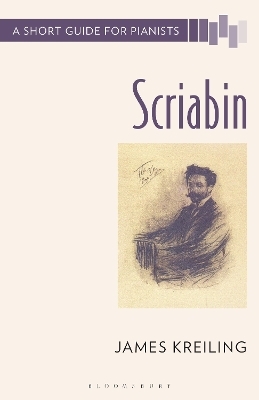
Scriabin
A Short Guide for Pianists
Seiten
2026
Bloomsbury Academic (Verlag)
9798216375258 (ISBN)
Bloomsbury Academic (Verlag)
9798216375258 (ISBN)
- Titel nicht im Sortiment
- Artikel merken
Scriabin: pianist, thinker, symbolist, radical, romantic, and often misunderstood composer – immerse yourself in his mystical world and develop an informed interpretation of his piano works.
Among pianists, the popularity of a handful of his youthful works – from preludes and etudes to sonatas – contrasts starkly with a general ambivalence, verging on animosity, toward his notorious later style. James Kreiling sets out not only to inform and advise but also to persuade. He illuminates the genius of Scriabin’s highly individual style while focusing on performance and interpretation.
Considering the various piano-roll recordings of Scriabin left to us as well as first-hand accounts from contemporaries, this book pieces together how a late 19th-century approach to rubato and improvisation is inherent in Scriabin’s notation, how notions of Scriabin’s orchestration and synesthesia are pianistic tools, and how all of this can influence performance. Kreiling also contemplates the development of Scriabin as “Thinker.” He looks at how the gradual evolution of his thought to apocalyptic heights – from brushes with theosophy and Russian cosmism to mysticism – was born from growing social and political tensions of the epoch, exploring their musical manifestations such as the “Mystic” chord and musical symbolism.
Among pianists, the popularity of a handful of his youthful works – from preludes and etudes to sonatas – contrasts starkly with a general ambivalence, verging on animosity, toward his notorious later style. James Kreiling sets out not only to inform and advise but also to persuade. He illuminates the genius of Scriabin’s highly individual style while focusing on performance and interpretation.
Considering the various piano-roll recordings of Scriabin left to us as well as first-hand accounts from contemporaries, this book pieces together how a late 19th-century approach to rubato and improvisation is inherent in Scriabin’s notation, how notions of Scriabin’s orchestration and synesthesia are pianistic tools, and how all of this can influence performance. Kreiling also contemplates the development of Scriabin as “Thinker.” He looks at how the gradual evolution of his thought to apocalyptic heights – from brushes with theosophy and Russian cosmism to mysticism – was born from growing social and political tensions of the epoch, exploring their musical manifestations such as the “Mystic” chord and musical symbolism.
James Kreiling is a British pianist, writer, teacher and transcriber. His debut double CD recording of Scriabin’s complete late piano music was met with great critical acclaim. His doctoral thesis, completed at the Guildhall School of Music and Drama, focused on the interaction of research, analysis and performance practice in the interpretation of Scriabin’s late piano sonatas.
Series Editor’s Preface
Introduction
1. Radical Genius or Deluded Prophet?
2. Scriabin the Pianist
3. Scriabin the Composer
4. Scriabin the Thinker
5. Scriabin the Symbolist
6. The Dark Side of Scriabin
7. The Future
Index
| Erscheint lt. Verlag | 3.9.2026 |
|---|---|
| Reihe/Serie | Short Guides to the Piano Repertoire |
| Verlagsort | New York |
| Sprache | englisch |
| Maße | 140 x 216 mm |
| Themenwelt | Kunst / Musik / Theater ► Musik ► Instrumentenkunde |
| Kunst / Musik / Theater ► Musik ► Klassik / Oper / Musical | |
| ISBN-13 | 9798216375258 / 9798216375258 |
| Zustand | Neuware |
| Informationen gemäß Produktsicherheitsverordnung (GPSR) | |
| Haben Sie eine Frage zum Produkt? |
Mehr entdecken
aus dem Bereich

aus dem Bereich
kleine Geschichte eines großen Instruments
Buch | Hardcover (2025)
C.H.Beck (Verlag)
CHF 34,90
Buch | Hardcover (2025)
Annette Betz im Ueberreuter Verlag
CHF 41,90
Steinway & Sons / Grotrian-Steinweg
Buch | Hardcover (2025)
Michael Imhof Verlag
CHF 29,90


