X-Men For Dummies (eBook)
351 Seiten
For Dummies (Verlag)
978-1-394-36275-2 (ISBN)
Meet the extraordinary mutants that make up the X-Men
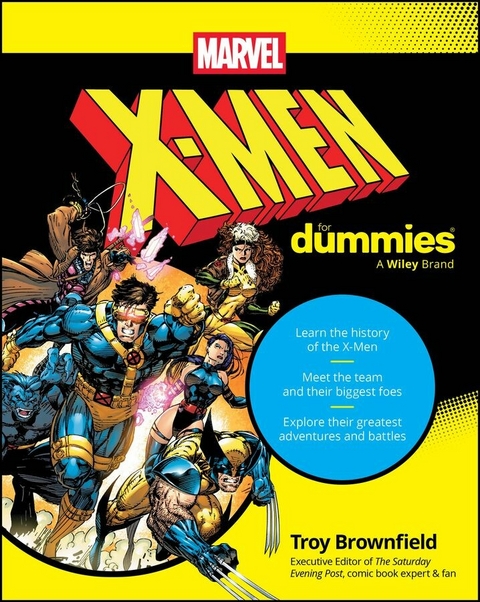
What started with five teenagers with unique abilities and the world's most powerful telepath grew into a school filled with gifted students and teachers. Between internal struggles, powerful enemies, and conflicting agendas, what could possibly go wrong? X-Men For Dummies unravels the complexities that come with having mutant abilities and being charged with protecting a world that fears your existence. Created in collaboration with Marvel and filled with striking artwork from the comics, X-Men For Dummies highlights Professor Charles Xavier's dream to protect and educate the next generation of mutants and their evolution to one of the most iconic super hero teams of all time.
- Uncover what a mutant is and the dueling philosophies about their role in society
- Get to know the mutants introduced in X-Men comics - from Professor X to Magneto, Wolverine, Cyclops, Jean Grey, Storm, Beast, and beyond
- Explore the team's greatest battles, triumphs, and tragedies
- Meet the X-Men's foes and allies
Whether you're a first-time fan or have been reading since the first comic, X-Men For Dummies is your first class guide to all things X-Men!
Troy Brownfield is the Executive Editor at The Saturday Evening Post and at the children's magazines, Jack & Jill and Humpty Dumpty. He has created content for DC Comics, Comiccon.com, Fangoria Comics/Graphix, and Zenescope Entertainment. He's also written trading cards for Topps Trading Cards.
Meet the extraordinary mutants that make up the X-Men What started with five teenagers with unique abilities and the world s most powerful telepath grew into a school filled with gifted students and teachers. Between internal struggles, powerful enemies, and conflicting agendas, what could possibly go wrong? X-Men For Dummies unravels the complexities that come with having mutant abilities and being charged with protecting a world that fears your existence. Created in collaboration with Marvel and filled with striking artwork from the comics, X-Men For Dummies highlights Professor Charles Xavier s dream to protect and educate the next generation of mutants and their evolution to one of the most iconic super hero teams of all time. Uncover what a mutant is and the dueling philosophies about their role in society Get to know the mutants introduced in X-Men comics from Professor X to Magneto, Wolverine, Cyclops, Jean Grey, Storm, Beast, and beyond Explore the team s greatest battles, triumphs, and tragedies Meet the X-Men s foes and allies Whether you re a first-time fan or have been reading since the first comic, X-Men For Dummies is your first class guide to all things X-Men!
Chapter 1
Children of the Atom
IN THIS CHAPTER
Getting to know the concept of mutants
Discovering mutants in the Marvel Universe
Exploring conflicting mutant philosophies
In the universe of Marvel Comics, the X-Men are one of the most important families of characters. They debuted in 1963 and, after a few difficult years, exploded in popularity in the mid-1970s. However, that was only a precursor for the rocket ride that the group would take in the 1980s and 1990s as they became a powerhouse of popular culture.
The obvious questions would be: Why did the X-Men blow up when they did, and what is it that connects so many readers and fans to the characters? Fortunately, we’ve got answers. But before that, we have to address the very first question that a new reader would have when stepping into the world of the X-Men.
What Is a Mutant?
The vast majority of characters featured in the various X-titles are mutants. In real-world scientific terms, the Cambridge Dictionary defines a mutant as “an organism that is different from others of its type because of a permanent change in its genes.” That change is called a mutation, and a conventional mutation in a human being can be anything from a variant eye color to sickle cell anemia.
In the pages of Marvel Comics, however, many mutants have experienced a genetic change prior to birth that grants them uncanny super powers. These powers run the gamut from physical expressions (great strength, wings, accelerated healing) to abilities of tremendous magnitude (telekinesis, weather control, energy manipulation).
An Omega-level mutant is a mutant who possesses massive power with “an undefinable upper limit.” Storm and Magneto are both Omega level (see Figure 1-1).
Story by Chris Claremont and Jim Lee. Art by Jim Lee, Scott Williams, and Joe Rosas.
FIGURE 1-1: Magneto displays his power above the Earth.
That means that Marvel’s mutants are generally born with their powers, but those powers don’t typically appear or activate until that mutant reaches puberty. At that point, when the body begins its transition to adulthood, the amazing powers locked inside that person begin to blossom. While some powers are easily controlled, others can be extremely dangerous and require some discipline to handle.
The dangerous nature of some mutant powers and the inability of newly discovered mutants to control those powers has created a climate of fear around mutants in the pages of Marvel Comics. While many people understand that the mutants are just different and trying to deal with the problems that are occasionally created by their powers, others express open hostility to mutantkind, ranging from prejudice to anti-mutant extremism.
Mutants in the Marvel Universe
If Stan Lee had had his way in 1963, the first X-Men comic would have been called The Mutants. When he and Jack Kirby created a team of teenage heroes who were born with an “X-tra power,” Lee just wanted to follow the science and put mutant right there in the title. However, publisher Martin Goodman pointed out that many young readers might not understand what a mutant was.
Lee and Kirby came back with a new title: The X-Men. Not only was the leader of the young heroes named Professor X, but the “X” could also stand for “X-tra power” and made for a cool logo to adorn the belt buckles of the teams’ matching uniforms. Never mind the fact that no new reader would know what an “X-Man” was until they cracked open the pages; X-Men just sounded cooler.
In the beginning, the X-Men operated in secret out of Xavier’s School for Gifted Youngsters at 1407 Graymalkin Lane in Westchester, New York. The opening of the first issue revealed that the school was also a facade for the secret headquarters of the team. Kirby envisioned an area in the school where the X-Men could train and sharpen their powers; he called it the Danger Room, and we see the team there in the first few pages of the first issue (see Figure 1-2).
Professor Charles Xavier, aka Professor X, had a mission statement of finding young mutants and training them in their powers with a long-term goal of both protecting and assimilating into mainstream humanity. Xavier was already aware of mutants like Magneto, who originally believed that mutants should be seen as the next step in evolution, there to replace the human race.
It was also important that the original X-Men were teenagers. Their struggles with their powers mirrored the struggles that real adolescents go through with changing bodies and emotions. Also, most of Marvel’s other heroes at the time were adults. Reed Richards (Mister Fantastic) and Bruce Banner (Hulk) were well-educated scientists. Tony Stark ran a corporation. But, much like Spider-Man, the X-Men were young people with young people problems.
By the fourth issue of X-Men, Magneto had formed his own team running counter to Xavier’s intentions: the Brotherhood of Evil Mutants. He also had two young team members: Scarlet Witch and Quicksilver. The twin siblings struggled not only with their understanding of their abilities, but with the issue of whether they were on the wrong side by backing Magneto’s vision of mutant supremacy.
Story by Stan Lee. Art by Jack Kirby and Paul Reinman.
FIGURE 1-2: The X-Men get down to training in the Danger Room.
That initial conflict set much of the groundwork for the X-Men in the comics. On one side, you had a group dedicated to protecting the world while envisioning harmony, and on the other side, you had a team willing to go to extremes to conquer the people who already feared them. In many early issues, the two teams came into conflict trying to find and recruit mutants to their side. Sometimes the X-Men failed, such as when mutants would become antagonists. On other occasions, they met people who would ultimately become long-term allies or team members, like Polaris.
Professor X found many mutants using a mutant-detecting machine of his own design, Cerebro, which was powered by his telepathy.
Over the years, the X-Men would grow, expand, and sometimes splinter. As a result, many factions of benevolent mutants developed with differing, even conflicting agendas. Also, as more mutant antagonists were discovered, many were revealed to have their own plans and far-reaching goals. This means that the mutant world can be a complex path of strained alliances, hidden agendas, and competing philosophies.
Conflicting Philosophies
The root belief system of the core X-Men team has always been taking responsibility for power. That is, the X-Men believe in protecting both mutants and humans alike while aspiring for a world in which everyone can coexist without fear. While different iterations of the team over time have expressed that value in different ways, the idea of the X-Men as protectors has existed from day one.
That is owed to the founding philosophy of Professor X, who was originally intent on guiding the X-Men with that dream of cohabitation as their number one principle. He grounded the instruction of the original team in that notion, hoping to teach the students that living alongside humans was better than trying to live “above” them. Let’s look at some of the various schools of thought to be found among the various mutant teams.
Professor X and the X-Men
Essentially, the X-Men typically fight for “Xavier’s Dream,” a world that represents peaceful coexistence. In the early days, Professor X even worked directly with the FBI, trying to lend some legal legitimacy to the X-Men’s actions. In their first public appearance, the X-Men protected the American military missile base Cape Citadel from an attack by Magneto. Xavier wanted to establish the X-Men as a benign, helpful presence who didn’t represent a threat to humanity (you learn more about the original mission in Chapter 2).
Magneto and the Brotherhood
As established by Magneto, the Brotherhood worked to draw mutants to their cause and belief that the world of humans should be overthrown and ruled by mutants. Part of Magneto’s radicalization against humans developed when he saw the atrocities committed against his people during the Holocaust.
Magneto financed his early operations with gold that he took from Hydra’s Baron Wolfgang von Strucker.
Magneto targeted a number of mutants for recruitment and also used them in his schemes against the X-Men. He was willing to use lethal force, such as when he sank a Soviet submarine that fired on his island. However, during a battle with the X-Men, he nearly accidentally killed a young Kitty Pryde. Magneto realized that he had become like those he hated, and his regret over harming Kitty stirred a change in him. He began to move to more of a middle ground, willing to act in defense of the world while still maintaining a staunch attitude of protecting his fellow mutants. (I cover more about the early days of the Brotherhood in Chapter 2.)
When Mystique launched her own version of the Brotherhood, her team employed terrorism in their goals to destabilize the human-dominated world. Their first major action was the attempted assassination of the anti-mutant United States senator, Robert Kelly. The X-Men saved Kelly, but that didn’t stop Mystique’s...
| Erscheint lt. Verlag | 3.11.2025 |
|---|---|
| Sprache | englisch |
| Themenwelt | Literatur |
| Kunst / Musik / Theater | |
| Schlagworte | Alpha Flight • ARIEL • Armor • Aurora • Avengers • Banshee • Beast • Betsy Braddock • Cable • Cannonball • Cerebra • chamber • changeling • Charles Xavier • cloak and dagger • Colossus • Comics • Cyclops • Cypher • Danger • Darwin • Days of Future Past • Dazzler • Deadpool • Doctor Nemesis • Domino • Erik Lehnsherr • Erik Magnus Lehnsherr • Excalibur • Firestar • Forge • Frenzy • Gambit • Glob Herman • Havok • Hepzibah • Honey Badger • Hope Summers • Husk • iceman • INK • Jack Kirby • Jean Grey • Jubilee • juggernaut • Karma • Kate Pryde • Kid Omega • Kuan-Yin Xorn • Kwannon • Lady Mastermind • Laura Kinney • Legion • Lifeguard • Lockheed • Logan • longshot • Madison Jeffries • Maggott • Magik • Magma • Magneto • Marrow • Marvel • Marvel Cinematic Universe • Marvel Comics • MCU • mimic • Mirage • Monet St. Croix • Ms. Marvel • Muir Island Saga • Mutant • mystique • Namor • Nightcrawler • NorthStar • Old Man Logan • Polaris • Professor X • Proudstar • Pyro • Rachel Grey • Rasputin IV • rogue • Sabretooth • Scott Summers • Slipstream • Stacy X • Stan Lee • Storm • Sunfire • SunSPOT • Sway • Synch • temper • The Dark Phoenix Saga • The Mutant Massacre • The New Mutants • Thunderbird • Vulcan • Warlock • warpath • Wolverine • Xavier's School For Gifted Youngers • X-Factor • X-Force • x-Man • X-Men |
| ISBN-10 | 1-394-36275-7 / 1394362757 |
| ISBN-13 | 978-1-394-36275-2 / 9781394362752 |
| Informationen gemäß Produktsicherheitsverordnung (GPSR) | |
| Haben Sie eine Frage zum Produkt? |
 EPUB (Adobe DRM)
Kopierschutz: Adobe-DRM
Adobe-DRM ist ein Kopierschutz, der das eBook vor Mißbrauch schützen soll. Dabei wird das eBook bereits beim Download auf Ihre persönliche Adobe-ID autorisiert. Lesen können Sie das eBook dann nur auf den Geräten, welche ebenfalls auf Ihre Adobe-ID registriert sind.
Details zum Adobe-DRM
Dateiformat: EPUB (Electronic Publication)
EPUB ist ein offener Standard für eBooks und eignet sich besonders zur Darstellung von Belletristik und Sachbüchern. Der Fließtext wird dynamisch an die Display- und Schriftgröße angepasst. Auch für mobile Lesegeräte ist EPUB daher gut geeignet.
Systemvoraussetzungen:
PC/Mac: Mit einem PC oder Mac können Sie dieses eBook lesen. Sie benötigen eine
eReader: Dieses eBook kann mit (fast) allen eBook-Readern gelesen werden. Mit dem amazon-Kindle ist es aber nicht kompatibel.
Smartphone/Tablet: Egal ob Apple oder Android, dieses eBook können Sie lesen. Sie benötigen eine
Geräteliste und zusätzliche Hinweise
Buying eBooks from abroad
For tax law reasons we can sell eBooks just within Germany and Switzerland. Regrettably we cannot fulfill eBook-orders from other countries.
aus dem Bereich