


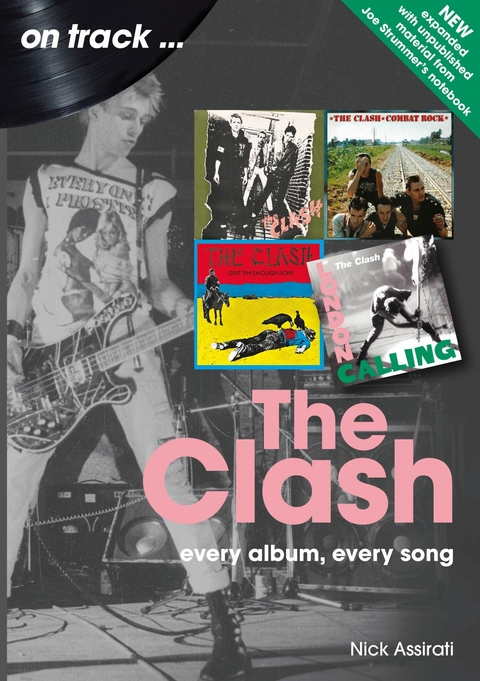
The Clash - revised and updated (eBook)
176 Seiten
Sonicbond Publishing (Verlag)
978-1-78952-470-3 (ISBN)
This revised edition adds previously unpublished material from Joe Strummer's personal notebook and cartoonist Ray Lowry's archive.
The Clash were an extraordinary band. Bursting out of the punk explosion in 1977, they recorded their self-titled first album over three weekends. It is now regarded as the quintessential punk record. Over the next five years, they recorded another fourteen sides of long-playing vinyl, including the platinum double LP London Calling, which was voted the best album of the 1980s and the eighth-best album of all time by Rolling Stone magazine. Through the triple-LP Sandinista! to their double-platinum Combat Rock plus a whole bunch of stand-alone singles and EPs, The Clash mixed both street and global politics with music spanning several genres, including rock, reggae, jazz, rap, calypso and rockabilly.
It provides a concise narrative of the rise and fall of The Clash, putting each song of their prolific musical output into context, including a selection of bootlegs and rarities. There is also advice about how to buy The Clash's music without falling into the record company trap of repeatedly buying the same material through different compilations, making this the most essential guide to the music of this iconic band yet written.
This is the third edition of Nick's book. Neither a trained writer nor a music critic, he is a lifelong Clash fan with a passion for their music and the punk ethic of 'Do It Yourself '. He was born and grew up in inner London and has spent his life taking the fight to the enemy. Nick is now a family man who spends his time playing music and planting trees in the Forest of Dean, UK.
Introduction – Punk Rock And The Clash
The world is divided into two kinds of people – those who ‘get’ The Clash and those who don’t. The Clash were a punk rock band. To understand punk rock (not the pastiche of Mohican hair, violence and aggression portrayed today) we need to go back a bit.
In the mid-1970s, British society was in the doldrums. After post-World War II austerity and the collapse of empire came hope with the establishment of the Commonwealth, the National Health Service and the Welfare State. In the 1960s came The Beatles, The Rolling Stones, the civil rights movements and society gradually working towards sexual and racial equality, opening a new chapter of emancipation and personal freedom. The monolithic political blocks of the early 20th century were beginning to crumble. Britain was gradually transforming into a post-industrial society, and no one really knew where we were heading. When the 1970s arrived, so did increased unemployment, high oil prices and a simmering social unrest.
Psychedelic rock and hippiedom appeared to have run their course. Music was alive and well in terms of sales, but progressive, underground and ‘album-oriented rock’ (AOR) seemed to be disappearing up its own decadent arsehole. These musically complicated genres were a long way from the simple three-chord songs that anyone could play and that qualified rock ‘n’ roll as truly ‘The People’s Music’. The alternatives were soul, disco and funk in their gentle opposition to casual and overt racism, light pop music or glam rock with its daft excess. There were notable exceptions such as the emergence of reggae, but for the (mostly) white UK working class – whose work prospects looked bleak – the cities in which they resided were in a state of general decay and the virtuoso and/or escapist music scene was disassociated from their everyday experiences. Then came The Sex Pistols.
Not quite out of nowhere – but raw rock ‘n’ roll sung in the vernacular came like a shot in the arm to disaffected youth. ‘GET OFF YOUR ARSE!’ shouted Johnny Rotten before launching into ‘Anarchy in the UK’ in 1976. In a weird, serendipitous moment, a spark fell on the dry tinder of UK youth and a new zeitgeist was born. The magnificent simplicity of punk rock was such that all you needed was a couple of mates, a bit of passion and something to say. The Sex Pistols kicked in the door, and The Clash, The Jam, The Buzzcocks, et al. piled through. Sure, there was a lot of crap tagging along, too – but it did seem that for one fleeting moment, the floodgates were open, and a creative explosion was underway. The Do-It-Yourself attitude of punk rock empowered a generation and, over the next year, spawned the ‘New Wave’ of music. You didn’t need to be a virtuoso musician or able to play a five-minute guitar solo, as long as you had the fire in your belly and something to say. And above all, to say it like it was – both barrels blazing. Small-run, locally produced punk ‘fanzines’ appeared all over the country, record sales reached a historical peak and interest in new music was at its zenith. In this sense, punk rock in general – and The Clash in particular – are a snapshot of British social history, but their music is so much more than a curious museum piece. All great music touches the soul, and the records made by The Clash resonate with music lovers to this day.
The Sex Pistols’ ‘God Save The Queen’ got to #1 in the UK charts during the Queen’s Silver Jubilee week in 1977 despite an effective radio ban. They made one seminal album and then disappeared (despite Malcolm McLaren flogging the dead horse). Important bands like X-Ray Spex, Stiff Little Fingers and The Tom Robinson Band appeared. Pseudo-punk bands like The Police rode the bandwagon, as did former pub rockers like The Stranglers and Ian Dury. Hot on the heels of ‘new wave’ came the 2-Tone movement, spearheaded by The Specials and giving air time and elbow room to the likes of Madness and The Beat. UB40 were the flagship reggae band and British music was powering forward.
Paradoxically, as working-class Britain began to suffer economic recession under a right-wing Thatcher government, aspirational escapism became the vogue and bands with something to say became deeply unfashionable. Fantasy became the name of the game, so the new romantics and electro-pop arrived, heavily influenced by the pioneering West German band Kraftwerk. The growth of MTV and the promotional pop video became increasingly important, and style began to outweigh substance. Consequently, the UK rock ‘n’ roll music scene began to decline to the extent that record sales almost halved in the early 1980s(2).
The arrival of the compact disc (CD) boosted music sales to an all-time high by the turn of the century. At first, the record companies must have thought all of their Christmases had come at once. They watched the money roll in as they sold their back catalogues on CD and didn’t bother investing in new artists. The joke was on them when listening to music became cheaper online and their party was over. In 2016, digital ‘streaming’ finally began to outstrip physical sales and downloads.
Punk rock and The Clash probably couldn’t have happened in the age of the internet. There was an ‘otherness’ to the music that they personified. The Clash were at the front line of punk. They were with The Sex Pistols on the ‘Anarchy’ tour of the UK in December 1976 (although only a few gigs actually took place on the tour due to local objections). The Clash signed to CBS in January 1977 (sparking silly cries that this was the end of punk) and recorded their eponymous first album in February that year.
Prior to The Clash, Mick Jones had been in a band called The London SS with Tony James (who went on to form Generation X with Billy Idol). After James and Jones’ amicable split, Mick asked Paul Simonon to join his new band – not because he could play, but because he looked good. Mick taught Paul how to play bass and they formed a band with Keith Levene on guitar and Terry Chimes on drums and had hooked up with Bernie Rhodes(3) as their Manager. Meanwhile, John Mellor (who had metamorphosed once into ‘Woody’ and then into ‘Joe Strummer’) had been in the West London squatter scene and was playing guitar for a pub-rock band called ‘The 101’ers’. He was spotted by Rhodes who suggested to Mick and Keith that they should go and see him. They liked what they saw. Co-incidentally, The 101’ers had been supported by The Sex Pistols at a gig in April 1976, and when Joe watched The Pistols, he sensed that revolution was in the air and that his old band was ‘history’. Bernie arranged a meeting and Mick, Keith and Paul asked Joe to join them. Within 48 hours, Joe had dumped The 101’ers, and The Clash was born.
As the first punk bands were formed, the musicians reinvented themselves, often with ironic or self-deprecating stage names like Poly Styrene, Rat Scabies and Captain Sensible. John Mellor had already become Joe Strummer and gave Terry Chimes the nickname ‘Tory Crimes’. Keith Levene left The Clash, soon to be followed by Chimes, who liked the music but didn’t like the uncompromising and fundamentalist anti-venal attitude of the members. He kindly agreed to help out and play drums for the first album before he left for good (for now). Both before and after recording their first album, The Clash auditioned several drummers before settling on Nicky ‘Topper’ Headon in April 1977. Jones had known Headon from the London SS days. Topper was more into jazz and soul, but he thought he’d join The Clash for a year ‘and then move on to something good’.
It transpired that Topper was the final piece of the jigsaw. He just happened to be one of the best drummers around, so now the live performance power of The Clash started at the back, driven by Topper, then drove forward in a direct line, straight through the electrifying Strummer in the centre of the stage to hit the audience right between the eyes. Left-handed Strummer had a unique percussive power to his guitar playing – he played it right-handed which gave him great dexterity for chord shapes, but he worked his right hand like a jackhammer (hence the new surname). Mick Jones was the strutting guitar hero to his right. To his left was Paul Simonon, the epitome of The Clash, looking great with his low-slung bass and tough, working-class persona. Paul also brought a reggae influence with him, having been raised in Brixton, South London which had been a hotbed of West Indian music. It was usually Paul who drove the aesthetic look of the band, including the artwork for the record sleeves.
What made The Clash different was that their music had a sense of purpose and direction rooted in anti-racist street politics, articulated in Strummer’s outstanding talent as a lyricist. They had decided from the beginning to do things differently. The Clash refused to appear on mainstream TV, which made seeing or hearing them a labour of love in a pre-internet society – with an element of commercial suicide thrown in for good measure. The Clash would go on to release double and triple LPs for the price of a single LP and absorb the additional costs themselves through reduced royalty payments. In addition, they would generally play a series of gigs in smaller, intimate venues rather than fewer shows in larger seated venues that would have proved more lucrative for themselves. They kept ticket prices...
| Erscheint lt. Verlag | 29.10.2025 |
|---|---|
| Reihe/Serie | On Track |
| Sprache | englisch |
| Themenwelt | Kunst / Musik / Theater ► Musik ► Musikgeschichte |
| Schlagworte | Combat Rock • Give Em Enough Rope • Joe Strummer • London Calling • Mick Jones • sandinista! • Topper Headon |
| ISBN-10 | 1-78952-470-9 / 1789524709 |
| ISBN-13 | 978-1-78952-470-3 / 9781789524703 |
| Informationen gemäß Produktsicherheitsverordnung (GPSR) | |
| Haben Sie eine Frage zum Produkt? |
 EPUB (Ohne DRM)
Digital Rights Management: ohne DRM
Dieses eBook enthält kein DRM oder Kopierschutz. Eine Weitergabe an Dritte ist jedoch rechtlich nicht zulässig, weil Sie beim Kauf nur die Rechte an der persönlichen Nutzung erwerben.
Dateiformat: EPUB (Electronic Publication)
EPUB ist ein offener Standard für eBooks und eignet sich besonders zur Darstellung von Belletristik und Sachbüchern. Der Fließtext wird dynamisch an die Display- und Schriftgröße angepasst. Auch für mobile Lesegeräte ist EPUB daher gut geeignet.
Systemvoraussetzungen:
PC/Mac: Mit einem PC oder Mac können Sie dieses eBook lesen. Sie benötigen dafür die kostenlose Software Adobe Digital Editions.
eReader: Dieses eBook kann mit (fast) allen eBook-Readern gelesen werden. Mit dem amazon-Kindle ist es aber nicht kompatibel.
Smartphone/Tablet: Egal ob Apple oder Android, dieses eBook können Sie lesen. Sie benötigen dafür eine kostenlose App.
Geräteliste und zusätzliche Hinweise
Buying eBooks from abroad
For tax law reasons we can sell eBooks just within Germany and Switzerland. Regrettably we cannot fulfill eBook-orders from other countries.
aus dem Bereich


