


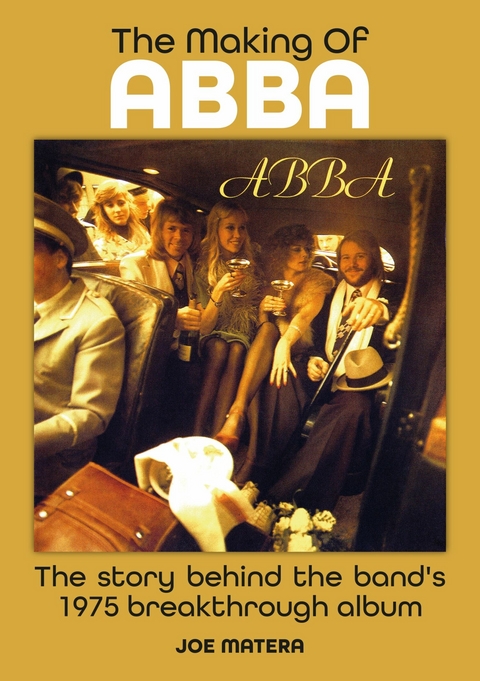
The Making Of ABBA (eBook)
88 Seiten
Sonicbond Publishing (Verlag)
978-1-78952-469-7 (ISBN)
Swedish quartet ABBA released their third, self-titled album in 1975. It was a record that led the group to their international breakthrough and eventual domination of the 1970s pop music world. ABBA also provided a blueprint for everything that defined the group, cementing once and for all the band's musicality and approach. It presents a unique and timeless sound that still resonates fifty years on, remaining as fresh as the day this remarkable recording was released.
This is the story of the album, from its inception to its triumphant commercial breakthrough and all in between, including ABBA's first live tour outside of their native Sweden. It is written from a perspective of not only a fan, but from that of a musician who has spent time in Stockholm and has recorded with some of ABBA's inner circle. Along with in-depth analysis of the music, it also includes new and exclusive interviews with many of the original musicians who were there in the studio, recording the album's now classic tracks. These include bassist Mike Watson, plus guitarists Janne Schaffer and Finn Sjöberg, and the book features a foreword by author Carl Magnus Palm. It's a story retold like never before.
Author Biography
Joe Matera is an Italian Australian musician, music journalist, and author. Over the course of his illustrious performing career, he has played guitar for famed British music legend Steve Harley, supported the likes of Canned Heat, The Animals, and Bay City Rollers in concert and earned a top-five-selling instrumental album on the Australian ARIA chart. He has co-written and recorded music with ABBA guitarist Janne Schaffer, as well as legendary English pop-rock group The Korgis. A respected music journalist too, his writings have appeared in Guitar Player, Record Collector and The Guardian, among many others. He is also the best-selling author of Backstage Pass: The Grit and the Glamour and Louder Than Words: Beyond the Backstage Pass.
Introduction
Released in 1992, ABBA Gold: Greatest Hits remains ABBA’s biggest-selling album. As the title affirms, it’s a compilation of the group’s greatest hits, though, depending on what territory around the world you are in, it’s not a complete collection. For example, ‘I Do, I Do, I Do, I Do, I Do’ was a number one in several countries, such as Belgium and, most notably, Australia. However, 1993’s follow-up, More ABBA Gold: More ABBA Hits, helped rectify this by adding this song and others that were missing on ABBA Gold.
When it comes to studio albums, the group’s fourth studio outing, 1976’s Arrival, remains the group’s bestselling studio album. Yet, if it wasn’t for its predecessor, 1975’s self-titled album, Arrival may not have reached the commercial heights it went on to achieve. And everything else that came after. You could argue that ABBA could be looked at as the group’s transitional album, the bridge between the group’s first worldwide release, 1974’s Waterloo, which laid the groundwork for the group’s pioneering pop music, and ABBA’s mass commercial appeal. But on deeper analysis and in retrospect, ABBA is the album that truly defined who and what ABBA were musically and, more importantly, their masterful approach to crafting pop music of the highest order.
The Swedish foursome – Agnetha Fältskog, Björn Ulvaeus, Benny Andersson and Anni-Frid Lyngstad – together with their staple of trusted studio musicians, created music that appealed to the young and old, music that bridged the generational gap and etched a musical legacy in stone, one that continues to survive beyond the boundaries of time.
While ABBA Gold reignited interest in ABBA’s music and its reappraisal, introducing the band to a whole new generation of fans, it also bred a whole industry around ABBA with documentaries, books, films, tribute bands and whatnot, which continues unabated today. Yet, there was a time during the 1980s when the group were considered musical dinosaurs and uncool both with the public and music cognoscenti.
Today, not a day goes by without someone or some artist expressing their admiration for the group’s music. Some come as a surprise considering their previous vitriolic distaste for ABBA’s music. So, what happened in the interim? Obviously, there was no distaste to begin with, but more a guilty pleasure that was kept under wraps to avoid the embarrassment of not wanting to look uncool amongst their musical peers of the day. Or in some cases, to appear as the antithesis to their supposedly hip image. The multitude of artists who shout the praises of the group’s music today come from all genres and generations. It’s been a coming out of sorts, with many who affirm their love for ABBA in present times, wearing it like a badge of honour. Oh, how times have changed! Just like life itself, music, too, is cyclic; it ebbs and flows.
ABBA’s eponymous album came right at the point when the last vestiges of glam rock were starting to fade and the early rumblings of punk rock and its nemesis, disco, were starting to infiltrate the musical climate. With its music, ABBA elevated the Phil Spector wall of sound template to new heights never before achieved. While Spector’s sounded purely American and rooted in the 1960s, ABBA’s had more of an overall international sound. This was because ABBA were able to mine influences from a diverse range of music and successfully incorporate them into their own. Elements from Germanic schlager, French chanson and even fragments from Spanish/Latin music, as well as from English and American rock and pop music, can all be heard in ABBA’s music. And to further accentuate the group’s international sound, and in order to reach a wider audience outside of Sweden, they also sang in English instead of remaining firmly with their native tongue. Due to this diversity within their music, their sound is more richly textured and less dated in comparison to Spector’s productions, which have not aged the best over the course of time.
Many don’t consider ABBA a serious album due to its mixed bag of styles, yet I view it in a totally different manner. The variation in styles can be looked at in this way. It showed the strength and skills of both Björn and Benny as songwriters and musicians, in their ability to not only put their hand to any style of music but also stamp it with their own distinctive sound. Similar to the way The Beatles – of whom Björn and Benny have cited as influences – had experimented with a diverse range of styles, particularly from The Beatles’ Revolver album onwards. And did Björn and Benny succeed? Most definitely.
ABBA has lots of charm. The thing to consider, too, is that, as artists, it was a constant push to evolve, to refine, to improve on what came before. Nothing can be worse for an artist’s career and musical output than to remain stale and formulaic. And as a listener, hearing an album which had the same beat, style and feel on every song, you would quickly tire of it after a couple of listens, and most likely, that would instil a lack of interest in hearing it again in future. Repetition will kill any art form. The reason why ABBA’s music still sounds as fresh today is that each album showed the group evolving and moving forward as the times changed.
I was ten years old when I bought ABBA on vinyl upon its release in 1975. I remember playing it on my parents’ radiogram, a leftover piece of furniture from the 1960s that incorporated a turntable. I would play that album daily. The music became such a part of my daily existence that it became pivotal in solidifying my deep love for the glorious sounds of pop music, something that was ignited in me a few years earlier upon hearing the heavenly sounds of The Beach Boys’ Pet Sounds album.
The ABBA album introduced me to a whole new world of pop music, one that was unique and remarkably different to the current flavour of the day. With the album’s variety of styles, it opened my mind and ears as I delved into musical tastes that I may not have discovered if it were not for ABBA. Later, as I ventured through different stages of my life and my musical leanings changed and evolved, the music of ABBA, and specifically this album, has remained a constant and a lifetime favourite.
Author’s Note On The Methodology Used In This Book
Diving deep into the music of ABBA is a fascinating and insightful process. Stripping apart every element in the music reveals much about the group’s creative approach to music and production and showcases how integral each element, each instrument, each nuance and detail was to each song and the overall music. No matter how small or insignificant it may sound within the full mix of each song, if you take away any one component from the whole, the full effect of the music begins to lose its inherent beauty. It shows the meticulous and well-thought-out planning that went into creating the music.
The reason why ABBA’s music doesn’t suffer from the shallowness that is inherent in a lot of shiny adolescent pop is due to the melancholy, which gives the music its essential substance. It has depth and avoids any syrupy plasticity usually found in a lot of pop music.
When Benny Andersson made his acceptance speech at ABBA’s induction into the Rock and Roll Hall of Fame on 15 March 2010, he pointed out that the melancholy which often permeated many of ABBA’s songs, particularly in the voices and harmonies of Fältskog and Lyngstad, was due to living within the ‘melancholy belt’ above the 59th latitude, where the sun virtually disappears for two months, and snow falls for nearly half a year. He argued that this despondency ran through Swedish and Russian folk music, classical composers like Finland’s Jean Sibelius and Norway’s Edvard Grieg, and one could even notice it in the films of Ingmar Bergman and see it in the eyes of Swedish-born film actress Greta Garbo.
And there are no weak links in their songwriting and arrangement. Every element and its role in the music is given much consideration and the interaction between the instrumentation and voices is of supreme priority. They were meticulous in this approach.
At the core of ABBA songs lies a nursery rhyme melodicism. Strip away the production and what’s left is a memorable, simple melody line. As nursery rhymes get ingrained in our heads and we retain them even when we’re older, the power in them is as strong as the melodies of ABBA.
While the signature vocal layering was pivotal in ABBA’s wall of sound, the arrangement of the instrumentation was also integral to the overall process. For example, when it came to guitars, the addition of acoustic guitars in the mix brought an extra layer of texture to the overall guitar sounds, as a blending of acoustics with electric guitars brings about a softer edge to the more rock-sounding electric guitars.
ABBA always had their finger on the pulse of what was happening in the musical landscape. Their forward-thinking approach saw them at the forefront of whatever new sound was on the horizon. A fine example of that is the influence of late-period ABBA, where Benny’s synth-laden sounds were more prominent and were the catalyst for the emerging new wave pop groups of the early 1980s, with groups such as The Human League. Benny would add multiple layers of synths in order to...
| Erscheint lt. Verlag | 29.10.2025 |
|---|---|
| Sprache | englisch |
| Themenwelt | Kunst / Musik / Theater ► Musik ► Musikgeschichte |
| Schlagworte | Agnetha • Benny • Bjorn • Frida • I Do I Do I Do I Do I Do • Mama Mia • S.O.S |
| ISBN-10 | 1-78952-469-5 / 1789524695 |
| ISBN-13 | 978-1-78952-469-7 / 9781789524697 |
| Informationen gemäß Produktsicherheitsverordnung (GPSR) | |
| Haben Sie eine Frage zum Produkt? |
 EPUB (Ohne DRM)
Digital Rights Management: ohne DRM
Dieses eBook enthält kein DRM oder Kopierschutz. Eine Weitergabe an Dritte ist jedoch rechtlich nicht zulässig, weil Sie beim Kauf nur die Rechte an der persönlichen Nutzung erwerben.
Dateiformat: EPUB (Electronic Publication)
EPUB ist ein offener Standard für eBooks und eignet sich besonders zur Darstellung von Belletristik und Sachbüchern. Der Fließtext wird dynamisch an die Display- und Schriftgröße angepasst. Auch für mobile Lesegeräte ist EPUB daher gut geeignet.
Systemvoraussetzungen:
PC/Mac: Mit einem PC oder Mac können Sie dieses eBook lesen. Sie benötigen dafür die kostenlose Software Adobe Digital Editions.
eReader: Dieses eBook kann mit (fast) allen eBook-Readern gelesen werden. Mit dem amazon-Kindle ist es aber nicht kompatibel.
Smartphone/Tablet: Egal ob Apple oder Android, dieses eBook können Sie lesen. Sie benötigen dafür eine kostenlose App.
Geräteliste und zusätzliche Hinweise
Buying eBooks from abroad
For tax law reasons we can sell eBooks just within Germany and Switzerland. Regrettably we cannot fulfill eBook-orders from other countries.
aus dem Bereich


