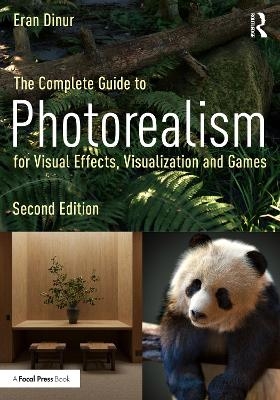
The Complete Guide to Photorealism for Visual Effects, Visualization and Games
Routledge (Verlag)
978-1-032-96655-7 (ISBN)
- Noch nicht erschienen (ca. Mai 2026)
- Versandkostenfrei
- Auch auf Rechnung
- Artikel merken
Emmy award-winning VFX supervisor Eran Dinur offers readers a deeper understanding of the complex interplay of light, surfaces, atmospherics, and optical effects, and then discusses techniques to achieve this complexity in the digital realm, covering 3D, 2D and Generative AI methodologies. In addition, the book features artwork, case studies, and interviews with leading artists in the fields of VFX, visualization, and games. Exploring color, integration, light and surface behaviour, atmospherics, shading, texturing, physically-based rendering, procedural modelling, compositing, matte painting, lens/camera effects, and much more, Dinur offers a compelling, elegant guide to achieving photorealism in digital media and creating imagery that is seamless from real footage. In this second edition, the book explores generative AI as a tool for producing photoreal content. It focuses on various workflows and techniques for controlling the generative process and guiding AI models toward the desired results.
The book’s broad perspective makes this detailed guide suitable for VFX, visualization and game artists and students, as well as directors, architects, designers, and anyone who strives to achieve convincing, believable visuals in digital media.
Eran Dinur is an Emmy and VES award-winning VFX supervisor, artist, and author of The Filmmaker’s Guide to Visual Effects (2024). His film and TV work includes Marty Supreme, The Trial of the Chicago 7, Hereditary, The Greatest Showman, Uncut Gems, The Wolf of Wall Street, Boardwalk Empire, Star Trek, and Iron Man. He is an adjunct professor at the School of Visual Arts and the author of several popular VFX courses at fxphd.com.
Preface to the 2nd Edition
Acknowledgements
Introduction
A Quick Overview of the Book
PART 1: CORE CONCEPTS
Chapter 1: Reality and Photorealism
Human vision and cameras
The similarities
Field of view
Seeing with the mind
The uncanny valley
The detail conundrum
The role of imperfections
Case study: detail and imperfections in man-made objects
The reality of the unreal
Image quality and photorealism
2D and 3D workflows
Chapter 2: Photorealism in Digital Media
Visual Effects
Games
Visualization
Architectural visualization
Product visualization
Case study: Nature in Architectural Renders
Chapter 3: Color
The six-layer approach
Thinking Additive
Subtractive color
Additive color
Hue, saturation, and brightness in RGB
Color operations
Gain (exposure)
Offset
Lift
Gamma
Saturation
Bit depth and dynamic range
The low end
The high end
PART 2: THE REAL WORLD
Chapter 4: Light essentials
Light as waves
Light as particles
Light decay
Direct and indirect illumination
What is "ambient light"?
Chapter 5: Light interaction
Absorption
Reflection and scattering
Specular reflection
Diffuse reflection
Scattering
Subsurface scattering
Transmission and refraction
Albedo
Case study: side by side comparison
Chapter 6: Daylight
The sun
The atmosphere
Reflection and absorption
Atmospheric scattering
Rayleigh scattering
Mie Scattering
Volumetric light
Aerial perspective
Air
Water droplets
Haze
Chapter 7: Nighttime and Artificial Lighting
Natural nighttime light
The Purkinje effect
Artificial lighting
Color temperature
Light intensity
Common lamp types
Light modifiers
Chapter 8: Shadows
Shadow softness
Shadow color
Overlapping shadows
Nested shadows
Contact shadows
Chapter 9: Basic Material Properties
Dielectric materials
Dielectric Diffuse/specular balance
Fresnel effect
Metals
Chapter 10: Lens and Camera Characteristics
Defocus
Depth of field
Bokeh
Lens distortion
Chromatic aberration
Lens flares
Simple glow
Diffraction Spikes
Additional flare elements
Dirt and imperfections
Anamorphic lens flares
Lens bloom
Motion blur
Grain
PART 3: THE CG WORLD
Chapter 11: Rendering and Lighting
From scanline to path tracing
Scanline/rasterized rendering
Raytracing
The challenge of global illumination
Path Tracing
Unbiased vs. biased rendering
Traditional light emitters
Point/spot lights
Directional light
Contemporary light emitters
Area and mesh lights
Image-based lighting
Procedural HDR environments
Photometric lights
Essential strategies for PBR lighting
Scale matters
Natural daytime lighting
Skylight color
Ambient occlusion for outdoor scenes
Daytime interior scenes
Man-made lighting
Case Study: Product Lighting
Chapter 12: Shading
A brief overview of shader evolution
The BRDF Shading model
Diffuse
Dielectric/metallic toggle
Specular
Coat
Transmission
Subsurface scattering
Emission
Additional BRDF features
Other common shaders
Car paint shaders
Volumetric shaders
Hair/fur shaders
Case study: Emulating Plastic Materials
Chapter 13: Texturing
PBR texturing
The linear workflow
Base color map
Roughness map
Metallic map
Bump (normal) map
Ambient occlusion (AO) map
Displacement (height) map
Transparency map vs. opacity map
Texture generation workflows
Image textures
Shooting and prepping photos for texturing
Resolution
Baked-in Lighting
Angle, perspective and focus
Exposure
Optimizing photographs for tiling
Procedural textures
Combining workflows
Chapter 14: Modeling
Modeling for lighting
Procedural modeling
Terrain modeling
Case Study: erosion algorithms in Gaea
Plant modeling
PART 4: THE 2D WORLD
Chapter 15: Integrating 2D Elements
Color matching
Edges: problems and solutions
Matching background luminosity
Spill suppression
Edge and core extractions
Edge reconstruction
Matte-less extractions
Edge blur and edge color
Light wrap
Chapter 16: Integrating CG elements
Compositing with render passes
Lighting passes
Utility passes
Deep compositing
Improving CG in comp
Render resolution
Hazing effect
Highlights bloom
Albedo pass and contrast
Edge treatment
Case Study: Hybrid 2D/3D Matte Painting
Chapter 17: Lighting in 2D
Relighting with color
The challenge of reflections
Fresnel effect
Breaking up reflections
Creating shadows
Shape, angle and stretching
Shadow softness and falloff
Breaking up shadows
Shadow color
Contact and proximity shadows
Case study: matte painting integration in film
Atmospheric Depth
Referencing the footage
Chapter 18: Lens and Camera Effects
Defocus
Lens distortion and chromatic aberration
Lens flares
Motion blur
Grain
Chapter 19: Photorealism with Generative AI
Generative AI for Video vs. stills
Oh, the errors it makes…
A note about Stable Diffusion
Understanding the Diffusion Process
Checkpoint Models
LoRA Models
Other Types of Models
Latent Space and VAE
Denoiser
Text Prompts (Clips)
Generative AI Concepts and Techniques
Aspect Ratio
Resolution
CFG
Denoising steps and schedulers
The Art of Prompting
Prompt Weights
Negative prompts
Prompting for photorealism
Prompting with AI
Split prompts
Inpainting
Inpainting prompts and additional guidance
Using ControlNet Models
Depth ControlNet
Normals ControlNet
A 3D scene in Maya is used to guide the generative process: the depth pass (top left) and normals pass (top right) are fed into ControlNet nodes in InvokeAI (bottom left) to drive the generated image of a modern villa (bottom right)
Canny
OpenPose
IP Adapters
Segmentation
Case Study: Season Changes with ComfyUI and Nuke
Epilogue
| Erscheint lt. Verlag | 13.5.2026 |
|---|---|
| Zusatzinfo | 11 Line drawings, color; 180 Halftones, color; 191 Illustrations, color |
| Verlagsort | London |
| Sprache | englisch |
| Maße | 178 x 254 mm |
| Themenwelt | Kunst / Musik / Theater ► Film / TV |
| Informatik ► Grafik / Design ► Film- / Video-Bearbeitung | |
| Informatik ► Software Entwicklung ► Spieleprogrammierung | |
| ISBN-10 | 1-032-96655-6 / 1032966556 |
| ISBN-13 | 978-1-032-96655-7 / 9781032966557 |
| Zustand | Neuware |
| Informationen gemäß Produktsicherheitsverordnung (GPSR) | |
| Haben Sie eine Frage zum Produkt? |
aus dem Bereich