Yardbirds (eBook)
160 Seiten
Sonicbond Publishing (Verlag)
978-1-78952-467-3 (ISBN)
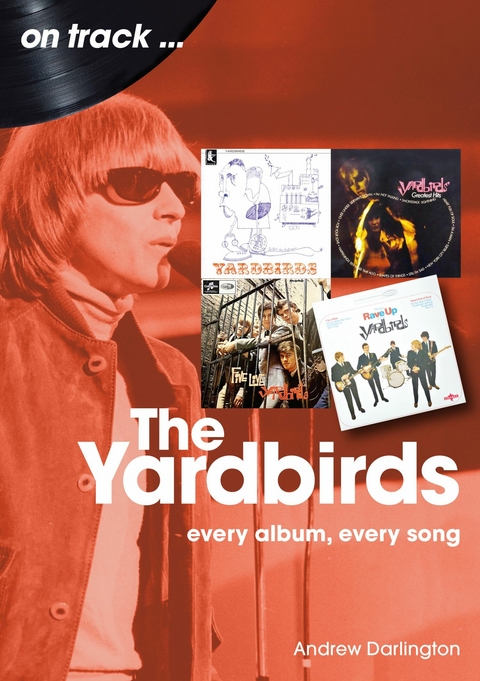
There are many reasons for loving The Yardbirds that go way beyond knowing that the group was the launchpad for three superstar guitarists - Eric Clapton, Jeff Beck and Jimmy Page. The Yardbirds operated as an interdependent unit, from their 'most blueswailing' origins in which they followed The Rolling Stones with a Crawdaddy Club residency, through their series of innovative hit singles - 'For Your Love', 'Evil Hearted You', 'I'm A Man' into 'Shapes Of Things' and beyond, which rivalled The Beatles, The Kinks and The Who at the very bleeding-edge of 1960s rock culture.
The neglected psychedelic classics 'Happenings Ten Years Time Ago' and 'Mister, You're A Better Man Than I' carried their legacy over into the punk era. Their cult albums, Five Live Yardbirds, Roger The Engineer and Little Games, remain highly esteemed and collectable decades later, while their sequence in Michelangelo Antonioni's Blow-Up movie catches the sixties at its most swingingly iconic. Classic rock seldom came as classic as it does with The Yardbirds, now considered stars of heritage rock. This book exhaustively traces the full Yardbirds story track-by-track from first to last, then picks up the narrative as former members become Led Zeppelin, Renaissance, Box of Frogs to the later Yardbirds reunion after the death of frontman Keith Relf.
While interviewing Fairground Attraction for their recent second album, Andrew Darlington found himself discussing favourite biscuits and the correct art of dunking with singer Eddi Reader. As part of UV Pop, Andrew's own lyrics can be found on the CD See You Later, Cowboy. His popular Eternal Assassin Sci-Fi-Fantasy stories are available from Tule Fog Press, taking the chronology from prehistory all the way into the far future. This book follows his other works on The Hollies, The Human League and The Small Faces. He lives in Ossett, West Yorkshire.
There are many reasons for loving The Yardbirds that go way beyond knowing that the group was the launchpad for three superstar guitarists - Eric Clapton, Jeff Beck and Jimmy Page. The Yardbirds operated as an interdependent unit, from their 'most blueswailing' origins in which they followed The Rolling Stones with a Crawdaddy Club residency, through their series of innovative hit singles - 'For Your Love', 'Evil Hearted You', 'I'm A Man' into 'Shapes Of Things' and beyond, which rivalled The Beatles, The Kinks and The Who at the very bleeding-edge of 1960s rock culture. The neglected psychedelic classics 'Happenings Ten Years Time Ago' and 'Mister, You're A Better Man Than I' carried their legacy over into the punk era. Their cult albums, Five Live Yardbirds, Roger The Engineer and Little Games, remain highly esteemed and collectable decades later, while their sequence in Michelangelo Antonioni's Blow-Up movie catches the sixties at its most swingingly iconic. Classic rock seldom came as classic as it does with The Yardbirds, now considered stars of heritage rock. This book exhaustively traces the full Yardbirds story track-by-track from first to last, then picks up the narrative as former members become Led Zeppelin, Renaissance, Box of Frogs to the later Yardbirds reunion after the death of frontman Keith Relf.While interviewing Fairground Attraction for their recent second album, Andrew Darlington found himself discussing favourite biscuits and the correct art of dunking with singer Eddi Reader. As part of UV Pop, Andrew s own lyrics can be found on the CD See You Later, Cowboy. His popular Eternal Assassin Sci-Fi-Fantasy stories are available from Tule Fog Press, taking the chronology from prehistory all the way into the far future. This book follows his other works on The Hollies, The Human League and The Small Faces. He lives in Ossett, West Yorkshire.
A Most Blueswailing History
As esteemed music journalist, Lillian Roxon, pointed out in her Rock Encyclopedia (Grosset & Dunlap, 1971) that ‘in late 1963/early 1964, when the English ‘scene’ was having its birth pangs, The Yardbirds followed The Rolling Stones into the ‘Crawdaddy Club’ (by day the somewhat staid Richmond Cricket Club) as house band.’ This is the root of the legend.
The Rolling Stones had been signed by Dick Rowe to Decca Records, they’d appeared on ABC-TV’s Thank Your Lucky Stars pop show, and by September 1963, their debut single, ‘Come On’, had charted and climbed as high as a UK number 21. Suddenly, they were moving up and out. Suddenly, they were too big to play small venues anymore.
So, there seemed to be a natural progression, a kind of inevitability about the rise of The Yardbirds from that point on. As Roxon says, ‘like the early Stones, they (The Yardbirds) used standard material – Bo Diddley, Isley Brothers, Muddy Waters, Sonny Boy Williamson – always remaining more faithful to the original than the improvisational/variation-prone Stones. This was important at a time when the concept of original material was not as overworked as it was to become in 1967-69. Also, man for man, The Yardbirds were better instrumentalists than The Stones were then.’
Although there had been school-age rock ‘n’ roll groups for the soon-to-be members, such as The Strollers and the Country Gentlemen, the original Yardbirds came out of a parent group called The Metropolis Blues Quartet – sometimes referred to as The Metropolitan Blues Quartet (MBQ). Keith listened to the Modern Jazz Quartet, abbreviated as the MJQ. Formed at the Kingston Art School, it featured Chris Dreja (born in Surbiton on 11 November 1945) on rhythm guitar, Paul ‘Sam’ Samwell-Smith (born in Brentford on 8 May 1943) on bass, Jim McCarty (born in Liverpool on 25 July 1943, but grew up in Teddington) on drums and Keith Relf (born in Richmond, Surrey, on 22 March 1943) doing vocals. They were joined by a very straight-looking crew-cut Eric Clapton, who played lead guitar, and they became The Yardbirds. At that time, the mods – or ‘modernists’ – followed The Who, The Action and The Small Faces, but the more discerning blues purist mods also steered their Vespa and Lambretta scooters towards the ‘Crawdaddy’ to catch The Yardbirds. And although The Yardbirds may well have been better musicians in the 1963-64 period, The Rolling Stones were arguably more charismatic performers, as a result of which their rival fan- factions used to fight it out, rather bitterly at times.
There was also Anthony ‘Top’ Topham (born on 3 July 1947 in Southall) in that formative lineup. His father had a collection of r&b records, which Chris and ‘Top’ were permitted to listen to. ‘I went ballistic when I heard the electric sounds of Jimmy Reed,’ Chris told biographer Alan Clayson, ‘it wasn’t regimented. It was pure emotion, feel. That was probably what shaped me forever – and partly what shaped The Yardbirds, too.’ Topham became written into The Yardbirds legend by quitting – in October 1963 – before they ever got to record, returning to college, and thereby making way for Eric Clapton (born on 30 March 1945), who had been playing with a rival r&b group called The Roosters.
A feature in The Daily Mail on 2 March 1964 claimed the Crawdaddy ‘should be called the southern equivalent of Liverpool’s Cavern. The Rolling Stones started their career there, but now they’ve moved on to higher things. The Yardbirds will soon be whisked away on the elevator of fame. Or so they say.’
In retrospect, the British Blues Boom was a strange and unlikely phenomenon, with skinny white youths earnestly attempting to replicate the sound of old black American blues musicians, learning licks and techniques from old hoarded scratchy records, traded and shared in a kind of cult code with others of a similar ilk.
Mick Jagger met Keith Richards on 17 October 1961 on platform two of Dartford railway station. They recognised each other because they’d both gone to Wentworth Primary School before Jagger went on to study at Dartford Grammar. But more than that, Keith was carrying his guitar and Mick was carrying two albums, Chuck Berry’s Rockin’ At The Hops and The Best Of Muddy Waters. That was the unifying catalyst.
In much the same way, during May 1963, Anthony Topham and his secondary school friend Chris Dreja visited the Railway Hotel located at the junction of Coombe Road and Station Road close by the Norbiton Tube station and Kingston-upon-Thames, where the upstairs music lounge featured trad jazz sessions, with the option for local musicians to jam together during intermissions in the scheduled sets. It was here they happened to meet up with fellow enthusiasts Relf, McCarty and Samwell-Smith. McCarty and Samwell-Smith were still pupils at Hampton Grammar School, where they’d formed a group called The Country Gentlemen – named after a Gretsch guitar favoured by Chet Atkins. They’d even taped a song written by Paul with older brother Brian, called ‘With Love’, which led to a failed audition with EMI’s John Schroeder during the autumn of 1961. Meanwhile, Dreja and Relf were studying at Kingston School of Art.
The new band held their first rehearsals at the Railway Hotel in Norbiton, where – as Chris recalls – the group ‘became very good very quickly.’ They upgraded to the South Western Hotel in Richmond, which became their regular rehearsal spot, close by the old Station Hotel, which had hosted The Rolling Stones’ early Crawdaddy gigs. There were inevitable crossovers. Both bands drew material from the same pool of original r&b artists, although The Yardbirds deliberately selected songs that The Stones neglected. And where The Rolling Stones’ sets were tightly structured, from their beginning, The Yardbirds featured the free-form open-ended ‘Rave-up’ improvisations that were always to be their speciality.
The issue of Fabulous magazine dated 26 September 1964 included a neat little free 52-page book called Alan Freeman’s Mini-Pop Guide, which offered concise pen-portraits of the group members. ‘Vocalist Keith Relf resembles Brian Jones of The Stones with his long fair hair and delicate features. Rhythm guitar is handled by fair-haired Chris Dreja. Paul Samwell-Smith, usually called Sam, is the bass player. Lead guitar is Eric Clapton. Eric wears American Ivy League suits and keeps his hair short, as do all The Birds except Keith. Jim McCarty is the handsome, dark-haired drummer.’ Collectively, ‘their way-out music has the fans hanging from the rafters.’
Oddly, the trad jazz connection is relevant. The post-war austerity years of the uptight conformist 1950s were enlivened by a boom in home-grown Dixieland or New Orleans jazz from which many of the attitudes and cult exclusivity of the blues fraternity would derive. The Chris Barber band were responsible for arranging and promoting the first UK tours for Muddy Waters, the amazing Sister Rosetta Tharpe, Big Bill Broonzy and Sonny Terry & Brownie McGhee, tours that provided British audiences with their first opportunity to see such exotic artists perform live. The Barber band also accidentally kicked off the skiffle craze when Lonnie Donegan’s ‘Rock Island Line’ was spun off from Chris Barber’s 1955 New Orleans Joys 10” LP (Decca LF1198). The single sent shockwaves through a music scene dominated by staid crooners and dreary balladeers, and motivated DIY amateurs across the country to hunt out Huddie ‘Lead Belly’ Ledbetter, Woody Guthrie and Big Bill Broonzy songs to flesh out their scanty repertoire.
The Ken Colyer band had a more hard-line Stalinist approach to what was and what wasn’t ‘authentic’, despite many of the original American jazz musicians themselves enjoying a quite playful openness to their instrumentation and presentation. As a merchant seaman, Colyer had jumped ship in America and played in New Orleans, which granted him a degree of awed authority within trad jazz circles, and it was that quest for ‘purity’ that he transmitted down the genetic timeline to the young blues pretenders.
Cyril Davies and the mighty Alexis Korner both came from trad or skiffle backgrounds but gravitated towards specialising in Chicago-style blues, with Davies’ harmonica technique heavily influenced by hearing Little Walter. To novelist Michael Moorcock in 2024’s The Woods Of Arcady, they ‘passed their lore down to us, the beginnings of what would become The Stones and The Yardbirds.’ It was Korner and Davies who launched what they named the ‘London Blues & Barrelhouse Club’ that ran from 1957 to 1961 at the ‘Round House’ pub in Wardour Street, Soho, which soon became a meeting place for devotees who came to watch performers such as Champion Jack Dupree or Ramblin’ Jack Elliott.
Then, again through Chris Barber’s good graces, their Blues Incorporated band – claimed to be Britain’s first amplified r&b group with Long John Baldry and Art Wood (older brother of Ronnie Wood) – as well as Korner and Davies, got to play regular spots at the ‘Marquee’ before relocating operations by founding the ‘Ealing Club’ in March 1962 as a regular ‘Rhythm & Blues Night’. This rapidly became the focus for numerous embryonic wannabes inspired by their gritty example, numbering future-Animal Eric...
| Erscheint lt. Verlag | 17.10.2025 |
|---|---|
| Reihe/Serie | On Track |
| Sprache | englisch |
| Themenwelt | Kunst / Musik / Theater ► Musik ► Pop / Rock |
| Schlagworte | Eric Clapton • Illusion • Jeff Beck • Jim McCarthy • Jimmy Page • Keith Relf • Renaissance |
| ISBN-10 | 1-78952-467-9 / 1789524679 |
| ISBN-13 | 978-1-78952-467-3 / 9781789524673 |
| Informationen gemäß Produktsicherheitsverordnung (GPSR) | |
| Haben Sie eine Frage zum Produkt? |
 EPUB (Ohne DRM)
Digital Rights Management: ohne DRM
Dieses eBook enthält kein DRM oder Kopierschutz. Eine Weitergabe an Dritte ist jedoch rechtlich nicht zulässig, weil Sie beim Kauf nur die Rechte an der persönlichen Nutzung erwerben.
Dateiformat: EPUB (Electronic Publication)
EPUB ist ein offener Standard für eBooks und eignet sich besonders zur Darstellung von Belletristik und Sachbüchern. Der Fließtext wird dynamisch an die Display- und Schriftgröße angepasst. Auch für mobile Lesegeräte ist EPUB daher gut geeignet.
Systemvoraussetzungen:
PC/Mac: Mit einem PC oder Mac können Sie dieses eBook lesen. Sie benötigen dafür die kostenlose Software Adobe Digital Editions.
eReader: Dieses eBook kann mit (fast) allen eBook-Readern gelesen werden. Mit dem amazon-Kindle ist es aber nicht kompatibel.
Smartphone/Tablet: Egal ob Apple oder Android, dieses eBook können Sie lesen. Sie benötigen dafür eine kostenlose App.
Geräteliste und zusätzliche Hinweise
Buying eBooks from abroad
For tax law reasons we can sell eBooks just within Germany and Switzerland. Regrettably we cannot fulfill eBook-orders from other countries.
aus dem Bereich