


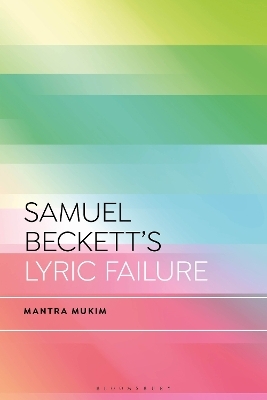
Samuel Beckett's Lyric Failure
Seiten
2026
Bloomsbury Academic (Verlag)
978-1-350-46422-3 (ISBN)
Bloomsbury Academic (Verlag)
978-1-350-46422-3 (ISBN)
- Noch nicht erschienen (ca. September 2026)
- Versandkostenfrei
- Auch auf Rechnung
- Artikel merken
Providing one of the first book-length accounts of Samuel Beckett’s poetry, this book argues how Beckett’s poetry reconfigures lyrical language to mark the emergence of an anti-expressive poetics.
Providing one of the first book-length accounts of Samuel Beckett’s poetry, this work illustrates how Beckett's poetry, and its failures, reconfigure the lyric form. Reading Beckett alongside nineteenth and twentieth century European poets such as Hölderlin, Mallarmé, Rimbaud, Montale, and Apollinaire, the book situates failure in the triangulation of the lyric impulse, subjectivity, and the human voice.
Beckett, in his poems, employs lyric tactics that range from deixis, parataxis, and caesura to specific kinds of timbre, resonances, and punctuations. These tactics situate the poetic voice in the liminal points between life and death, event and non-event, beginning and ending, and more broadly, between expression and failure. The book frames these liminalities under the rubric of 'lyric failure'.
Moving beyond the usual comparisons with his prose and drama, the study highlights failure as a generative force that structures Beckett's anti-expressive poetics.
Providing one of the first book-length accounts of Samuel Beckett’s poetry, this work illustrates how Beckett's poetry, and its failures, reconfigure the lyric form. Reading Beckett alongside nineteenth and twentieth century European poets such as Hölderlin, Mallarmé, Rimbaud, Montale, and Apollinaire, the book situates failure in the triangulation of the lyric impulse, subjectivity, and the human voice.
Beckett, in his poems, employs lyric tactics that range from deixis, parataxis, and caesura to specific kinds of timbre, resonances, and punctuations. These tactics situate the poetic voice in the liminal points between life and death, event and non-event, beginning and ending, and more broadly, between expression and failure. The book frames these liminalities under the rubric of 'lyric failure'.
Moving beyond the usual comparisons with his prose and drama, the study highlights failure as a generative force that structures Beckett's anti-expressive poetics.
Mantra Mukim is a Marie Curie Postdoctoral Fellow (Eutopia-SIF) at CY Cergy Paris Université, France.
Introduction: Beckett’s Lyric
Chapter 1: Survival
Chapter 2: Event
Chapter 3: Timbre
Chapter 4: Endings
Chapter 5: Coda: On Form
Bibliography
| Erscheint lt. Verlag | 17.9.2026 |
|---|---|
| Reihe/Serie | Bloomsbury Studies in Critical Poetics |
| Verlagsort | London |
| Sprache | englisch |
| Maße | 156 x 234 mm |
| Themenwelt | Kunst / Musik / Theater ► Theater / Ballett |
| Geisteswissenschaften ► Sprach- / Literaturwissenschaft ► Anglistik / Amerikanistik | |
| Geisteswissenschaften ► Sprach- / Literaturwissenschaft ► Literaturwissenschaft | |
| ISBN-10 | 1-350-46422-8 / 1350464228 |
| ISBN-13 | 978-1-350-46422-3 / 9781350464223 |
| Zustand | Neuware |
| Informationen gemäß Produktsicherheitsverordnung (GPSR) | |
| Haben Sie eine Frage zum Produkt? |
Mehr entdecken
aus dem Bereich

aus dem Bereich
Poetik eines sozialen Urteils
Buch | Hardcover (2023)
De Gruyter (Verlag)
CHF 83,90


