


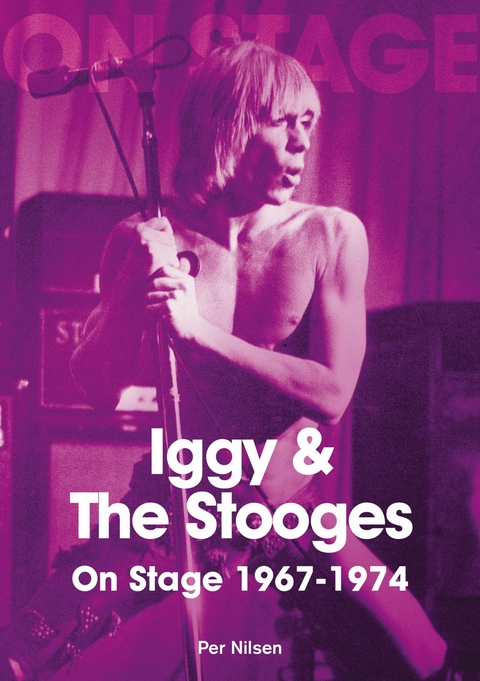
Iggy & The Stooges On Stage: 1967 - 1974 (eBook)
160 Seiten
Sonicbond Publishing (Verlag)
978-1-78952-461-1 (ISBN)
Exploding onto the late 1960s scene, The Stooges were a bunch of misfit Mid-Western delinquents, and their charismatic frontman, Iggy Pop, was a performer extraordinaire. Confrontational and theatrical, this maniacal entertainer was originally joined by the Asheton brothers, Ron and Scott, and Dave Alexander. This lineup delivered two albums of primal, brutal-sounding rock before fracturing. A fortuitous crossing of paths with David Bowie in 1971, however, led to a creative rebirth with a new guitarist in place, James Williamson and before delivering a third album of nihilistic ferocity. However, the album bombed, leaving the band to limp on until 1974 before calling it a day.
During their absence, the band's influential legacy blossomed, and in 2003, the original trio reunited, once again performing under The Stooges banner. The band toured extensively, finally achieving the respect and adulation that had been lacking the first time around. A new album appeared in 2007 before Ron's passing in 2009. Williamson subsequently returned, enabling the band to continue touring and recording before Scott Asheton passed away in 2014 and the band folded.
The Stooges' music has influenced countless other bands, artists and genres, and this book examines the band's enduring musical legacy by taking a fully comprehensive look at all the group's officially recorded output.
The Author
Robert Day-Webb graduated from the University of Birmingham and subsequently worked in the publishing industry for 16 years, undertaking a wide variety of editorial and writing roles. A self-confessed music, movie and TV buff, Robert has previously had two on track books published, by Sonicbond Publishing, focusing on the bands Badfinger and Humble Pie, respectively. Robert has also had several personal reflection essays published in a number of music and TV-related anthology books. He currently lives in Gloucester, UK, with his wife, Marie, and their two children, Joshua and Lauren.
Exploding onto the late 1960s scene, The Stooges were a bunch of misfit Mid-Western delinquents, and their charismatic frontman, Iggy Pop, was a performer extraordinaire. Confrontational and theatrical, this maniacal entertainer was originally joined by the Asheton brothers, Ron and Scott, and Dave Alexander. This lineup delivered two albums of primal, brutal-sounding rock before fracturing. A fortuitous crossing of paths with David Bowie in 1971, however, led to a creative rebirth with a new guitarist in place, James Williamson and before delivering a third album of nihilistic ferocity. However, the album bombed, leaving the band to limp on until 1974 before calling it a day.During their absence, the band's influential legacy blossomed, and in 2003, the original trio reunited, once again performing under The Stooges banner. The band toured extensively, finally achieving the respect and adulation that had been lacking the first time around. A new album appeared in 2007 before Ron's passing in 2009. Williamson subsequently returned, enabling the band to continue touring and recording before Scott Asheton passed away in 2014 and the band folded.The Stooges' music has influenced countless other bands, artists and genres, and this book examines the band's enduring musical legacy by taking a fully comprehensive look at all the group's officially recorded output.The AuthorRobert Day-Webb graduated from the University of Birmingham and subsequently worked in the publishing industry for 16 years, undertaking a wide variety of editorial and writing roles. A self-confessed music, movie and TV buff, Robert has previously had two on track books published, by Sonicbond Publishing, focusing on the bands Badfinger and Humble Pie, respectively. Robert has also had several personal reflection essays published in a number of music and TV-related anthology books. He currently lives in Gloucester, UK, with his wife, Marie, and their two children, Joshua and Lauren.
1967–1968
The Psychedelic Stooges revealed their mind-blowing version of contemporary music on Halloween 1967 in the house of their manager Ron Richardson. Shortly after this, the band moved from Richardson’s house, where they had rehearsed. They continued temporarily in the Asheton basement before a friend of Richardson, Jimmy Silver, took over the managerial reins. ‘They had energy that they needed to get off in some way,’ said Richardson. ‘It was hard being around that energy. It’s like a marriage in some ways. It’s hard enough for two to live together. It’s even harder for five people living together. We parted ways. It was time for me to do something different. They were heading in one direction and I was heading in some other direction. I wanted to get away from it all. It was just like being in debt and deeper in debt. It was not happening as fast as you should think it should happen. Then we went our separate ways.’ Silver found them a farmhouse where they could live and practice together in the communal spirit of the day. Life at the Fun House centered around smoking pot, watching television and rehearsing. There were also healthy periods when Iggy and the guys were served macrobiotic food by Jimmy Silver and his wife, who moved into the band house.
The Psychedelic Stooges public debut was on 20 January 1968, although it was an unannounced performance because they filled in on a bill at the Grande Ballroom in Detroit. The band played over 20 shows at the Grande Ballroom throughout 1968, typically on Saturdays and Sundays, to the extent that they more or less became the house band. Ron Asheton was grateful for the opportunity to play there: ‘We were lucky to have the Grande in full swing; that was a good venue for us. There’d be sympathetic people there. The people that came there were supposedly, most of them, hip, so that’s where the old Psychedelic Stooges really learned how to play. Thank God for the Grande Ballroom, or we wouldn’t have worked.’
Inspired by the emergence of concert venues like The Avalon and The Fillmore in San Francisco, the 2,000-seat Grande Ballroom was the brainchild of ‘Uncle’ Russ Gibb, a high school teacher and local DJ, who acquired the building in 1966. Catering to what Gibb hoped would be hipper and more musically mature crowds, the Grande proved to be the perfect classroom for young Michigan bands learning their craft. Gibb worked closely with John Sinclair, MC5’s manager and key Detroit counterculture figure, and Hugh ‘Jeep’ Holland, an agent, producer and manager of many local bands. According to Silver, ‘Previously there was a club scene, but the clubs weren’t big enough to have enormous amounts of kids attend them. There were a whole bunch of clubs in Ann Arbor, Birmingham, Leonard, etc. But it really wasn’t until Grande Ballroom opened and the ballroom scene got big, that you could have a couple of thousand kids in one place in one night.’
Gibb and Holland brought in national artists and presented local bands as opening acts. The Psychedelic Stooges and all the Detroit and Michigan bands, MC5, The Rationals, SRC, Jagged Edge, The Woolies, Thyme, The Frost, The Amboy Dukes, Third Power, Up and Savage Grace, played the Grande Ballroom regularly, either as headliners or opening for the national acts. Supported by the enthusiastic and loyal Detroit audiences, the locally bred groups often received wilder audience response than the top acts on the bill. ‘There were a lot of great bands there all at once, fighting for the same few gigs, all fighting for national attention,’ Iggy commented. ‘When you’re young and fighting to make it, you’re concerned with every other band on the block.’
While every major US city had some sort of a local music scene, few reached the proportion of Detroit during the 1967-1970 period. The Detroit/Michigan scene was dominated by bands playing hard, energetic rock music, performed with intensity and total belief, which seemed to reflect the industrial factory climate of Detroit. The scene was distant enough geographically and culturally from New York and California to shield it from the pretentiousness that had come to characterize the music of both scenes. Detroit music often had a raw, down-to-earth quality, which contrasted with the more intellectual approach to music typical of many bands from cities like San Francisco and New York.
The early performances by The Psychedelic Stooges were quite experimental, with the band members playing home-made instruments and the music being largely improvised. Silver would occasionally perform with the band: ‘They had a very bizarre collection of instruments. When they first started performing, they had me play this bizarre instrument that they had designed. We took an oil tank that people put outside their houses – not an oil drum – an oil tank that people use to store oil in. It’s got pipes coming out of it everywhere. We took this thing and spray painted it white, took it to Grande Ballroom, and as the finale to the act, we took the PA microphone and dropped it down inside this thing and they had me beat on it with a rubber mallet that is used for body repair on an automobile.’ Iggy described his instruments: ‘I had a Waring blender with about two inches of water in and if you miced that up, you got a great sound like a waterfall, very beautiful, very spacey. I played vacuum cleaner at the first few gigs and then I got an air compressor that was more powerful. If you put your thumb over the end of a vacuum nozzle, you get this real weird wailing sound. I used to wear golf shoes and dance on this piece of galvanized sheet metal too. It was different, you know?’
Iggy performed in whiteface make-up, usually without a shirt: ‘The first few times we literally played just two or three ultra-simplistic pieces, just a couple of chords, a simple riff, and I didn’t use the English language at the time. I’d just say “wooooh...,” anything that came out that I liked, which was pretty to me, beautiful, but only with the understanding that it was the best I could do, and still understanding that it’s the best I can do, and that’s all that it is.’ Ron remembered, ‘Usually we basically just got up there and jammed one riff and built into an energy freak-out until finally we’d broken a guitar or one of my hands would be twice as big as the other and my guitar would be covered in blood. I wouldn’t even realize it at the time I was doing it. A lot of our shows were like that until we started finding little bits that were starting to get more musical.’
Around this time, Iggy became Iggy Pop, as he adopted and adapted the surname of a friend called Jim Popp. Scott Asheton said, ‘Iggy had shaved off his eyebrows. We had a friend named Jim Popp, who had a nervous condition and had lost all his hair, including his eyebrows. So when Iggy shaved his eyebrows, we started calling him Pop.’ Iggy explained, ‘Iggy was a nickname that stuck. And Pop I took from one of my boyhood heroes, Jim Pop, who sniffed so much glue that he lost all his hair. And he would lay around the student union, just laying there, like, with these big frog eyes and looked more like a frog as he lost his eyebrows too. Every time the hair on the top of his head would start to grow back, Scott would go up to him and give him a good hard flick on the top of his head, pup! Like that, and it would fly off again. He fascinated me, fascinating creature.’
At some point in spring 1968, Iggy made the transition to becoming the band’s singer and frontman. At the same time, the band’s experimental format evolved into a more traditional rock band setting, with Ron Asheton playing guitar, Dave Alexander on bass, and Scott Asheton behind a regular drum set. According to Ron, ‘It just all sort of evolved. I said to Iggy one day, “You should just concentrate on singing. Let Dave play the bass, I wanna play guitar”. I originally wanted to play guitar. I had taken guitar lessons for years; three, four years. That’s what I wanted to do anyway. We stopped using the home-made instruments when we realized we wanted to get better and make records.’
While they began employing a more conventional line-up, The Psychedelic Stooges’ music was anything but orthodox or predictable. The songs were usually spontaneous, based around monotonously-repeated riffs and rhythms. Even more remarkable than the music was the live performing style of Iggy. He improvised with vocal sounds and acted out the imagery embodied in songs like ‘I’m Sick’ and ‘Asthma Attack,’ both of which had their roots in Iggy’s breathing problems. The band’s concerts were short and intense, typically lasting between 15 and 25 minutes. From the outset, their set featured few recognizable songs, focusing instead of jams that grew out of guitar or bass riffs. Aside from ‘I’m Sick’ and ‘Asthma Attack,’ two of their earliest songs were ‘Goodbye Bozos’ and ‘The Dance Of Romance.’
The Psychedelic Stooges played many concerts with MC5, and the members of the two bands became close friends, although MC5 considered themselves to be superior musically. MC5’s Dennis Thompson said, ‘At the beginning, I thought they were God-awful musicians. I thought they sucked and they should all get a different job. But they were determined to come up with their own sound and, as we know, Iggy and the boys developed performance art.’ MC5’s Michael Davis said, ‘All they knew what to do was get on stage and be...
| Erscheint lt. Verlag | 7.10.2025 |
|---|---|
| Reihe/Serie | On Stage |
| Sprache | englisch |
| Themenwelt | Kunst / Musik / Theater ► Musik ► Musikgeschichte |
| Kunst / Musik / Theater ► Musik ► Pop / Rock | |
| Schlagworte | Raw Power |
| ISBN-10 | 1-78952-461-X / 178952461X |
| ISBN-13 | 978-1-78952-461-1 / 9781789524611 |
| Informationen gemäß Produktsicherheitsverordnung (GPSR) | |
| Haben Sie eine Frage zum Produkt? |
 EPUB (Ohne DRM)
Digital Rights Management: ohne DRM
Dieses eBook enthält kein DRM oder Kopierschutz. Eine Weitergabe an Dritte ist jedoch rechtlich nicht zulässig, weil Sie beim Kauf nur die Rechte an der persönlichen Nutzung erwerben.
Dateiformat: EPUB (Electronic Publication)
EPUB ist ein offener Standard für eBooks und eignet sich besonders zur Darstellung von Belletristik und Sachbüchern. Der Fließtext wird dynamisch an die Display- und Schriftgröße angepasst. Auch für mobile Lesegeräte ist EPUB daher gut geeignet.
Systemvoraussetzungen:
PC/Mac: Mit einem PC oder Mac können Sie dieses eBook lesen. Sie benötigen dafür die kostenlose Software Adobe Digital Editions.
eReader: Dieses eBook kann mit (fast) allen eBook-Readern gelesen werden. Mit dem amazon-Kindle ist es aber nicht kompatibel.
Smartphone/Tablet: Egal ob Apple oder Android, dieses eBook können Sie lesen. Sie benötigen dafür eine kostenlose App.
Geräteliste und zusätzliche Hinweise
Buying eBooks from abroad
For tax law reasons we can sell eBooks just within Germany and Switzerland. Regrettably we cannot fulfill eBook-orders from other countries.
aus dem Bereich


