


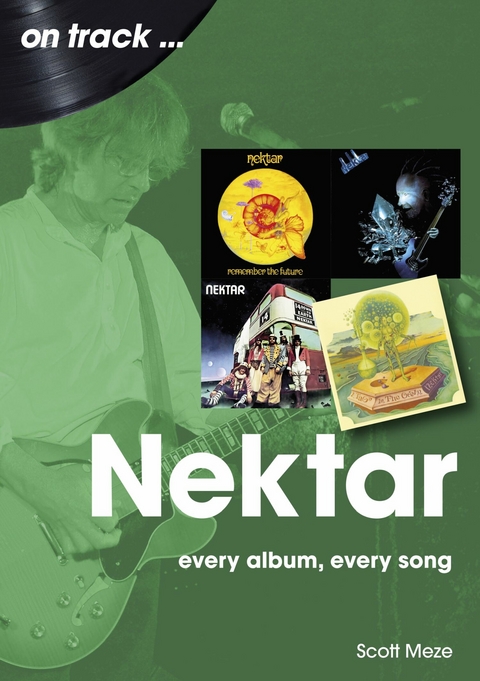
Nektar (eBook)
128 Seiten
Sonicbond Publishing (Verlag)
978-1-78952-457-4 (ISBN)
Of all the British bands that rose to fame in rock's golden age, Nektar remain the most mysterious and least documented. Because they chose to base themselves in West Germany, commentators in their native land tended to overlook them. They're all but excluded from prog's official narrative even though Remember The Future is a classic and one of very few European art rock albums to succeed in the USA.
This book reveals Nektar as much more than just a hit LP, celebrating works of equal stature which seemed to pour effortlessly from the players. Whether you know only the 1970s albums that show the band at the pinnacle, or you've followed their progress under leaders Roye Albrighton and now Derek Moore, here is everything you need to complete your understanding of an intriguing band as distinctive as their artwork and as dazzling as their light show.
It documents how Germany was both boon and bane for the band, how America tore them apart and pulled them back together, and how from Journey To The Centre Of The Eye to The Other Side, Nektar have a vision and a connection that brings them much closer to our lives than any other band of their stature.
Scott Meze's many guises include music critic, science fiction author, and folk horror poet. For him, Nektar are the perfect nexus between the space rock that shifts the animal part of his brain out into the wonder of the universe and the prog that keeps his humanity grounded in the sheer inventive brilliance of our species. Scott abandoned the drippy dells of Somerset, UK, for the steamy swamp of Tokyo decades ago, and neither he nor his wife have a clue what he's doing here.
Of all the British bands that rose to fame in rock's golden age, Nektar remain the most mysterious and least documented. Because they chose to base themselves in West Germany, commentators in their native land tended to overlook them. They're all but excluded from prog's official narrative even though Remember The Future is a classic and one of very few European art rock albums to succeed in the USA.This book reveals Nektar as much more than just a hit LP, celebrating works of equal stature which seemed to pour effortlessly from the players. Whether you know only the 1970s albums that show the band at the pinnacle, or you've followed their progress under leaders Roye Albrighton and now Derek Moore, here is everything you need to complete your understanding of an intriguing band as distinctive as their artwork and as dazzling as their light show.It documents how Germany was both boon and bane for the band, how America tore them apart and pulled them back together, and how from Journey To The Centre Of The Eye to The Other Side, Nektar have a vision and a connection that brings them much closer to our lives than any other band of their stature.Scott Meze s many guises include music critic, science fiction author, and folk horror poet. For him, Nektar are the perfect nexus between the space rock that shifts the animal part of his brain out into the wonder of the universe and the prog that keeps his humanity grounded in the sheer inventive brilliance of our species. Scott abandoned the drippy dells of Somerset, UK, for the steamy swamp of Tokyo decades ago, and neither he nor his wife have a clue what he s doing here.
Introduction
Exiled geographically and spiritually from prog rock’s heartland, Nektar have struggled to gain not just the seat at the high table they deserve but presence in the room. A band that sold extremely well, that was one of the very few British acts to crack America, and that made two of prog’s pinnacle albums during the genre’s golden age can’t even warrant a mention in most books on the subject. Even though Nektar are the epitome of what prog is supposed to represent – including widescreen, multi-textured structures, side-length suites, narrative concept albums, instrumental dexterity, even lyrical depth – they somehow don’t fit the template. This book is an attempt not just to celebrate one of Britain’s most underrated bands but to set the record straight.
The deeper you dive into Nektar, the more singular a band you uncover, and the more of those uneasy prog conventions you realise they bucked or transcended, which may go some way to understanding their ostracism.
For example, Nektar doesn’t fit into the cliché of prog as the music of an upper class or intellectual elite. None of its members used an ability in classical music as their hook, like Keith Emerson or Rick Wakeman. They didn’t claim roots in a prestigious university town or develop art school pretensions – both of which apply to the band they most resemble, Pink Floyd. They didn’t even have the good grace to come from the south. In fact, their origins in the country’s industrial centres of Sheffield, Coventry, and Rotherham place them closer to their two major and acknowledged influences – The Beatles and The Moody Blues – both of which grew fruitful music from barren soil.
Nor did they lord it over the rabble beneath, to use one of the music industry’s gripes against prog. Nektar weren’t funded by a rich patron and they didn’t make much money of their own. The uncomfortable truth about the band, like so many in the genre that we now revere, is that they were all but penniless throughout the golden age.
British they may be, but the fact that Nektar soon abandoned their home country to seek greater reward in continental Europe is also a strike against them for a genre that always found it hard to accommodate artists from outside the home counties. This places them in the same boat as Frank Zappa, say, a man who toured with and admired the band. Zappa’s every musical breath ought to place him at the very heart of the genre. He was earlier, more radical, more establishment, and more transgressive than almost all his British equivalents, but he also struggles to gain space in its texts.
I use ‘texts’ here pointedly. Prog’s fans, among whom I proudly count myself, have the most liberal taste of any musical genre. We don’t just fill our heads with reggae or rap or jazz or folk to the exclusion of all other styles. We listen to and assimilate everything from Opeth to Pauline Oliveros. We’ll switch at a beat from wailing guitars to wailing Bulgarian throat singers. We relish Nektar among all the other flavours in our collections. It’s the rock journalism that grew up in the same golden age that is the problem. Even as prog burgeoned in Britain, its weekly music papers became squalid, self- centred, and cruelly opinionated. It was the press that sidelined bands like Nektar, and so rehabilitating the band means building on the void where their media foundations ought to be.
Most notably, the British music papers never knew where to place the band. Since they were based in West Germany, they must be part of the West German scene, which was characterised as freaky and primitive: shag-haired Neanderthals clanging trance rhythms and blooping rudimentary electronics to accompany blockhead mushroom trips. It hardly mattered that the derogatory label ‘krautrock’ applied only to a small subset of German bands. Nektar, by the dismissive pigeonholing of the age, must be one of them.
Typical of this view was Ian MacDonald, whose three-part overview ‘Krautrock: Germany Calling’ in New Musical Express in December 1972 derided the country’s ‘prevailing anti-cerebral climate’ and the ‘generally rather bovine contemplations’ of bands such as Tangerine Dream. MacDonald called upon a fellow NME journalist, Tony Stewart, to stick the ultimate early- 1970s dagger in: ‘If there were any British bands five years out of date, they’d go down a storm in Germany at the moment.’
In reality, Nektar were the most visible of a rich seam of melodicists on the continent. The correct category is not alongside Ash Ra Tempel and Guru Guru but with bands such as Eloy, Grobschnitt, Novalis, and Triumvirat, France’s Atoll and Gong, Finland’s Wigwam, or even the symphonic bands from Italy. They never forsook hummable tunes, relatable lyrics, and soulful singing. They rewarded listeners with the perfect blend of tightness and extemporisation. Their solos soared without a glimpse of showboating. And their fluidity of sound was less constipated than so many of their British rivals, more daringly open to the flow of the moment, and far warmer in its effect than just about anybody I can think of, save perhaps the more smiling of the Canterbury bands.
Besides, the cross-pollination of British and West German bands was richer and more ingrained than MacDonald’s musical snobbery allowed. The country had been, after all, the staging post for much of the beat boom, had a network of US military bases hungry for Anglo rock’n’roll, tuned greedily into radio stations broadcasting to those troops, and had flowered into the world’s third-largest market. Nektar were only one British band, along with others such as Message and Light Of Darkness, that went there to hone their craft and stayed, finding themselves among a host of West German bands with British members, including Twenty Sixty Six And Then, Abacus, Amon Düül II, Between, Blackwater Park, Epitaph, and Slapp Happy. Then there were UFO, a British band who gained success when they added German guitarist Michael Schenker, and British bands such as Bachdenkel and Sindelfingen that gave themselves German-sounding names.
Moreover, West Germany was open-eared. It was every bit as musically daring and inventive in the early 1970s as Britain and had a far stronger claim to its radicalism. Here was home to Karlheinz Stockhausen, a towering classical composer with impeccable avant-garde credentials who, almost uniquely among the grand old men of his time (he was 42 in 1970), thoroughly embraced psychedelia. Like Can and many others, Nektar visited Stockhausen, listened to Stockhausen, and revered Stockhausen. There was simply nothing remotely similar to inspire young performers in Britain.
Here too were drugs in wild profusion – a landscape of hallucinogens far deeper and less paranoid than Britain’s – and vast stoned audiences that wanted to be transported. Here was a hippie culture that hadn’t been beaten into the dust as it had in Britain and the US, and a youth that had legitimate, achingly evident grounds for rejecting everything its parents’ generation stood for. Here was an infrastructure of outrageously talented producers such as Dieter Dierks in well-equipped studios to cater, without interference, to every crazy fantasy the bands could devise, and labels that, perhaps in sheer incomprehension, were willing to release the results.
It’s no wonder that the British prog bands all gravitated to West Germany. Many found a ready audience there, as did artists such as David Bowie in their wake. Or that West German electronics, inspired by Pink Floyd’s pioneering work with sequencers, became the dominant voice in all of pop.
But if the British press refused to understand you – there were also, naturally, historical reasons for the weeklies to hate West German music – then you weren’t in the press, and if you weren’t in the press, then you’d lost the bulk of your visibility. Why should listeners seek you out? The least we can say is that Britain in the early 1970s was awash with musical talent. If kids didn’t know you, they had plenty of other options to latch onto.
Nektar did themselves no favours by making little attempt to play in the UK for years. But could there have been a living there for a band of their style? They could have slaved, as Hawkwind did, to gain notoriety as a druggy space rock act. They could have struggled on the alternative and free festival scene – to have played Glastonbury Fayre in 1971, for instance, shoving their van through muddy fields to flapping, tarpaulin-covered stages like Mighty Baby or Kingdom Come – but like them, they would surely have remained an also-ran.
West Germany was, in fact, the perfect incubator for a wayward band like Nektar. In his 1996 memoir Rhinos, Winos & Lunatics, Deke Leonard explained exactly what made the country so attractive to Man, a band who were musically very similar to Nektar in their early years:
We had totally given up on Britain. The occasional gig we did there was poorly attended and never covered by the press. Our gig circuit was comprised entirely of Cook’s Ferry Inn, where our average audience was about 15 in number. In Schorndorf, it was 2,000.
Never covered by the press: hence the dismal numbers. Man spent six months in West Germany, living as guests in Nektar’s communal home, and considered staying there permanently. Those six months certainly honed the band’s drug-baked meanderings, making them...
| Erscheint lt. Verlag | 7.10.2025 |
|---|---|
| Reihe/Serie | On Track |
| Sprache | englisch |
| Themenwelt | Kunst / Musik / Theater ► Musik ► Musikgeschichte |
| Kunst / Musik / Theater ► Musik ► Pop / Rock | |
| Schlagworte | Remember The Future • Roye Albrighton |
| ISBN-10 | 1-78952-457-1 / 1789524571 |
| ISBN-13 | 978-1-78952-457-4 / 9781789524574 |
| Informationen gemäß Produktsicherheitsverordnung (GPSR) | |
| Haben Sie eine Frage zum Produkt? |
 EPUB (Ohne DRM)
Digital Rights Management: ohne DRM
Dieses eBook enthält kein DRM oder Kopierschutz. Eine Weitergabe an Dritte ist jedoch rechtlich nicht zulässig, weil Sie beim Kauf nur die Rechte an der persönlichen Nutzung erwerben.
Dateiformat: EPUB (Electronic Publication)
EPUB ist ein offener Standard für eBooks und eignet sich besonders zur Darstellung von Belletristik und Sachbüchern. Der Fließtext wird dynamisch an die Display- und Schriftgröße angepasst. Auch für mobile Lesegeräte ist EPUB daher gut geeignet.
Systemvoraussetzungen:
PC/Mac: Mit einem PC oder Mac können Sie dieses eBook lesen. Sie benötigen dafür die kostenlose Software Adobe Digital Editions.
eReader: Dieses eBook kann mit (fast) allen eBook-Readern gelesen werden. Mit dem amazon-Kindle ist es aber nicht kompatibel.
Smartphone/Tablet: Egal ob Apple oder Android, dieses eBook können Sie lesen. Sie benötigen dafür eine kostenlose App.
Geräteliste und zusätzliche Hinweise
Buying eBooks from abroad
For tax law reasons we can sell eBooks just within Germany and Switzerland. Regrettably we cannot fulfill eBook-orders from other countries.
aus dem Bereich


