


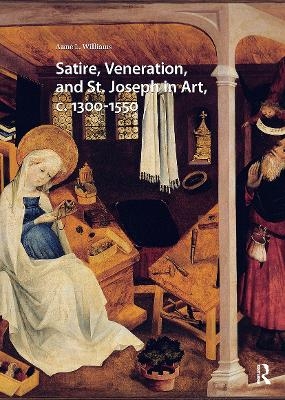
Satire, Veneration, and St. Joseph in Art, c. 1300-1550
Seiten
2025
Routledge (Verlag)
978-1-041-18577-2 (ISBN)
Routledge (Verlag)
978-1-041-18577-2 (ISBN)
This is the first book to reclaim satire as a central component of Catholic altarpieces, devotional art, and veneration, moving beyond humor's relegation to the medieval margins or to the profane arts alone. The book challenges humor's perception as a mere teaching tool for the laity and the antithesis of 'high' veneration and theology.
Satire, Veneration, and St. Joseph in Art, c. 1300.1550 is the first book to reclaim satire as a central component of Catholic altarpieces, devotional art, and veneration, moving beyond humor's relegation to the medieval margins or to the profane arts alone. The book challenges humor's perception as a mere teaching tool for the laity and the antithesis of 'high' veneration and theology, a divide perpetuated by Counter-Reformation thought and the inheritance of Mikhail Bakhtin (Rabelais and His World, 1965). It reveals how humor, laughter, and material culture played a critical role in establishing St. Joseph as an exemplar in western Europe as early as the thirteenth century. Its goal is to open a new line of interpretation in medieval and early modern cultural studies by revealing the functions of humor in sacred scenes, the role of laughter as veneration, and the importance of play for pre-Reformation religious experiences.
Satire, Veneration, and St. Joseph in Art, c. 1300.1550 is the first book to reclaim satire as a central component of Catholic altarpieces, devotional art, and veneration, moving beyond humor's relegation to the medieval margins or to the profane arts alone. The book challenges humor's perception as a mere teaching tool for the laity and the antithesis of 'high' veneration and theology, a divide perpetuated by Counter-Reformation thought and the inheritance of Mikhail Bakhtin (Rabelais and His World, 1965). It reveals how humor, laughter, and material culture played a critical role in establishing St. Joseph as an exemplar in western Europe as early as the thirteenth century. Its goal is to open a new line of interpretation in medieval and early modern cultural studies by revealing the functions of humor in sacred scenes, the role of laughter as veneration, and the importance of play for pre-Reformation religious experiences.
Anne L. Williams is Visiting Assistant Professor of Art History at the College of William & Mary.
Introduction, Chapter One: Humor and Joseph's Hosen: The 'Domestic' Saint and the Earliest Evidence of His Cult Chapter Two: Secular Satire, St. Joseph, and Revealing Hidden Humor Chapter Three: The Vir Facetus, Urbanitas, and the Rhetoric of Humor in the Religious Image Chapter Four: The Miserly Saint: Sanctity, Satire, and Subversion, Conclusion, Select Bibliography, Index.
| Erscheinungsdatum | 03.12.2025 |
|---|---|
| Reihe/Serie | Visual and Material Culture, 1300-1700 |
| Verlagsort | London |
| Sprache | englisch |
| Maße | 174 x 246 mm |
| Gewicht | 470 g |
| Themenwelt | Kunst / Musik / Theater ► Kunstgeschichte / Kunststile |
| ISBN-10 | 1-041-18577-4 / 1041185774 |
| ISBN-13 | 978-1-041-18577-2 / 9781041185772 |
| Zustand | Neuware |
| Informationen gemäß Produktsicherheitsverordnung (GPSR) | |
| Haben Sie eine Frage zum Produkt? |
Mehr entdecken
aus dem Bereich



aus dem Bereich
kleine Kulturgeschichte einer brillanten Allianz
Buch | Softcover (2025)
Iudicium (Verlag)
CHF 33,90


