


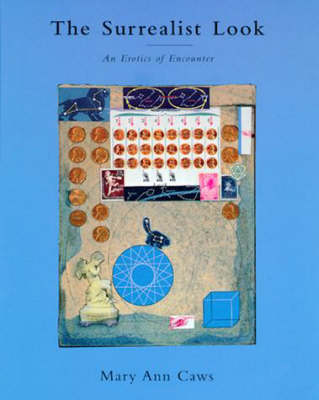
The Surrealist Look
An Erotics of Encounter
Seiten
1999
MIT Press (Verlag)
978-0-262-53162-7 (ISBN)
MIT Press (Verlag)
978-0-262-53162-7 (ISBN)
- Titel ist leider vergriffen;
keine Neuauflage - Artikel merken
In this attempt to make sense of the way surrealism sees, conceals, poses, and stares at its own self and the selves of others, this text examines the decors, games, portraits, transformations, and mirrorings that establish Surrealism's links to Baroque forms of representation.
How we look at Surrealism, how it looks at the objects it encounters, and how it looks from here: all these looks intertwine in this study linking Surrealism and the Baroque. Le look (whatever it might be): you have it or you don't, and Surrealism had it all the way. The emotional charge Surrealism extended to the objects of its encounter makes itself felt as at least philosophically erotic. This charged look determines the atmosphere around the Surrealist text and its encounters--in the world of art and the world it made into art. In this unprecedented attempt to make sense of the way Surrealism sees, conceals, poses, and stares at its own self and the selves of others, Mary Ann Caws examines the decors, games, portraits, transformations, and mirrorings that establish Surrealism's links to Baroque forms of representation." We have to learn to look and to read slowly," Caws writes. Her study begins with an exhortation to take one's time, for the figures in the carpet of this study are not easy, nor do they put one at ease. Take, for example, the self-portraits of Claude Cahum and Dorothea Tanning, Marcel Duchamp's creation Rrose Selavy, the crossing of Andre Breton into Melusine. The constructions of Joseph Cornell and the fashionings by Man Ray meet in a space determined by the architecture of Francois de Nome, Robert Desnos, and Antonin Artaud, pointed at by Marcel Duchamp in his crossings not just with Rrose but with Ludwig Wittgenstein. The game of the Exquisite Corpse has it own erotic charge, and the Baroque vanitas casts its shadow over everything from Cornell's Shadow Boxes to the game of chance. It all ends with two of Picasso's pipes, one by a skull and one in a frame play--signaling, perhaps, that Surrealism looks the way it looks and speaks the Baroque language it speaks because whoever is looking frames it that way.
How we look at Surrealism, how it looks at the objects it encounters, and how it looks from here: all these looks intertwine in this study linking Surrealism and the Baroque. Le look (whatever it might be): you have it or you don't, and Surrealism had it all the way. The emotional charge Surrealism extended to the objects of its encounter makes itself felt as at least philosophically erotic. This charged look determines the atmosphere around the Surrealist text and its encounters--in the world of art and the world it made into art. In this unprecedented attempt to make sense of the way Surrealism sees, conceals, poses, and stares at its own self and the selves of others, Mary Ann Caws examines the decors, games, portraits, transformations, and mirrorings that establish Surrealism's links to Baroque forms of representation." We have to learn to look and to read slowly," Caws writes. Her study begins with an exhortation to take one's time, for the figures in the carpet of this study are not easy, nor do they put one at ease. Take, for example, the self-portraits of Claude Cahum and Dorothea Tanning, Marcel Duchamp's creation Rrose Selavy, the crossing of Andre Breton into Melusine. The constructions of Joseph Cornell and the fashionings by Man Ray meet in a space determined by the architecture of Francois de Nome, Robert Desnos, and Antonin Artaud, pointed at by Marcel Duchamp in his crossings not just with Rrose but with Ludwig Wittgenstein. The game of the Exquisite Corpse has it own erotic charge, and the Baroque vanitas casts its shadow over everything from Cornell's Shadow Boxes to the game of chance. It all ends with two of Picasso's pipes, one by a skull and one in a frame play--signaling, perhaps, that Surrealism looks the way it looks and speaks the Baroque language it speaks because whoever is looking frames it that way.
Mary Ann Caws is Distinguished Professor of English, French, and Comparative Literature in the Graduate School of the City University of New York and Co-director of its Henri Peyre French Institute. She is the author, editor, or translator of more than forty books in the fields of poetry and the avant-garde.
| Reihe/Serie | The Surrealist Look |
|---|---|
| Verlagsort | Cambridge, Mass. |
| Sprache | englisch |
| Maße | 178 x 229 mm |
| Gewicht | 794 g |
| Themenwelt | Kunst / Musik / Theater ► Allgemeines / Lexika |
| Kunst / Musik / Theater ► Kunstgeschichte / Kunststile | |
| ISBN-10 | 0-262-53162-3 / 0262531623 |
| ISBN-13 | 978-0-262-53162-7 / 9780262531627 |
| Zustand | Neuware |
| Informationen gemäß Produktsicherheitsverordnung (GPSR) | |
| Haben Sie eine Frage zum Produkt? |
Mehr entdecken
aus dem Bereich


aus dem Bereich
Vorlesungen März-Juni 1981 : die legendären Vorlesungen des großen …
Buch | Hardcover (2025)
Suhrkamp (Verlag)
CHF 53,90
verlorene Techniken der Alten Meister wiederentdeckt von David …
Buch | Hardcover (2025)
Frölich & Kaufmann (Verlag)
CHF 27,90


