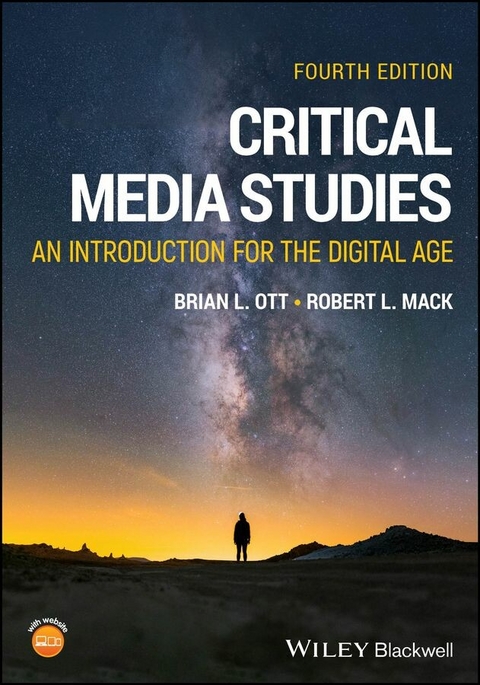
Critical Media Studies (eBook)
895 Seiten
Wiley-Blackwell (Verlag)
978-1-394-24035-7 (ISBN)
Master the critical tools for understanding media in today's fast-evolving digital landscape
Critical Media Studies: An Introduction for the Digital Age provides students with a powerful framework for analyzing the impact of media on knowledge, attitudes, and behaviors. In a world increasingly shaped by digital technologies and personalized information feeds, this leading textbook supplies the theoretical tools and knowledge to understand how media influence individuals and society.
With an interdisciplinary approach, Brian L. Ott and Robert L. Mack explore media's role as a powerful socializing force, addressing the key areas of media technologies, industries, messages, and audiences. Each section delves into distinct critical perspectives, such as Marxist, feminist, and queer analysis, alongside exclusive chapters on pragmatic and erotic approaches.
The fourth edition includes significant updates, including a detailed examination of the ecological impact of digital media and unique engagement with Byung-Chul Han's philosophy. Throughout this edition, revised chapters incorporate contemporary examples, cutting-edge pedagogical features, timely discussion of global trends, and much more.
Ideal for both undergraduate and graduate students, Critical Media Studies is perfect for courses in Media Studies, Communication, and Digital Media programs. Whether in introductory or advanced classes, students will find the text invaluable for fostering critical thinking, media literacy, and informed citizenship. Covering both introductory and advanced topics, it is also a valuable reference for scholars, media professionals, and those in communication-related fields.
BRIAN L. OTT is Distinguished Professor of Media and Communication at Missouri State University. He has been studying the interplay between rhetoric and media for more than 25 years, during which time he has authored more than 100 books, essays, and op-eds addressing the evolving nature of communication in the digital era. His insights have been featured in major publications such as The New York Times and The Washington Post.
ROBERT L. MACK is Associate Teaching Professor and Honors Faculty Fellow at Barrett, the Honors College at Arizona State University. In addition to teaching the college's signature seminar, The Human Event, he also specializes in media studies, rhetoric, and psychoanalysis. His research has been published in respected journals including Journal of the Fantastic in the Arts and The Journal of Religion and Communication.
Master the critical tools for understanding media in today s fast-evolving digital landscape Critical Media Studies: An Introduction for the Digital Age provides students with a powerful framework for analyzing the impact of media on knowledge, attitudes, and behaviors. In a world increasingly shaped by digital technologies and personalized information feeds, this leading textbook supplies the theoretical tools and knowledge to understand how media influence individuals and society. With an interdisciplinary approach, Brian L. Ott and Robert L. Mack explore media s role as a powerful socializing force, addressing the key areas of media technologies, industries, messages, and audiences. Each section delves into distinct critical perspectives, such as Marxist, feminist, and queer analysis, alongside exclusive chapters on pragmatic and erotic approaches. The fourth edition includes significant updates, including a detailed examination of the ecological impact of digital media and unique engagement with Byung-Chul Han s philosophy. Throughout this edition, revised chapters incorporate contemporary examples, cutting-edge pedagogical features, timely discussion of global trends, and much more. Ideal for both undergraduate and graduate students, Critical Media Studies is perfect for courses in Media Studies, Communication, and Digital Media programs. Whether in introductory or advanced classes, students will find the text invaluable for fostering critical thinking, media literacy, and informed citizenship. Covering both introductory and advanced topics, it is also a valuable reference for scholars, media professionals, and those in communication-related fields.
1
Introducing Critical Media Studies
KEY CONCEPTS
CONVERGENCE
CRITICAL CITIZENSHIP
CRITICAL MEDIA STUDIES
DECENTRALIZATION
DIGITIZATION
INDIVIDUALIZATION
INTERACTIVITY
INTERPRETIVIST PARADIGM
MASS MEDIA
MEDIUM
MOBILITY
SIMULATION
SKILL
SOCIALIZATION
THEORY
Many years ago, while listening to live music at a country and western bar with a friend, one of the authors of this book tried Rocky Mountain oysters for the first time. He had never heard of them before and knew nothing about them. But when the basket of deep‐fried treats arrived at the table, he confidently picked one up, dipped it in barbecue sauce, and popped it in his mouth. It was surprisingly chewy, gamey even, and he did not really care for it, especially after his friend revealed that “Rocky Mountain oysters” is just a clever name for bull testicles.
We begin with this brief anecdote because it illustrates one of the chief ways that we learn things, namely through first‐hand experience. We know what some things look, smell, feel, sound, or taste like because we have personally seen, smelled, felt, heard, or tasted them. In short, some of what we know about the world is based on direct sensory experience of our immediate surroundings or environment. You know what “sour” tastes like not because someone explained it to you or because you read about it in a book, but because you tasted something sour. But, as it turns out, direct sensory experience is not the only or even most common way we learn things.
A great deal of what we know we have learned through someone or something else such as a parent, friend, teacher, museum, book, film, television show, online video, or website. Thank goodness for Wikipedia! This type of knowing or learning is mediated, meaning that it was conveyed via some indirect channel or medium. Indeed, the word “medium,” which derives from the Latin word medius, means “middle” or that which comes between two things. Readers of this book who have never tasted Rocky Mountain oysters, for instance, now know that they are chewy, as that information has been mediated by or communicated through the medium of this book.
When we stop to think about all the things we know, we suddenly realize that the vast majority of what we know is mediated. We know things about places we have never visited, historical figures and celebrities we have never met, and practices and behaviors in which we have never personally engaged. Thanks to mediated experiences, we know things about faraway lands, including the deepest depths of the ocean and the furthest reaches of outer space, about Robert Oppenheimer and Taylor Swift, and, thanks to CSI and other crime‐based TV series, we may even know something about conducting a homicide investigation. In fact, in our ever‐connected digital world, when we are faced with something we do not know, we simply look it up. In short, much of what we know we have learned through media.
That having been said, we need to be careful not to assume that the things we learn through media are neutral or unbiased. The media, after all, do more than merely expose us to information, which can itself be accurate or not. They expose us to attitudes, values, and beliefs. In other words, media not only teach us about things but also shape our thoughts and feelings toward those things. As we will see throughout this book, it is impossible for media (any media) to teach us about things in a neutral or unbiased way. That is because media filter the world even when they do not intend to. There is no way for media, as their name suggests, not to “mediate” our experience, and, thus, no way for them not to filter it.
Because much of what we know, as well as much of what we think and feel about what we know, is a product of the media we consume, much of who we are – including our attitudes, values, and beliefs about virtually everything – is a product of the media as well. Before the advent of digital media, we were all largely exposed to similar if not the same media. This created a sort of monoculture that was widely shared. But in a networked digital world, where we are constantly fed targeted information based on computer algorithms that analyze our preferences and behaviors, we no longer share a common mediated experience. This shift carries profound implications for those who interact with media and especially for those who study media. So, we think it is worthwhile to take a moment to explore it in greater detail.
Take politics as an example. All of us have views – even if we are not conscious of them – about the proper role of government in people's lives. Some people believe that government ought to play a central role in our lives. These people tend to support social programs run by the government, as well as government regulations for things like guns. Other people believe that government should play a very limited role in our lives. These people tend to oppose government‐sponsored social programs along with regulations related to gun control. But how do people form these beliefs? Attitudes about government are shaped by, among other things, the media people consume, which is why whether one gets their news from MSNBC or Fox (and which, if either, is recommended by their newsfeed) matters quite a bit.
Nor is what we think and feel about the world limited to things as seemingly removed from daily life as politics. Your attitudes, values, and beliefs about love, romance, sex, marriage, friendship, and family are also shaped and influenced by media. Let us face it, long before you experienced the “feeling” of romantic love for the first time, you already had attitudes about it based on the music you listen to, the films and online videos you watch, and the social influencers you follow. Your whole conception of romantic love is, to some degree, shaped by your media environment, and the content of that environment may look very different than the content in someone else's media environment.
While media increasingly create personalized experiences, they are, nonetheless, a powerful socializing force. Socialization is the process by which social institutions like education, religion, family, and media teach us about the social world and our place in it. Given that the average person consumes more than 12 hours of media every day, there is likely no more powerful socializing force in your life today than media. After all, you do not spend 12 hours a day in school, in church, or interacting with your family. And even if you did, those institutions are themselves heavily influenced by the ideas and information circulating widely in our endlessly mediated world.
In the preceding paragraph, we shared what we take to be a relatively uncontroversial claim: that media are the most powerful socializing force in the world today because they – more so than any other social institution – shape what we know, as well as our thoughts and feelings about what we know. But media do something even more fundamental. In addition to influencing what we know (our thoughts, feelings, and beliefs) through their content, media also shape how we know (the very process of thinking itself) through their form. Media are much more than their messages, which carry meanings and values. They are also technologies, which condition our habits of mind and modes of consciousness. In other words, media convey both information (facts and data) and ideologies (attitudes, values, and beliefs) about the world and create epistemologies (modes of information processing). A post on X, for instance, both conveys a simple message like “here is what I am having for lunch” and, through habitual use, conditions us to think in simple ways. Table 1.1 summarizes media's twofold socialization influence.
Once one understands that media teach us not only what to think but also how to think, then one might conclude that media are not simply the most powerful socializing force in the world today, but that they have likely always been the most powerful socializing force in the world. We recognize this claim may seem counterintuitive and, thus, requires some explanation. After all, are not media a relatively recent invention? The short answer is no. Recall our definition of media as that which “mediates” or filters our experience of the world. This view is consistent with the work of Marshal McLuhan, who famously defined media as, “any extension of ourselves.”1
From this perspective, media would include everything from telescopes, which extend our sense of sight, to clocks, which manage our sense of time. It would also include cave drawings, which, as pictorial representations, mediate the experiences that they depict such as hunting. Not all media are as readily recognizable as telescopes, clocks, and cave drawings, however. One ancient and relatively “invisible” medium is language, and like cave drawings, it also mediates our experience of the world. The words we use for things are not the actual things themselves; they are linguistic representations of those things. The word “hammer” is not an actual hammer (and you cannot pound a nail with the word). As such, absolutely everything that anyone has ever told you is mediated,...
| Erscheint lt. Verlag | 10.9.2025 |
|---|---|
| Sprache | englisch |
| Themenwelt | Kunst / Musik / Theater ► Film / TV |
| Sozialwissenschaften ► Kommunikation / Medien | |
| Sozialwissenschaften ► Politik / Verwaltung | |
| Schlagworte | communication studies textbook • Critical Media Studies • digital media analysis • feminist media studies • mass media critical reception • media analysis textbook • media literacy textbook • media studies erotic analysis • queer theory media studies |
| ISBN-10 | 1-394-24035-X / 139424035X |
| ISBN-13 | 978-1-394-24035-7 / 9781394240357 |
| Informationen gemäß Produktsicherheitsverordnung (GPSR) | |
| Haben Sie eine Frage zum Produkt? |
 EPUB (Adobe DRM)
Kopierschutz: Adobe-DRM
Adobe-DRM ist ein Kopierschutz, der das eBook vor Mißbrauch schützen soll. Dabei wird das eBook bereits beim Download auf Ihre persönliche Adobe-ID autorisiert. Lesen können Sie das eBook dann nur auf den Geräten, welche ebenfalls auf Ihre Adobe-ID registriert sind.
Details zum Adobe-DRM
Dateiformat: EPUB (Electronic Publication)
EPUB ist ein offener Standard für eBooks und eignet sich besonders zur Darstellung von Belletristik und Sachbüchern. Der Fließtext wird dynamisch an die Display- und Schriftgröße angepasst. Auch für mobile Lesegeräte ist EPUB daher gut geeignet.
Systemvoraussetzungen:
PC/Mac: Mit einem PC oder Mac können Sie dieses eBook lesen. Sie benötigen eine
eReader: Dieses eBook kann mit (fast) allen eBook-Readern gelesen werden. Mit dem amazon-Kindle ist es aber nicht kompatibel.
Smartphone/Tablet: Egal ob Apple oder Android, dieses eBook können Sie lesen. Sie benötigen eine
Geräteliste und zusätzliche Hinweise
Buying eBooks from abroad
For tax law reasons we can sell eBooks just within Germany and Switzerland. Regrettably we cannot fulfill eBook-orders from other countries.
aus dem Bereich