


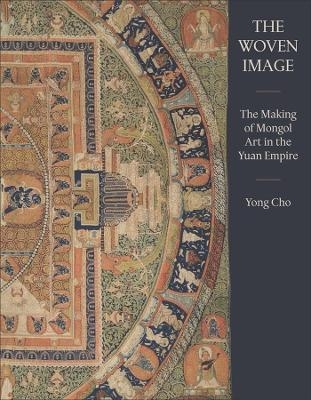
The Woven Image
The Making of Mongol Art in the Yuan Empire
Seiten
2026
Yale University Press (Verlag)
978-0-300-28274-0 (ISBN)
Yale University Press (Verlag)
978-0-300-28274-0 (ISBN)
- Noch nicht erschienen (ca. Juni 2026)
- Versandkostenfrei
- Auch auf Rechnung
- Artikel merken
A groundbreaking study of woven images in the medieval Mongol Yuan Empire and their enduring effect on Chinese and East Asian art
East Asia’s Yuan Empire (1271–1368), led by the nomadic Mongol people and Qubilai Khan (1215–1294), was marked by cross-cultural exchange and significant developments in trade, technology, and infrastructure. The Mongol visual culture, however, has often been ignored or dismissed as insignificant in the operations of the Mongols’ own empire. The Woven Image: The Making of Mongol Art in the Yuan Empire highlights Yuan tapestries and fabric images to demonstrate Mongol visual culture’s impact on the history of Chinese and East Asian art.
Yong Cho gives medieval Mongols historical agency in constructing new forms of cultural expression and visual knowledge, correcting the misperception that members of the Mongol court primarily played a passive role in the realm of the arts. Cho argues that Mongol rulers oversaw radical experimentations with the artform, facilitating trans-Eurasian movement and interactions of artists and techniques, which led to woven tapestries becoming unprecedented objects of political and sacral power. Using the Vajrabhairava mandala—the best-preserved example of woven image produced during the Yuan—as an anchor, the book examines the Mongol court’s weaving as a reflection of the court itself, including the changing hierarchy of art within the court, politics of patronage, ritual function, and the construction of textiles.
East Asia’s Yuan Empire (1271–1368), led by the nomadic Mongol people and Qubilai Khan (1215–1294), was marked by cross-cultural exchange and significant developments in trade, technology, and infrastructure. The Mongol visual culture, however, has often been ignored or dismissed as insignificant in the operations of the Mongols’ own empire. The Woven Image: The Making of Mongol Art in the Yuan Empire highlights Yuan tapestries and fabric images to demonstrate Mongol visual culture’s impact on the history of Chinese and East Asian art.
Yong Cho gives medieval Mongols historical agency in constructing new forms of cultural expression and visual knowledge, correcting the misperception that members of the Mongol court primarily played a passive role in the realm of the arts. Cho argues that Mongol rulers oversaw radical experimentations with the artform, facilitating trans-Eurasian movement and interactions of artists and techniques, which led to woven tapestries becoming unprecedented objects of political and sacral power. Using the Vajrabhairava mandala—the best-preserved example of woven image produced during the Yuan—as an anchor, the book examines the Mongol court’s weaving as a reflection of the court itself, including the changing hierarchy of art within the court, politics of patronage, ritual function, and the construction of textiles.
Yong Cho is assistant professor in the Department of the History of Art at the University of California, Riverside.
| Erscheint lt. Verlag | 23.6.2026 |
|---|---|
| Zusatzinfo | 118 color + b-w illus. |
| Sprache | englisch |
| Maße | 216 x 279 mm |
| Themenwelt | Kunst / Musik / Theater ► Design / Innenarchitektur / Mode |
| Kunst / Musik / Theater ► Kunstgeschichte / Kunststile | |
| ISBN-10 | 0-300-28274-5 / 0300282745 |
| ISBN-13 | 978-0-300-28274-0 / 9780300282740 |
| Zustand | Neuware |
| Informationen gemäß Produktsicherheitsverordnung (GPSR) | |
| Haben Sie eine Frage zum Produkt? |
Mehr entdecken
aus dem Bereich

aus dem Bereich
ein Designer und sein kreatives Vermächtnis
Buch | Hardcover (2023)
Verlag Zabert Sandmann
CHF 24,90
die Geschichte der Mode-Revolutionärin
Buch | Hardcover (2024)
ZS - ein Verlag der Edel Verlagsgruppe
CHF 24,90


