


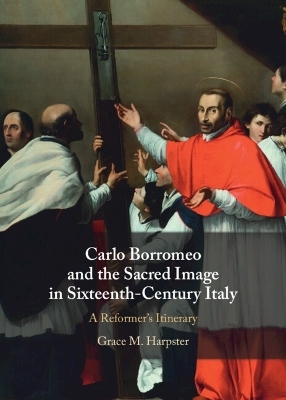
Carlo Borromeo and the Sacred Image in Sixteenth-Century Italy
A Reformer's Itinerary
Seiten
2026
Cambridge University Press (Verlag)
978-1-009-66413-4 (ISBN)
Cambridge University Press (Verlag)
978-1-009-66413-4 (ISBN)
- Noch nicht erschienen (ca. März 2026)
- Versandkostenfrei
- Auch auf Rechnung
- Artikel merken
Exploring the social roles of images in late sixteenth-century Italy, this book demonstrates that the pressures of Catholic reform increased, rather than limited, the authority of the image. It follows the reformer Carlo Borromeo (d. 1584) into a world of powerful images that includes miraculous images, famous altarpieces, and popular prints.
Scholars have long acknowledged that reforms after the Catholic Council of Trent (1545–63) represent a watershed in art history, yet they have failed to agree on whether, and how, they had any effect on art. In this study, Grace Harpster offers new insights on the impact of Catholic reform on early modern art. Exploring the social roles of images in late sixteenth-century Italy, she demonstrates that the pressures of Catholic reform increased, rather than limited, the authority of the image. Harpster approaches the topic through a focus on the zealous, peripatetic reformer Carlo Borromeo (1538–84), who implemented new ways to police and pray to sacred images after Trent. His actions demonstrate that Catholic reformers endorsed the image as a powerful object, truthteller, and miracle-worker. The diverse corpus of images on his itinerary, moreover, reveals the critical role of the sacred image in a formative religious and art historical moment.
Scholars have long acknowledged that reforms after the Catholic Council of Trent (1545–63) represent a watershed in art history, yet they have failed to agree on whether, and how, they had any effect on art. In this study, Grace Harpster offers new insights on the impact of Catholic reform on early modern art. Exploring the social roles of images in late sixteenth-century Italy, she demonstrates that the pressures of Catholic reform increased, rather than limited, the authority of the image. Harpster approaches the topic through a focus on the zealous, peripatetic reformer Carlo Borromeo (1538–84), who implemented new ways to police and pray to sacred images after Trent. His actions demonstrate that Catholic reformers endorsed the image as a powerful object, truthteller, and miracle-worker. The diverse corpus of images on his itinerary, moreover, reveals the critical role of the sacred image in a formative religious and art historical moment.
Grace M. Harpster is Associate Professor of Art History at Georgia State University in Atlanta. Her research, which examines the stakes of the image in early modern Catholicism, has been published in Oxford Art Journal, Religions, and the Journal of Jesuit Studies, among other venues.
Introduction; Part I. Catholic Antiquities: 1. Sacred objects; 2. Portraits as artifacts; Part II. Narrative Experts: 3. Abuses and parerga; 4. Relics and istorie; Part III. Miracle-Working Images: 5. Privileged copies; 6. True effigies and new saints; Epilogue; List of references; Index.
| Erscheint lt. Verlag | 31.3.2026 |
|---|---|
| Zusatzinfo | Worked examples or Exercises |
| Verlagsort | Cambridge |
| Sprache | englisch |
| Gewicht | 500 g |
| Themenwelt | Kunst / Musik / Theater ► Kunstgeschichte / Kunststile |
| Geisteswissenschaften ► Geschichte ► Regional- / Ländergeschichte | |
| ISBN-10 | 1-009-66413-1 / 1009664131 |
| ISBN-13 | 978-1-009-66413-4 / 9781009664134 |
| Zustand | Neuware |
| Informationen gemäß Produktsicherheitsverordnung (GPSR) | |
| Haben Sie eine Frage zum Produkt? |
Mehr entdecken
aus dem Bereich


aus dem Bereich
die Geschichte meiner Urgroßmutter
Buch | Hardcover (2025)
C.H.Beck (Verlag)
CHF 32,15
Träume und Macht : eine Biografie
Buch | Hardcover (2025)
C.H.Beck (Verlag)
CHF 61,60


