


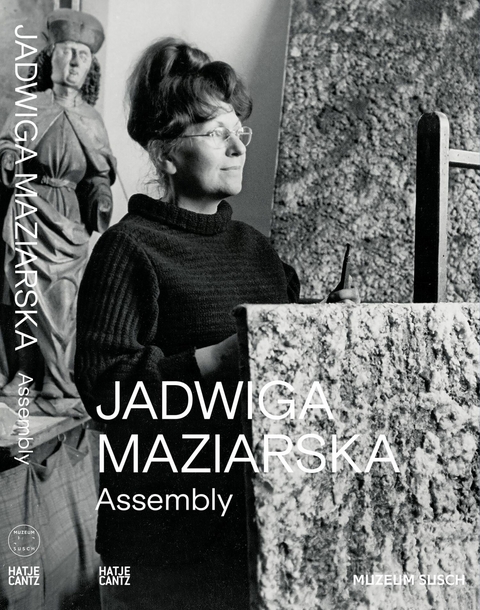
Jadwiga Maziarska: Assembly (eBook)
200 Seiten
Hatje Cantz Verlag
978-3-7757-6153-6 (ISBN)
Cover
Title Page
Contents
Foreword
Jadwiga Maziarska: A Life in Images
Maziarska's Transpositions
Clippings, Postcards, and Sketches
Exhibition Views: Jadwiga Maziarska: Assembly
Jadwiga Maziarska: The Missing Link
"If you work by yourself": On Jadwiga Maziarska after the Critical Reception of Agnes Martin and Eva Hesse
A Paralyzing Encounter
Energy, Matter, and Art: Jadwiga Maziarska in Conversation with Zbigniew Taranienko
Jadwiga Maziarska's Letters to Erna Rosenstein (Selection from 1947–1995)
Author Biographies
Copyright Page
Barbara Piwowarska Jadwiga Maziarska: A Life in Images
● Jadwiga Maziarska was born on July 20, 1913, in Sosnowiec, Poland, as the daughter of Karol Maziarski, a private official, and Helena, née Tabor, who ran a tailor’s shop. She spent her childhood in Sosnowiec, where she graduated from Emilia Plater Girls High School. In 1932, she enrolled in the Faculty of Law and Social Sciences at Stefan Batory University in Vilnius.
Maziarska in the 1930s, mocak Archive, Kraków
● At that time, she became interested in mathematics, philosophy, and psychoanalysis, and considered taking up medical studies. In 1932, she also attended lectures on psychology and psychoanalysis, and, most importantly, the seminars of Maksymilian Rose, a professor in the Department and Clinic of Psychiatry at the University of Vilnius, renowned neurologist and psychiatrist, and an author of the first atlases on the functioning of the brain and its cytoarchitectonics. This period played a crucial role in shaping Maziarska’s research and scientific attitude.
Maziarska started examining the conditions for the possibility for things to appear in the mind. She was also fascinated by anatomy, atomic theories, fission, medical photography, and early techniques for imaging it through the use of new optical devices. It was already at that time that she perhaps started perceiving art as one of the most efficient cognitive tools.
Diagrams of the human telencephalon from Maksymilian Rose’s treatise: Józef Piłsudski’s Brain, Vilnius, 1938
● In 1933–34, disappointed with the “code of law,” Maziarska abandoned her studies at Stefan Batory University in Vilnius and moved to Kraków to take up art studies. She first enrolled in Alfred Terlecki’s Private Painting School. From that time on and until the 1950s, she maintained contact with her uncle Stanisław Maziarski, a professor at the Medical Faculty of Jagiellonian University, as well as a former dean and provost, and a histologist and researcher of the structure of the cell nucleus, who after World War II headed the Department of Histology until his retirement in 1950. She borrowed and received scientific journals and medical diagrams from him, a large collection of which she later kept in her studio in Kraków. Many of the clippings from them would serve in the future as sketches for paintings, a source material she used over decades, even into the 1980s.
Illustration from a medical book, part of Maziarska’s “atlas”—a collection of clippings used as sketches for her future paintings, private collection
● Between 1934 and 1939 she studied at the Faculty of Painting and Sculpture of the Academy of Fine Arts in Kraków, attending the studios of professors associated with Krakovian and Parisian modernism (Sztuka [Art] circle, Académie Julian, and Postimpressionism): Władysław Jarocki, Stefan Filipkiewicz, and Ignacy Pieńkowski, who was supervisor of her graduation in 1939. Drawing was taught by Kazimierz Sichulski and sculpture by Xawery Dunikowski. In 1934, she was married to Jerzy Malina, then a painter and student at the Kraków Academy, for a brief period.
Maziarska’s Index of the Faculty of Painting and Sculpture of the Academy of Fine Arts in Kraków, 1934, private collection
● During her studies, Maziarska was associated with the left. Along with her closest friend, Erna Rosenstein, she belonged to the communist organization at the Academy of Fine Arts, the Society of Workers’ Universities, and the Democratic Party, and cooperated with the Communist Union of Polish Youth. Maziarska maintained contacts with the first Kraków Group (Grupa Krakowska I), the artists’ theater Cricot 1, and the Workers’ Theater in the Railwaymen’s House. She became close friends with Rosenstein, Tadeusz Kantor, and Bogumiła Zbirożanka, who began their studies at the Academy of Fine Arts at the same time, as well as with Artur Sandauer, Jonasz Stern, Berta Grünberg, Sasza Blonder, Kornel Filipowicz, and Maria Jarema. In accordance with the avant-garde postulate of bringing art and life closer together, the “Moderns” generation, to which they all belonged, succumbed to the “Hegelian bite,” as coined by Czesław Miłosz. But they were also shaped by echoes of Nietzsche’s philosophy of life, processualism, Bergson’s Élan vital, Freudian psychoanalysis, as well as atomic theories, Leon Chwistek’s The Limits of Science, Andre Breton’s concept of super-reality and the internal model, and, subsequently, after World War II, phenomenology and existentialism.
Jadwiga Maziarska, on the right, 1930s, Józef Chrobak Archive
● In spring 1937, Maziarska, along with Rosenstein and Tadeusz Brzozowski, took part in a performance, directed by Tadeusz Kantor, of Death of Tintagiles, based on the work by Maurice Maeterlinck, in the “Bratniak” at the Academy of Fine Arts—according to Kantor, “as one of the moving figures and one holding the moving puppet.” It should also be mentioned that Kantor became the most famous Polish artist and director two decades later as head of the postwar theater Cricot 2, creator of his “Theater of Death,” and founding member of the second Kraków Group (Grupa Krakowska II).
Directly after this theatrical experience, in May 1937, antisemitic and anticommunist riots at the Academy of Fine Arts in Kraków escalated, forever changing the life of many students: of both Jewish and non-Jewish origin with communistic beliefs. The incidents during a lecture on the theory of Impressionism by Professor M. Samlicki led to the preparation of a historically significant note by Professor W. Jarocki on May 26, 1937. It resulted in the unmasking of the illegal communist organization at the academy, to which Maziarska also belonged. At that time, her colleagues Stern and Lewicki were arrested and sent to prison.
Tadeusz Kantor, Untitled, drawing for Maurice Maeterlinck’s play The Death of Tintagiles (Puppet Theater, Bratniak of the Academy of Fine Arts in Kraków, 1937), 1938, tempera, paper 18.5 × 28.5 cm, deposited at the National Museum in Kraków, courtesy Cricoteca, Kraków
Tadeusz Kantor, Three Maids (Trzy służące), drawing for Maurice Maeterlinck’s play The Death of Tintagiles (Puppet Theater, Bratniak of the Academy of Fine Arts in Kraków, 1937), 1938, tempera, pastel, and collage on cardboard, 24.5 × 32 cm, deposited at the National Museum in Kraków, courtesy Cricoteca, Kraków
● At the beginning of World War II, Maziarska was in Sosnowiec, where Emil Zegadłowicz, the well-known writer and a friend of the Maziarski family, lived in their house at 4 Mariacka Street from 1940 to 1941. As she reported in letters to Artur Sandauer: “The author of Nightmares (Zmory) lives with us.” In 1941, having been exposed by the Gestapo, which was searching for Zegadłowicz, she successfully escaped and made her way back to Kraków.
In 1941 and 1942, she worked at the Kawiarnia Plastyków (Artists’ Café) as a waitress, alongside Maria Jarema, and cooperated with the underground organization of Fik and Lewiński, for which she was a liaison with the Kraków Ghetto, and produced false identification cards for members of the organization and for the ghetto.
Maziarska during World War II, first on the left, Kawiarnia Plastyków (Artists’ Café), Kraków, 1942, Józef Chrobak Archive
● Between 1942 and 1944, Maziarska worked in Kraków at the Zieliński Brothers Graphic Works and joined the Polish Workers’ Party. Starting in 1944, she collaborated with the conservation studio of Stanisław Pochwalskiin Kraków. It was then that she acquired basic conservation skills, and learned the wax technique, which she later used in her art over decades, combining it with pigments and oil paint.
Pochwalski was an internationally renowned art conservator, descendant of the famous family of academic painters, including Kazimierz Pochwalski, a professor at the Art Academy in Vienna, and portraitist of Franz Josef and the imperial family. Stanisław’s brother, Kasper, was a successful student of Józef Mehoffer, but also of Maurice Denis in Paris. Kasper and Stanisław were well connected with both the Polish and the international artworld, and also co-founded the Zwornik Group in the 1920s. They had a very good atelier space, filled with Pochwalski’s antiquities, in Kraków’s old town at 8 Mikołajska Street. Maziarska later took over the studio and lived there until the end of her life.
Maziarska in Pochwalski’s former and later her studio at 8 Mikołajska Street in Kraków, 1960s, with heaters for wax, which she mixed with pigments, in the foreground; photo: Wacław Nowak, private collection
● At the age of thirty-three, Maziarska made her debut as a member of the Young Artists Group, the so called “Moderns,” along with Rosenstein, Kantor, Nowosielski, and others, all of whom exhibited together from then on. At that time, she created various quasi-figurative compositions— Seamstress (Szwaczka), Musicians (Muzykanci), landscapes, portraits—in an expressive and colorist manner, and, starting in 1946, also post-Cubist compositions and the Surrealist-Dadaist Don Quixote. In 1947, she met Marian Bogusz and Henryk Stażewski in Warsaw, and exhibited at the Young Artists and Scientists’ Club.
Jadwiga Maziarska, Don Quixote, 1946, oil on canvas, composition reminiscent of Erna Rosenstein’s works, Dadaist machines, and Picabia’s Love Parade (Parade Amoureuse), Leon Wyczółkowski...
| Erscheint lt. Verlag | 29.10.2025 |
|---|---|
| Mitarbeit |
Designer: Harald Pridgar |
| Verlagsort | Berlin |
| Sprache | englisch |
| Themenwelt | Kunst / Musik / Theater ► Malerei / Plastik |
| Schlagworte | 20. Jahrhundert • Avantgarde • Bildband • Collagen • Cricot-Theater • Grupa Krakowska • Kunstbuch • Malerei • Materiemalerei • Monografie • polnische Avantgarde • Skulptur |
| ISBN-10 | 3-7757-6153-5 / 3775761535 |
| ISBN-13 | 978-3-7757-6153-6 / 9783775761536 |
| Informationen gemäß Produktsicherheitsverordnung (GPSR) | |
| Haben Sie eine Frage zum Produkt? |
 EPUB (Wasserzeichen)
DRM: Digitales Wasserzeichen
Dieses eBook enthält ein digitales Wasserzeichen und ist damit für Sie personalisiert. Bei einer missbräuchlichen Weitergabe des eBooks an Dritte ist eine Rückverfolgung an die Quelle möglich.
Dateiformat: EPUB (Electronic Publication)
EPUB ist ein offener Standard für eBooks und eignet sich besonders zur Darstellung von Belletristik und Sachbüchern. Der Fließtext wird dynamisch an die Display- und Schriftgröße angepasst. Auch für mobile Lesegeräte ist EPUB daher gut geeignet.
Systemvoraussetzungen:
PC/Mac: Mit einem PC oder Mac können Sie dieses eBook lesen. Sie benötigen dafür die kostenlose Software Adobe Digital Editions.
eReader: Dieses eBook kann mit (fast) allen eBook-Readern gelesen werden. Mit dem amazon-Kindle ist es aber nicht kompatibel.
Smartphone/Tablet: Egal ob Apple oder Android, dieses eBook können Sie lesen. Sie benötigen dafür eine kostenlose App.
Geräteliste und zusätzliche Hinweise
Buying eBooks from abroad
For tax law reasons we can sell eBooks just within Germany and Switzerland. Regrettably we cannot fulfill eBook-orders from other countries.
aus dem Bereich


