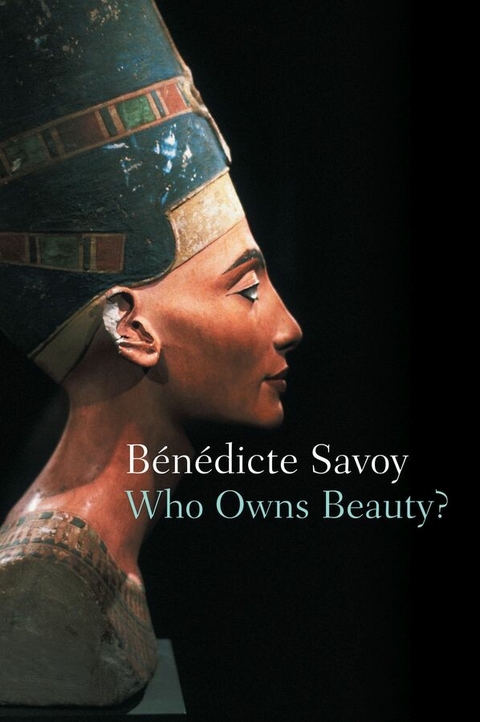
Who Owns Beauty? (eBook)
268 Seiten
Polity (Verlag)
978-1-5095-6862-8 (ISBN)
We can begin to answer these questions, argues Bénédicte Savoy, by examining how these objects actually came to be with us and what their journeys reveal about our history and its violence and asymmetries, both symbolic and real. These objects have no doubt left their mark on the places where they arrived; they have also left wounds that are still raw in the places from which they came. The bust of Nefertiti, the Great Pergamon Altar, The Adoration of the Mystic Lamb, the 'Sistine Madonna', the Old Summer Palace bronze heads, Watteau's L'Enseigne de Gersaint, the 'Bangwa Queen', Klimt's Portrait of Adele Bloch-Bauer, the Benin bronzes: through the journeys of these iconic works, Savoy reflects on desire and domination, on rupture and restitution, and on the profound emotions evoked by beauty when it is laced with the pain of historical loss.
This timely and highly original reflection on beauty, provenance, power, and loss will be essential reading for all those concerned with the preservation and restitution of cultural objects and it will appeal to anyone interested in art, culture, and politics today.
Bénédicte Savoy is Professor of Art History at the Technische Universität Berlin.
Beauty belongs to no one. But what about the objects that museums celebrate as great works of art: to whom do they belong? Do they belong to the places where they originated? To the cultures whose genius they embody? To the enlightened collectors who saw their value and appropriated them? Or to the whole of humanity which has access to them through institutions dedicated to their preservation? And if the latter, how can we justify the fact that some people are able to enjoy what is supposed to be a universally shared heritage while others cannot? We can begin to answer these questions, argues B n dicte Savoy, by examining how these objects actually came to be with us and what their journeys reveal about our history and its violence and asymmetries, both symbolic and real. These objects have no doubt left their mark on the places where they arrived; they have also left wounds that are still raw in the places from which they came. The bust of Nefertiti, the Great Pergamon Altar, The Adoration of the Mystic Lamb, the Sistine Madonna , the Old Summer Palace bronze heads, Watteau s L'Enseigne de Gersaint, the Bangwa Queen , Klimt s Portrait of Adele Bloch-Bauer, the Benin bronzes: through the journeys of these iconic works, Savoy reflects on desire and domination, on rupture and restitution, and on the profound emotions evoked by beauty when it is laced with the pain of historical loss. This timely and highly original reflection on beauty, provenance, power, and loss will be essential reading for all those concerned with the preservation and restitution of cultural objects and it will appeal to anyone interested in art, culture, and politics today.
Introduction
At the end of the eighteenth century, in Paris and London, in Rome and in Weimar, the massive transfer of cultural goods and the real or symbolic violence that underlay them started to provoke reactions of unease in enlightened circles. In France, in 1796, Antoine Chrysostome Quatremère de Quincy attacked the policy of artistic conquests pursued by the French Directoire in Italy, and described in admirable and frequently quoted pages the sacred unity that, in his view, linked the object of art to its original context:
Neither in the midst of the fogs and smokes of London, the rains and muds of Paris, or the ice and snows of Petersburg; neither in the midst of the tumult of the great cities of Europe, nor in the midst of the chaos of distractions of a needy people occupied with mercantile cares, can a profound sensitivity for beautiful things develop.1
In 1812, in England, Lord Byron protested against Lord Elgin’s transfer of the Parthenon friezes from Athens to what he called England’s ‘northern climes abhorr’d’.2 Half a century later, in 1861, Victor Hugo, revolted by the sack of the Summer Palace in Beijing by the French and British armies, denounced in what was to become a famous letter what he viewed as a crime perpetrated by European barbarism against Chinese civilization.3
These indictments have long been forgotten, and we have mainly just remembered the positive side of the accumulation of cultural capital between the eighteenth and twentieth centuries that forged the reputation of European museums. Admittedly, from the gathering and conservation of these objects, from the individual and collective emotions that they aroused, the very idea of a universal heritage was born. But what happened to the places where they were no longer to be found? How can we accept that the symbolic and real capital generated by these museums is not shared? And how can we not want – through museums, thanks to museums, because they have given us so much and we have taken so much – to seek to engage in a fairer policy towards the dispossessed?
Since the history of Europe has for centuries been the painful tale we are so familiar with – a history of enmities between our nations, of bloody wars and discriminations painfully overcome after the Second World War – we have within ourselves the sources and resources to understand the sadness, anger, and hatred of those who – in other tropics, further away, poorer, weaker – were subjected in the past to the ‘intense absorbent power’4 of our continent. Or, to put it simply: today, all we need is a tiny effort of introspection and a slight change in perspective to empathize with them.
Introspection is the effort that consists, collectively, in connecting the objects that our museums hold to the story of their arrival among us and to the people who still live in the places we once occupied. It means we need to show and to think; to consciously embrace the problematic part of our history as Europeans ‘to whom everything came’.5 It means we must pay extreme, constant, and critical attention to the voices of all those who, inside and outside Europe, see heritage as a political issue. In short, we have to try to do what Achille Mbembe encourages us to do:
To move across [a multiplicity of places] as responsibly as possible, as the holders of rights that we all are, but in a total relationship of freedom and, where necessary, of detachment. In this process, one that involves translation, but also conflict and misunderstandings, certain questions will dissolve by themselves. Then, in relative clarity, we will see emerge the demand, if not for a possible universality, at least for an idea of the earth as what is common to us, our common condition.6
Beyond the simple question of the ‘belonging’ of works of art, we must question their history and that of the populations on whose lives they had an impact; we must shed light on the past of these objects and the conditions in which they were exiled; we must expose in all transparency the historical, economic, and cultural contexts from which they were torn, and the way in which they were received in the enlightened and then industrialized Europe that appropriated and transformed them. To answer the question of restitution, we must first look at our history.
How can we justify that some people enjoy a heritage deemed to be universal while others are kept away from it, physically and economically? What are we to think of the fact that the latter are those who have been deprived of their possessions by the violence and asymmetries of history? What can we say to them? What are the consequences of the connection – real or felt, legally fixed or couched as a cultural demand – to these objects of dispute? What view(s) should we take of them? What do our emotions, individual and collective, refer to when faced with these icons of beauty?
Who owns beauty? The question is rhetorical: of course, nobody owns beauty. However, since the eighteenth century and the invention of museums as we know them today, certain objects have been chosen and exhibited precisely for their beauty. As ‘objects of desire’, they have been bought, stolen, hidden, plundered, offered, or donated; they have constantly given rise to germinations, aesthetic fertilizations, and unexpected crystallizations. However, any object ‘transported’ from one place to another also creates a ‘lack’ where it is no longer. This is why we will alternately adopt the gaze of the admirer, whose fascination can lead to the acquisition or confiscation of the work in question, and the point of view of the dispossessed, in whom the feeling of loss, injustice, and absence can lead to indignation and protest. Through objects, a transnational history of Europe and the world emerges, the writing of which engages in a dialogue between disciplines and historiographies.
The challenge of the present work is to think simultaneously about the ‘movement’ of objects, and the very varied conditions under which they were moved: pillage, archaeological excavations, scholarly expeditions, looting, acquisitions, donations, etc. Some of these terms already constitute a political reading of the events. This is particularly apparent when we try to translate them.
In French, spoliation (‘looting’) and pillage (‘pillage’) immediately evoke the period of the German Occupation. On the other hand, we avoid these terms when it comes to describing our own actions: when, under the Revolution and then the Napoleonic Empire, France seized works of art throughout Europe, we tended to speak of ‘artistic conquests’ or ‘revolutionary confiscations’ – gentle euphemisms to legitimize their capture. We therefore note that ‘looting’ tells the point of view of the victims, while ‘artistic conquest’ refers to that of the victors. The Italians still speak today of spoliazioni (‘lootings’) and furti napoleonici (‘Napoleonic thefts’) when referring to the French policy of appropriation in the 1800s. We find equivalent expressions in Spain, the Netherlands, and Luxembourg. Germany, which – like France – has been both victim and perpetrator, uses different terms for each situation: Beutekunst (‘artistic spoils’) to designate the confiscations of works of art carried out by the Red Army in 1945 that were suffered by Germany, and Kunstraub (‘art theft’) for the lootings perpetrated by the Nazi regime against Jewish families. Indeed, in the German-speaking context, almost untranslatable expressions have emerged in recent years to refer to the latter: NS-verfolgungsbedingt entzogene oder kriegsbedingt verlagerte Kulturgüter (‘cultural property removed as a result of Nazi persecution, or displaced due to conflict’). In Russia, the term ‘war trophies’ is still used to refer to the collections of German libraries and museums that remained on the territory of the former USSR after the great wave of restitution to the German Democratic Republic (GDR) in the 1950s. In short, words always convey points of view.
This is why, after working for many years on these issues from a transnational perspective, I propose the more neutral term ‘heritage translocations’ – not to depoliticize the debate, but to include all types of appropriations of works of art and heritage that are carried out to the detriment of the party that is economically or militarily weakest. And I also wish to emphasize the multiplicity of points of view involved. For wars are only one subcategory among others. The dispersion of African art in the nineteenth and twentieth centuries was not only the result of war or colonization. After decolonization, it was also a result of the art market. Nazi lootings and archaeological transfers did not have the same goal or the same meaning: in one case, it was a massive and planned dispossession of works of art, linked to genocide; in the other, a displacement of fragments or entire works by archaeologists for scientific and scholarly reasons. It is not a question of mixing together what are distinct subjects, historical contexts, and dramas. The fact remains that all these objects that were taken, moved, or torn away by force, ultimately arrived in the same place, in the same receptacle – namely, the museums dedicated to the...
| Erscheint lt. Verlag | 3.9.2025 |
|---|---|
| Übersetzer | Andrew Brown |
| Sprache | englisch |
| Themenwelt | Kunst / Musik / Theater ► Kunstgeschichte / Kunststile |
| Kunst / Musik / Theater ► Malerei / Plastik | |
| Schlagworte | Adoration of the Mystic Lamb • African Art • altar of Pergamon • Appropriation • Archaeological discovery • art and aesthetics • art collection • Art Ethics • art history books • Benedicte Savoy's new book • Bénédicte Savoy’s new book • Benin Bronze • books about art • British Museum • Bust of Nefertiti • Civilisation • colonial extraction • Colonialism • Conscience • contemporary museums • Cultural ethics • cultural heritage • cultural responsibility • Decolonisation • Elgin Marbles • empire, British empire, French empire, decolonising the museum • Excavation • history of art • History of Art • Looted Art • Nazi Stolen Art • Neues Museum Berlin • Pillage • politics in the art world • portrait of Adele Bloch-Bauer • Postcolonialism • Reparation • repatriation • Restitution • Sistine Madonna • stolen art • the Bangwa Queen • the Old Summer Palace bronze heads • transfer of heritage • universal heritage • Watteau's L'Enseigne de Gersaint • Watteau’s L'Enseigne de Gersaint • what are the stories behind the art in Western museums • who owns beauty • why is it essential to know the history of colonial artefacts • Woman in Gold film |
| ISBN-10 | 1-5095-6862-X / 150956862X |
| ISBN-13 | 978-1-5095-6862-8 / 9781509568628 |
| Informationen gemäß Produktsicherheitsverordnung (GPSR) | |
| Haben Sie eine Frage zum Produkt? |
 EPUB (Adobe DRM)
Kopierschutz: Adobe-DRM
Adobe-DRM ist ein Kopierschutz, der das eBook vor Mißbrauch schützen soll. Dabei wird das eBook bereits beim Download auf Ihre persönliche Adobe-ID autorisiert. Lesen können Sie das eBook dann nur auf den Geräten, welche ebenfalls auf Ihre Adobe-ID registriert sind.
Details zum Adobe-DRM
Dateiformat: EPUB (Electronic Publication)
EPUB ist ein offener Standard für eBooks und eignet sich besonders zur Darstellung von Belletristik und Sachbüchern. Der Fließtext wird dynamisch an die Display- und Schriftgröße angepasst. Auch für mobile Lesegeräte ist EPUB daher gut geeignet.
Systemvoraussetzungen:
PC/Mac: Mit einem PC oder Mac können Sie dieses eBook lesen. Sie benötigen eine
eReader: Dieses eBook kann mit (fast) allen eBook-Readern gelesen werden. Mit dem amazon-Kindle ist es aber nicht kompatibel.
Smartphone/Tablet: Egal ob Apple oder Android, dieses eBook können Sie lesen. Sie benötigen eine
Geräteliste und zusätzliche Hinweise
Buying eBooks from abroad
For tax law reasons we can sell eBooks just within Germany and Switzerland. Regrettably we cannot fulfill eBook-orders from other countries.
aus dem Bereich