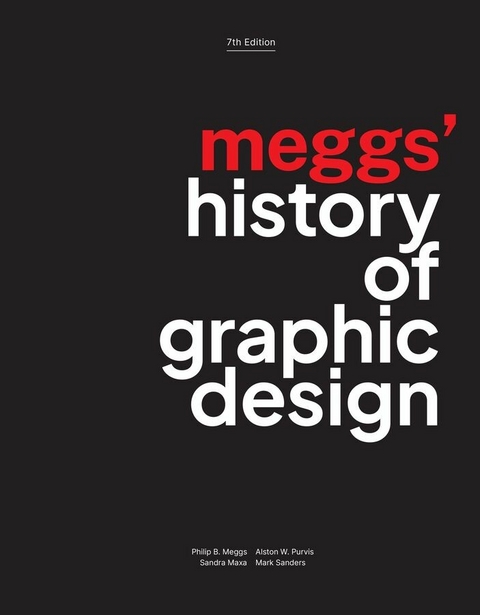
Meggs' History of Graphic Design (eBook)
1998 Seiten
Wiley (Verlag)
978-1-119-74338-5 (ISBN)
The bestselling graphic design reference, restructured by themes to represent motivations for visual communication over time
Graphic designers must have a thorough understanding of the field's rich history in order to inspire and inform their work. Meggs' History of Graphic Design is the industry's original reference, serving as an essential resource for a generation of professionals, scholars, and students. With over 1,400 high-quality images throughout, this visually stunning text guides you through artistic innovators, breakthrough tools and technologies, and significant artifacts that have pushed the boundaries of graphic design throughout its history. The initial publication of this book was heralded as a landmark, and author Philip B. Meggs is credited with significantly shaping the academic field of graphic design.
This new edition foregrounds cultural and social context and elevates diverse voices that are pivotal contributors to the history of graphic design. This seventh edition also covers:
- Artifacts, methods, designers, and events from pre-history to the twenty-first century
- Technological advancements in media and design, from the earliest technologies to recent developments
- A timeline for studying graphic history from multiple viewpoints and culturally diverse approaches
- Updated ancillary materials, including an instructor's manual, key terms, and quizzes
You can't master a field without knowing its history. Meggs' History of Graphic Design presents a diverse, visually spectacular history of graphic design for students and professionals. The updates to this edition solidify its continuing legacy as a must-have in any contemporary graphic design library.
Sandra Maxa (Baltimore, MD) is Director of the Graphic Design Master of Arts program at the Maryland Institute College of Art (MICA) where she teaches design theory, process and typography. Her research investigates the connection between mapping, narrative and culture. She has also taught at Pratt Institute, Parsons The New School for Design, and Rutgers University - Newark.
Mark Sanders (Baltimore, MD), has taught typography, systems, and interaction design with research focused on reinventing typographic and digital frameworks to address the expanding roles and mediums of design. He has taught at Maryland Institute College of Art (MICA), Pratt Institute, Parsons The New School for Design, and Rutgers University - Newark.
As partners at the multi-disciplinary studio Q Collective, Sandra and Mark produce work that reflects a deep interest in identity, interactivity, history and visual culture. Sandra and Mark are also co-authors of the 6th and 7th editions of Typographic Design: Form and Communication.
The bestselling graphic design reference, restructured by themes to represent motivations for visual communication over time Graphic designers must have a thorough understanding of the field s rich history in order to inspire and inform their work. Meggs History of Graphic Design is the industry s original reference, serving as an essential resource for a generation of professionals, scholars, and students. With over 1,400 high-quality images throughout, this visually stunning text guides you through artistic innovators, breakthrough tools and technologies, and significant artifacts that have pushed the boundaries of graphic design throughout its history. The initial publication of this book was heralded as a landmark, and author Philip B. Meggs is credited with significantly shaping the academic field of graphic design. This new edition foregrounds cultural and social context and elevates diverse voices that are pivotal contributors to the history of graphic design. This seventh edition also covers: Artifacts, methods, designers, and events from pre-history to the twenty-first century Technological advancements in media and design, from the earliest technologies to recent developments A timeline for studying graphic history from multiple viewpoints and culturally diverse approaches Updated ancillary materials, including an instructor s manual with discussion questions and a guide for transitioning from the previous edition You can t master a field without knowing its history. Meggs History of Graphic Design presents a diverse, visually spectacular history of graphic design for students and professionals. The updates to this edition solidify its continuing legacy as a must-have in any contemporary graphic design library.
1
Timeline
Pre‐History and the Origins of Writing
75,000 BCE–500 BCE
c. 75,000 BCE
Crosshatch patterns are engraved on silcrete flake stones at Blombos Cave in South Africa
c. 15,000–10,000 BCE
Cave paintings are made at Lascaux in France
c. 3500 BCE
The Sumerians settle in Mesopotamia
c. 3100 BCE
Early Sumerian pictographs are pressed into clay tablets
c. 3100 BCE
Hieroglyphics are used in Egypt
c. 2600 BCE
The pyramids at Giza, in Egypt, are completed
c. 2500 BCE
Egyptians begin to make papyrus
c. 2500 BCE
Cuneiform tablets are used for accounting
c. 2000 BCE
Early Cretan pictographs and alphabet‐like forms are inscribed on the Phaistos Disk
c. 1800–1400 BCE
Stonehenge is constructed in England
c. 1792–1750 BCE
Law Code of Hammurabi is written
c. 1500 BCE
The Phoenician alphabet with 22 characters is developed
c. 1500 BCE
Hinduism is brought to India by nomads
c. 1400–1100 BCE
Chinese “bone and script” writing is developed
1447 BCE
The exodus of the Jews from Egypt begins
c. 1420 BCE
The Papyrus of Ani includes hieroglyphic writing
c. 1000 BCE
Mayan culture begins in Mesoamerica
c. 850 BCE
Aramaic script is developed
776 BCE
The first Olympic Games are held
551 BCE
Confucius is born in China
540 BCE
The first public library is established in Athens, Greece
c. 528 BCE
Siddhartha Gautama becomes the Buddha
Writing, Paper, and Printing
500 BCE–1450
447–432 BCE
The Parthenon is built in Athens, Greece
c. 400–200 BCE
Mayan writing appears in mural paintings in San Bartolo, Guatemala
c. 400–300 BCE
Greek manuscript writing develops
300 BCE
Euclid establishes the foundations of geometry in his treatise, Elements
c. 200 BCE
Brahmi, a syllabic writing system, is developed in India
c. 221 BCE
Construction of the Great Wall of China begins
c. 197 BCE
The Rosetta Stone includes hieroglyphics and Demonic and Greek scripts
c. 160 BCE
Parchment, made from animal skins, is used for manuscripts in Greece
51 BCE
Cleopatra becomes queen of Egypt
c. 79 CE
Brushes are used for mural writing in Pompeii, Italy
105
Paper is invented in China
c. 200–500
Roman square capitals and rustic capitals are in use
c. 300
In China, chops are used as identifying seals
325
Emperor Constantine moves the Roman capital to Constantinople
400
Nsibidi, an African pictogram‐based writing system, is developed
c. 425
The Vatican Vergil, the earliest illuminated Christian manuscript is created
c. 500
Early Arabic script is in use
c. 500
Uncials, a modification stemming from Old Roman Cursive, are rounded
570
Muhammad is born
c. 751
Arabs learn papermaking from Chinese prisoners
800
Charlemagne is crowned emperor of the Holy Roman Empire
800–1100
Caroline miniscules are used throughout Europe
c. 800
The Book of Kells is created in a Celtic monastery
868
The Diamond Sutra, the earliest woodblock manuscript, is printed in China
c. 1000
Naskhi becomes the dominant Arabic script
c. 1040
Movable type is invented in China
1095
The First Crusade begins
1163
Construction of Notre‐Dame Cathedral begins in Paris, France
1202
Fibonacci introduces Arabic numerals to the West
1215
The Magna Carta grants constitutional liberties in England
c. 1265
Marco Polo travels to China
1276
A paper mill is established in Fabriano, Italy
c. 1325
Tenochtitlan, capital of the Aztec empire, is founded in modern Mexico City (illustration by Diego Rivera)
1377
Jikji, a Korean Buddhist document, is printed with movable metal type
c. 1387
Geoffrey Chaucer begins writing The Canterbury Tales
c. 1400
Block printed playing cards are the first printed matter that is accessible to the working class
1400–1500s
Khipu, or "talking knots," are used by the Inca in Peru for recordkeeping and sending messages
c. 1413–16
Les Très Riches Heures du Duc de Berry, an illuminated manuscript with ornate visual organization, is created in France
1431
Joan of Arc is made a martyr
1446
Hangul, the Korean alphabet, is developed
c. 1450
Johannes Gutenberg prints with movable type in Germany
Renaissance Design and Modern Typography
1450–1800
1465
Conrad Sweynheym and Arnold Pannartz introduce the printing press to Italy
1470
Nicolas Jenson creates a legible roman typeface
1484
Sandro Botticelli paints The Birth of Venus
1493
Anton Koberger publishes the Nuremberg Chronicles, a history of the world with complex woodcut illustrations
1494
Aldus Manutius establishes the Aldine Press in Venice, Italy to publish works by Greek and Roman thinkers
1501
Francisco Griffo designs and cuts the first italic typeface
1503
Leonardo da Vinci paints the Mona Lisa
1517
Martin Luther launches the Reformation
1520
The Spanish colonize the Aztecs
1529
Geoffroy Tory publishes Champ Fleury, with instructions for constructing letters of the Latin alphabet
c. 1530
The first Qur'an is printed in Venice, Italy
c. 1535
Claude Garamond establishes an independent type foundry (Typeface: Grecs du roi)
1543
Nicolaus Copernicus publishes the theory of the heliocentric solar system
1546
Jacques Kerver's edition of Poliphili uses three sizes of type, italic, and capitals, bringing variety to page design
1538
The first printing press is established in Mexico
1558
Elizabeth I is crowned in England
1565
The graphite pencil is invented
1594
Shakespeare writes Romeo and Juliet
1608
Virgin of Guadalupe cards are printed in Mexico
1648
The Taj Mahal Palace in India is completed
1682
Ukiyo‐e artists embrace woodblock prints in Japan
1689
Peter the Great becomes czar of Russia
1690
The first paper mill in America is established near Philadelphia
1692
Louis XIV commissions the Romain du Roi, a new typeface designed by scientific principles
1700
The Selling of Joseph, the first antislavery pamphlet is published in North America
1721
Johann Sebastian Bach composes the Brandenburg Concertos
1734
William Caslon designs Old Style typefaces whiich are used throughout Europe
1737
Pierre‐Simon Fournier le Jeune standardizes type sizes
1750s
John Baskerville creates Transitional typefaces
1769
James Watt patents the steam engine
1776
The American Declaration of Independence is signed
1784
Francois Didot creates a true Modern style typeface
1789
George Washington becomes the first U.S. president
1789
The French Revolution begins
1792
Mary Wollstonecraft publishes A Vindication of the Rights of Women
1796
Aloys Senefelder invents lithography
The Industrial Revolution
1800–1899
1800
The Library of Congress is established in Washington, D.C.
1803
Robert Thorne designs the first fat‐face type
1804
Napoleon is crowned emperor
1808
Ludwig van Beethoven writes his "Fifth Symphony"
1809
Sequoyah begins work on a Cherokee syllabary in North America
1814
The first steam‐powered press is used in London
1816
The first sans‐serif typeface is shown in a specimen book produced by William Caslon IV
1818
Manuale Tipograpfico, the work of Giambattista Bodoni, is published
1818
Frankenstein by Mary Shelley is published
1820s
New manufacturing...
| Erscheint lt. Verlag | 3.9.2025 |
|---|---|
| Sprache | englisch |
| Themenwelt | Kunst / Musik / Theater ► Design / Innenarchitektur / Mode |
| Technik ► Architektur | |
| Schlagworte | art history textbook • design history • Digital Art History • Graphic Design • graphic design book • graphic design history • Graphic History • logo art • Logo Design • logo modernism • meggs • meggs history graphic design • typography • typography textbook |
| ISBN-10 | 1-119-74338-9 / 1119743389 |
| ISBN-13 | 978-1-119-74338-5 / 9781119743385 |
| Informationen gemäß Produktsicherheitsverordnung (GPSR) | |
| Haben Sie eine Frage zum Produkt? |
 EPUB (Adobe DRM)
Kopierschutz: Adobe-DRM
Adobe-DRM ist ein Kopierschutz, der das eBook vor Mißbrauch schützen soll. Dabei wird das eBook bereits beim Download auf Ihre persönliche Adobe-ID autorisiert. Lesen können Sie das eBook dann nur auf den Geräten, welche ebenfalls auf Ihre Adobe-ID registriert sind.
Details zum Adobe-DRM
Dateiformat: EPUB (Electronic Publication)
EPUB ist ein offener Standard für eBooks und eignet sich besonders zur Darstellung von Belletristik und Sachbüchern. Der Fließtext wird dynamisch an die Display- und Schriftgröße angepasst. Auch für mobile Lesegeräte ist EPUB daher gut geeignet.
Systemvoraussetzungen:
PC/Mac: Mit einem PC oder Mac können Sie dieses eBook lesen. Sie benötigen eine
eReader: Dieses eBook kann mit (fast) allen eBook-Readern gelesen werden. Mit dem amazon-Kindle ist es aber nicht kompatibel.
Smartphone/Tablet: Egal ob Apple oder Android, dieses eBook können Sie lesen. Sie benötigen eine
Geräteliste und zusätzliche Hinweise
Buying eBooks from abroad
For tax law reasons we can sell eBooks just within Germany and Switzerland. Regrettably we cannot fulfill eBook-orders from other countries.
aus dem Bereich