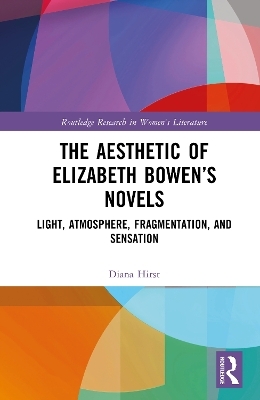
The Aesthetic of Elizabeth Bowen’s Novels
Routledge (Verlag)
978-1-032-65216-0 (ISBN)
This is the first monograph to evaluate Elizabeth Bowen’s ‘verbal painting’, and the first to acknowledge the influence of the East Kent landscape in her novels. Drawing on the work of critics and on Bowen’s own essays and articles, Hirst introduces Bowen to the reader, outlining the range of her literary work and elaborating on Bowen’s advice that the reader needs to work at understanding her prose. She examines Bowen’s use of light and the eye from the perspective of neuropsychology, before considering the importance to Bowen of place. She discusses her ‘verbal painting’, drawing parallels with different genres (Post-Impressionism, Surrealism, Futurism, Collage) and artists (Paul Cézanne, Pierre Bonnard, Edouard Vuillard, Giorgio de Chirico, Umberto Boccioni, Paul Nash), and the films of French Left Bank Cinema directors (Alain Resnais, Jean Cocteau). Finally, using the neologism ‘dyslocution’ for Bowen’s fragmented syntax, she suggests this has been influenced by French syntax and by poetic techniques, all of which combine in a Cubist style.
Brought up in East Kent, Diana Hirst moved to London in the Swinging Sixties where she worked as PA to the Head of BBC World Service, Bob Gregson. Her late husband’s work then took them for two years to France, where he was a lecteur at the University of Tours. On their return she spent time bringing up their two sons before embarking on management work in the world of classical music. She was Director of the award-winning Mecklenburgh Opera for six years before freelancing, concentrating on event management and public relations: for this work she was dubbed the Thinking Person’s PR Consultant. On retirement, she turned first to writing poetry, often about the Kent landscape, becoming Deal and Dover Poet of the Year in 2008, before a chance encounter with Elizabeth Bowen’s work led to her study of the novelist. An Advanced Diploma at the Institute of Continuing Education, University of Cambridge, supervised by Dr Trudi Tate, was followed by a PhD at Canterbury Christ Church University, supervised by Dr Andrew Palmer and Dr Stefania Ciocia. Subsequently she has published a number of short essays and presented papers at Conferences, and a chapter, ‘Experimenting with Tradition: Elizabeth Bowen’s Literature Laboratory’, has appeared in Tradition and Experimentation in Irish Literature since Modernism (Hungarian Journal of English and American Studies Books New Series).
Foreword
Dr Heather Ingman
Preface
Acknowledgements
Abbreviations
Introduction
A brief autobiography
Bowen in context
Chapter 1
‘The Process of Reading is Reciprocal’
Genesis: Genesis of Ideas and Influences
Process: Pattern and Plot; Scene; Characters; Technique
An Experimental Writer
The Reader Must Take Responsibility
Chapter 2
By the Light of her Eye
Light: Reflection and Refraction; Light and its Cousins in the Novels
The Eye: A Writer’s Eye; Characters and Their Eyes; Ocular Communication; Houses have Eyes
Chapter 3
‘Place Feeling’
Origins of the Importance of Place for Bowen: Physical Place: Geology; Architectural Space; Archaeology; The Mobile Place; Atmosphere: The Liminal Place
Place in the Novels: The Early Novels; The 1930s Novels; The War-time Novel; The Post-War Novels
Chapter 4
An Artist in her Studio
Affinity with genres and artists
Patterns, Shapes, Geometry of Relationships, Puzzles: Pattern; The Shape of the Novel; The Geometry of Relationships; Puzzles
Two-dimensional work: Post-Impressionism; Surrealism; Futurism; Mirroring; Landscape; Chiaroscuro
Three-dimensional work: Assemblage; Sculpture; Objet Trouvé
Chapter 5
‘I Collect Scraps to Make Scrap Screens’
Fairy Tales
Children’s Stories
Biblical and Liturgical Collage
Literary Collage
Chapter 6
‘A Camera at the Tip of Her Pen’
The Techniques
The 1930s Novels
Developments During and After the Second World War
War-time Short Stories: The Heat of the Day
The Final Novels
Chapter 7
Dyslocution: Casting off the Superstition of Syntax
Style
Dyslocution: Futurism; Fragmentation; Obliteration; Characteristics of Bowen’s Syntax
The Influence of French
Poetic Techniques
Cubism
Envoi
Index
| Erscheinungsdatum | 04.12.2025 |
|---|---|
| Reihe/Serie | Routledge Research in Women's Literature |
| Verlagsort | London |
| Sprache | englisch |
| Maße | 152 x 229 mm |
| Gewicht | 650 g |
| Themenwelt | Kunst / Musik / Theater ► Kunstgeschichte / Kunststile |
| Geisteswissenschaften ► Sprach- / Literaturwissenschaft ► Anglistik / Amerikanistik | |
| Geisteswissenschaften ► Sprach- / Literaturwissenschaft ► Literaturwissenschaft | |
| ISBN-10 | 1-032-65216-0 / 1032652160 |
| ISBN-13 | 978-1-032-65216-0 / 9781032652160 |
| Zustand | Neuware |
| Informationen gemäß Produktsicherheitsverordnung (GPSR) | |
| Haben Sie eine Frage zum Produkt? |
aus dem Bereich