


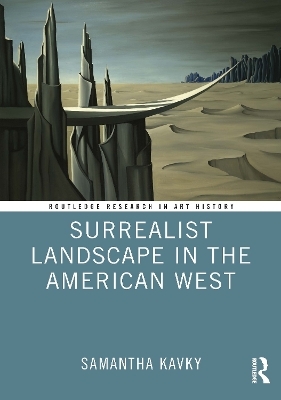
Surrealist Landscape in the American West
Seiten
2025
Routledge (Verlag)
978-1-032-36850-4 (ISBN)
Routledge (Verlag)
978-1-032-36850-4 (ISBN)
Focusing on the period of the Second World War, this book explores the emergence of surrealist landscape as a genre throughout the period of surrealist exile in the Americas.
By positioning surrealist landscape within the formal, iconographic, and theoretical strategies of the larger movement as well as within the historical context of war and exile, the volume encompasses critical and historical discussions from a broad spectrum of interrelated fields including psychology, anthropology, military history, art history, and ecocriticism. Central to this book are the landscapes of Max Ernst who, along with transplanted European surrealists, Wolfgang Paalen and Kurt Seligmann, revitalized a Romantic image of the American landscape and its indigenous peoples, divorced from, and as a challenge to, European nationalism. American surrealists Dorothea Tanning and Kay Sage challenged traditional analogies between the earth and the female body retained by their male partners. Other European surrealists such as Salvador Dalí and Yves Tanguy perpetuated the appropriation of the desert as a generic space for visionary projection.
The book will be of interest to scholars working in art history, surrealism, ecocriticism, American studies, and feminist studies.
By positioning surrealist landscape within the formal, iconographic, and theoretical strategies of the larger movement as well as within the historical context of war and exile, the volume encompasses critical and historical discussions from a broad spectrum of interrelated fields including psychology, anthropology, military history, art history, and ecocriticism. Central to this book are the landscapes of Max Ernst who, along with transplanted European surrealists, Wolfgang Paalen and Kurt Seligmann, revitalized a Romantic image of the American landscape and its indigenous peoples, divorced from, and as a challenge to, European nationalism. American surrealists Dorothea Tanning and Kay Sage challenged traditional analogies between the earth and the female body retained by their male partners. Other European surrealists such as Salvador Dalí and Yves Tanguy perpetuated the appropriation of the desert as a generic space for visionary projection.
The book will be of interest to scholars working in art history, surrealism, ecocriticism, American studies, and feminist studies.
Samantha Kavky is Associate Professor of Art History at Penn State Berks, USA.
Introduction 1. Surrealist Landscape as a Genre, No Man’s Land 2. Surrealist Landscape between the Wars: Nature Devouring 3. Romantic Transplants: Surrealist Landscape in the Americas in the 1940s 4. The Dangerous Deserts of Dorothea Tanning and Kay Sage 5. Camouflage and World War II 6. Surrealism in the Desert
| Erscheinungsdatum | 31.12.2025 |
|---|---|
| Reihe/Serie | Routledge Research in Art History |
| Zusatzinfo | 20 Halftones, color; 37 Halftones, black and white; 20 Illustrations, color; 37 Illustrations, black and white |
| Verlagsort | London |
| Sprache | englisch |
| Maße | 174 x 246 mm |
| Gewicht | 440 g |
| Themenwelt | Kunst / Musik / Theater ► Kunstgeschichte / Kunststile |
| Geschichte ► Allgemeine Geschichte ► 1918 bis 1945 | |
| Geschichte ► Teilgebiete der Geschichte ► Militärgeschichte | |
| ISBN-10 | 1-032-36850-0 / 1032368500 |
| ISBN-13 | 978-1-032-36850-4 / 9781032368504 |
| Zustand | Neuware |
| Informationen gemäß Produktsicherheitsverordnung (GPSR) | |
| Haben Sie eine Frage zum Produkt? |
Mehr entdecken
aus dem Bereich



aus dem Bereich
Deutschland 1933 bis 1945
Buch | Hardcover (2025)
S. Fischer (Verlag)
CHF 47,60
ein Psychologe erlebt das Konzentrationslager
Buch | Hardcover (2024)
Kösel (Verlag)
CHF 30,80


