


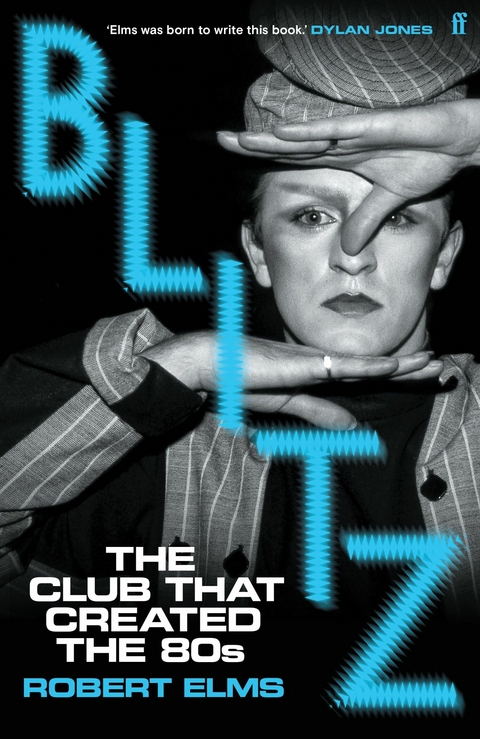
Blitz (eBook)
304 Seiten
Faber & Faber (Verlag)
978-0-571-39420-3 (ISBN)
Robert Elms is a broadcaster and writer, best known for his eponymous radio show on BBC Radio London. He began as a journalist, writing for The Face and NME, and is the author of Live!: Why We Go Out, London Made Us, The Way We Wore, Spain: A Portrait After the General and In Search of the Crack. He lives in London with his wife and children.
'Elms is one of the greatest chroniclers of our age. He was born to write this book.' Dylan Jones'Fantastic! It is like time travel . . . [to] the most exciting, innovative, outrageous, wildest, most creative club ever.' Steve Dagger'Elms was not only in the room where it happened, he was at the very heart of it.' Gary Kemp'The perfect witness and commentator: open-minded, outward looking, and an expert and shrewd cultural analyst.' Lavinia Greenlaw'Sharp, funny and caked in two-day old eyeliner.' Jodie HarshA history of the club that set the '80s alight, by the much-loved presenter, writer and Blitz attendee Robert Elms. The short-lived Blitz club in London's Covent Garden was more than somewhere to hang out or be seen: it was a catalyst for cultural explosion, a counter-culture blast against everything Thatcher's leadership had ushered in by the dawn of the 80s. Tuesday nights boasted a ferocious, fearless cast - from Boy George and Spandau Ballet to Grayson Perry and Peter Doig, to Michele Clapton, Sade and Alexander McQueen. This was the vanguard of a different England; socially liberal, loud, proud and diverse, fiercely individualistic and determined to succeed. Britain was black and white; the Blitz Kids switched on the colour. In Blitz, Elms reflects on a club night founded by working-class kids, one whose impact reverberated beyond its doors, through the worlds of Art, Literature, Fashion and Music, and into the present day.
For about eighteen months, as 1979 segued into a startling new decade, a small, musty, Second World War-themed wine bar in Covent Garden became the centre of the universe. The door to No. 4, Great Queen Street was the most important portal in London. If you could make it through there on a Tuesday night, you found yourself at the thrilling epicentre of a youth culture explosion of a kind this city had not seen since the Swinging Sixties: a nightclub which would come to define an era and whose influence is still reverberating today.
The 1980s, and all that they became, began a year early in the Blitz club, with Steve Strange deciding who would make it through the door and Rusty Egan spinning tunes to jive and flirt and pose and preen to. It was the hard core of 150 or so overdressed, undervalued youngsters inside – those vain, arrogant, remarkably creative teenage misfits and macaronis* – who would go on to shape the decade and define so many aspects of the world we live in today.
I would guess that at least two-thirds of those Blitz kids – and they were indeed all kids, almost nobody over the age of twenty-one, almost all from working-class backgrounds, none of them privileged or monied – went on to become very successful in their chosen fields. Many became internationally prominent and plenty of them are still famous today. Nearly half a century later, I’m returning to the club’s heyday in the pages of this book to reflect on how it happened.
Like a petri dish fizzing with alchemical reactions, or a pressure cooker of perpetual creativity, the realms of music, nightlife, fashion, design, art, dance and journalism were all ripped up and reshaped by this coterie of do-it-yourself dandy urchins dancing to a selection of epic electronic tunes and plotting to take over the world. Downstairs in the toilets, meanwhile, our collective sexual and gender mores were being tested to destruction. Boys will be girls and girls will be boys. Gender fluidity and bodily fluids.
The list of Blitz alumni covers just about every aspect of British cultural life, a remarkable number of them now sporting honours from OBEs to knighthoods, still more of them notorious and glamorous – stars of every kind. It is an incredible legacy, and I regularly bump into hugely successful people who I first saw dancing to ‘Moskow Diskow’ by Telex or applying eyeliner in the ladies’ cubicle. Those days were so long ago that I’ve now also started going to their funerals.
But I still remember it vividly. What it felt like and smelled like to be there in that pulsating room after midnight pretty much every Tuesday for a year and a half. I was there with a truly remarkable cast of characters, writing the future as we went along. But I also recall what it was like outside that magical enclave in our grim and bitter land, torn by strife and riven by division.
All this has stayed with me because it was a truly defining period of my life. It formed who I was and who I would become. George O’Dowd and Gary Kemp, Siobhan Fahey and Sade Adu, Grayson Perry and Peter Doig, Dinny Hall, Dylan Jones, Chris Sullivan, Michele Clapton, Michael Clark and John Galliano … They shaped and styled our world.
Once I set to writing this book, the memories came whooshing back. I think they are fairly reliable; they are certainly visceral, though time may have played tricks and hindsight will undoubtedly have played a part. Others will definitely remember things differently. The Blitz was full of giant egos (mine very much included), all of whom assumed that the room rotated around them. They will have their own Blitz memories, their own versions of events, their own analysis of what happened. This is mine.
I resisted the temptation to talk to lots of my fellow Blitz survivors; this is a personal narrative of how I saw it and felt it and lived it at the time. I wanted to reach back to become that stroppy, optimistic, overdressed young man again. But I still often speak to Chris Sullivan, Graham Ball and Gary Kemp. They are still close friends, and no doubt some of their memories are mixed in with mine. We lived this tumultuous time together and have since shared the stories so many times. Spandau’s manager Steve Dagger has also been my confidant in this process. He was always the most clear-headed among us, the one who saw the possibilities and who can still recall the particulars. His help has been invaluable.
Looking at photos brings back some very specific moments and sensations, particularly those taken by Graham Smith, my arty mate from grammar school with a camera round his neck, who was there with us all the way and whose pictures grace this tome. His own book, We Can Be Heroes, with fantastic words by Chris Sullivan, is for me easily the best on this subject and the whole club scene of the 70s and 80s. It comes directly from the people who were there and I allowed myself to dip into that. With its ebullient but earthy imagery, flawless chronology and great storytelling, it plunged me right back into that maelstrom of extreme emotions and haircuts.
A few other photographers took shots, but they tended to be outsiders, and later there was a barrage of press coverage which largely got it wrong, always pointing their lenses at the most outrageous, the least authentic. Graham’s pictures are special. His grainy black-and-white photos are strikingly evocative, raw, untutored but absolutely genuine, just like we were.
It is remarkable how young we all look, because it is remarkable how young we all were. To quote the title of Patti Smith’s memoir, we were ‘Just Kids’. But when I meet those grown-up Blitz kids today, when I bump into Rusty Egan or Stephen Jones, Fiona Dealey or Princess Julia, I still see those blazing brilliant youths of yore, still see the magic and the mischief in their eyes.
Even Graham almost never took his camera inside the Blitz; he was too busy doing what we were all doing, which was living it as large as our egos and our imaginations would allow. As well as there being few photos, there is almost no film or video evidence, little record of what actually went on at No. 4, Great Queen Street all those decades ago. Just the memories of some ageing New Romantics.
This was a pre-digital age, so it was not captured and chronicled much at the time; it was a purely lived experience. You had to be there, and if you were there, you had to be fully immersed; it was no place for part-timers or voyeurs. There was no shortage of exhibitionists at the Blitz, but all the furious posing and peacocking was just for ourselves. We did this – showing up and showing off, putting in so much effort, dressing to the nines – strictly for each other, not for wider consumption or financial compensation.
Nobody was trying to gain followers or get clicks and likes. Social media didn’t exist; social advancement didn’t seem likely. For more than a year, the whole thing was out of sight and beneath the radar, until it all suddenly blew up and we became a national and even international news story. Before that, we were completely ignored by what is now termed the mainstream media, and even by the still-surviving alternative press and music press. Just a load of poseurs in preposterous outfits.
Talking of clothes – and inevitably I talk a lot about clothes in this book – I have a pretty accurate memory for what I wore and what others wore, a sign, I guess, of just what a vain and shallow man I am. Clothes, for me, work like an aide-memoire, a spear-collared, kipper-tied, fly-fronted, zoot-suited, cowboy-booted mnemonic. I can only remember outfits and song lyrics, both skills which have served me quite well.
But despite my very clear recall of specific items of clothing, I cannot guarantee that every one of the memories in this book is sartorially accurate. Sometimes I have quoted an example of what, say, Christos Tolera or Melissa Caplan were wearing on this or that occasion, and it may in fact have been on a different night that the low-rider outfit came out or that the tabard dress first appeared. I wanted to illustrate the kinds of garments, the outfits, the styles which were worn – and, believe me, many styles were worn. At the Blitz, a look lasted just one night.
I have also gone before and beyond the Blitz. Our story starts with the various trouser tribes and subsects which preceded Tuesday nights in Covent Garden, particularly the punks and the soul boys who were the progenitors of this cult with no name. Then it continues after the Blitz was no more, into the numerous clubs and bands, the designers, dancers, photographers and writers who emerged from that extraordinary milieu, from that little group of hardened hedonists and exhibitionists dancing together on a Tuesday night. The club was a catalyst for change, a motor for an age driven by pure, unfiltered teenage desire and wanton, egotistical energy. The 1980s would not have been the same without them.
For a long time, I wanted to escape that decade. It was great while it lasted, and I am not the least embarrassed – indeed, I’m very proud to have played my part – but to be forever linked to what you were wearing, saying and doing nearly half a century ago can be a little galling. I’ve done a lot of other stuff since...
| Erscheint lt. Verlag | 23.9.2025 |
|---|---|
| Sprache | englisch |
| Themenwelt | Literatur ► Biografien / Erfahrungsberichte |
| Kunst / Musik / Theater ► Malerei / Plastik | |
| Sozialwissenschaften | |
| ISBN-10 | 0-571-39420-5 / 0571394205 |
| ISBN-13 | 978-0-571-39420-3 / 9780571394203 |
| Informationen gemäß Produktsicherheitsverordnung (GPSR) | |
| Haben Sie eine Frage zum Produkt? |
 EPUB (Adobe DRM)
Kopierschutz: Adobe-DRM
Adobe-DRM ist ein Kopierschutz, der das eBook vor Mißbrauch schützen soll. Dabei wird das eBook bereits beim Download auf Ihre persönliche Adobe-ID autorisiert. Lesen können Sie das eBook dann nur auf den Geräten, welche ebenfalls auf Ihre Adobe-ID registriert sind.
Details zum Adobe-DRM
Dateiformat: EPUB (Electronic Publication)
EPUB ist ein offener Standard für eBooks und eignet sich besonders zur Darstellung von Belletristik und Sachbüchern. Der Fließtext wird dynamisch an die Display- und Schriftgröße angepasst. Auch für mobile Lesegeräte ist EPUB daher gut geeignet.
Systemvoraussetzungen:
PC/Mac: Mit einem PC oder Mac können Sie dieses eBook lesen. Sie benötigen eine
eReader: Dieses eBook kann mit (fast) allen eBook-Readern gelesen werden. Mit dem amazon-Kindle ist es aber nicht kompatibel.
Smartphone/Tablet: Egal ob Apple oder Android, dieses eBook können Sie lesen. Sie benötigen eine
Geräteliste und zusätzliche Hinweise
Buying eBooks from abroad
For tax law reasons we can sell eBooks just within Germany and Switzerland. Regrettably we cannot fulfill eBook-orders from other countries.
aus dem Bereich


