


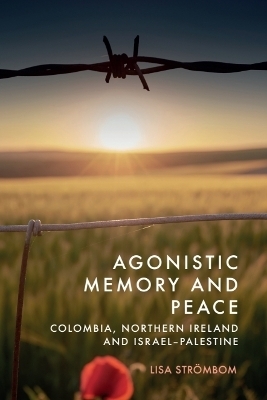
Agonistic Memory and Peace
Colombia, Northern Ireland and Israel-Palestine
Seiten
2026
Edinburgh University Press (Verlag)
978-1-3995-4578-5 (ISBN)
Edinburgh University Press (Verlag)
978-1-3995-4578-5 (ISBN)
- Noch nicht erschienen (ca. Juli 2026)
- Versandkostenfrei
- Auch auf Rechnung
- Artikel merken
Investigates memory initiatives in three of the world’s hardest to solve conflicts and how they can be invested with more constructive dynamics.
This is a book about the power of memory in fractured societies and initiatives that resist pressures to simplify history. It traces the intricate pathways of local dialogue initiatives in three of the world's most emotionally charged conflicts: Colombia, Israel-Palestine, and Northern Ireland.
There, the past is always contested terrain—it is present, alive and deeply political. The book draws on agonistic peace theory, which proposes continued contestation, discussion and disagreement - in non-violent, constructive forms - as the most productive way to transform violent conflicts.
Focusing on how local organisations can work to facilitate dialogue about conflict memory, the analyses rely on interview-based case studies where organisations working on bringing people together to juxtapose their memories of these conflicts are probed. The results underline that safeguarding dialogue spaces, stimulating counter-hegemonic forces and the circulation of memory between memoryscapes at different scales are crucial enabling factors for successful agonistic memory work.
This is a book about the power of memory in fractured societies and initiatives that resist pressures to simplify history. It traces the intricate pathways of local dialogue initiatives in three of the world's most emotionally charged conflicts: Colombia, Israel-Palestine, and Northern Ireland.
There, the past is always contested terrain—it is present, alive and deeply political. The book draws on agonistic peace theory, which proposes continued contestation, discussion and disagreement - in non-violent, constructive forms - as the most productive way to transform violent conflicts.
Focusing on how local organisations can work to facilitate dialogue about conflict memory, the analyses rely on interview-based case studies where organisations working on bringing people together to juxtapose their memories of these conflicts are probed. The results underline that safeguarding dialogue spaces, stimulating counter-hegemonic forces and the circulation of memory between memoryscapes at different scales are crucial enabling factors for successful agonistic memory work.
Lisa Strömbom is Associate Professor in Political Science at Lund University, where she is a former Director of Peace and Conflict Studies.
1. Introduction
2. Agonistic Memory Work
3. Memory Work in Post-accord Colombia
4. Memory Work Following the Oslo Accords
5. Memory Work after the Belfast Agreement
6. Agonistic Memory Work Post-Accord: Circulation, Counter-Hegemony and Safeguarding Agonistic Spaces
7. Concluding Reflections
References
Appendix
| Erscheint lt. Verlag | 8.7.2026 |
|---|---|
| Verlagsort | Edinburgh |
| Sprache | englisch |
| Maße | 156 x 234 mm |
| Themenwelt | Kunst / Musik / Theater ► Kunstgeschichte / Kunststile |
| Sozialwissenschaften ► Politik / Verwaltung ► Europäische / Internationale Politik | |
| Sozialwissenschaften ► Politik / Verwaltung ► Politische Theorie | |
| ISBN-10 | 1-3995-4578-7 / 1399545787 |
| ISBN-13 | 978-1-3995-4578-5 / 9781399545785 |
| Zustand | Neuware |
| Informationen gemäß Produktsicherheitsverordnung (GPSR) | |
| Haben Sie eine Frage zum Produkt? |
Mehr entdecken
aus dem Bereich


aus dem Bereich
kurze Geschichte einer langen Beziehung
Buch | Hardcover (2025)
Suhrkamp (Verlag)
CHF 36,40
Amerikas Strategie der Vorherrschaft und der Kampf um Eurasien
Buch | Softcover (2024)
NOMEN Verlag
CHF 27,95
erfolgreiche Interessenvertretung durch Prozesskompetenz im komplexen …
Buch | Hardcover (2023)
Wiley-VCH (Verlag)
CHF 58,75


