


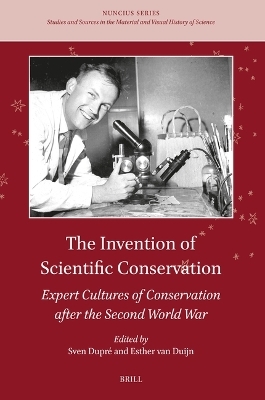
The Invention of Scientific Conservation
Expert Cultures of Conservation after the Second World War
Seiten
2025
Brill (Verlag)
978-90-04-73729-7 (ISBN)
Brill (Verlag)
978-90-04-73729-7 (ISBN)
The book shows how experts from a variety of backgrounds made science the type of knowledge carrying most authority in questions of conservation following the Second World War until the 1970s, when the principles of scientific conservation were questioned again.
The book addresses the question of how experts from a variety of educational backgrounds and with different professional identities created scientific conservation. How did they make science the type of knowledge carrying most authority in questions of conservation? From the ruins of the Second World War, international organisations (e.g. IIC), journals (e.g. Studies in Conservation), and institutes (e.g. the KIK-IRPA in Brussels) emerged. This book discusses these developments until the 1970s, when conservators confronted with the processual and intangible aspects of contemporary art started to question the principles of scientific conservation and again began to value other forms of knowledge.
Contributors are: Camille Bourdiel, Marco Cardinali, Leib Celnik, Angela Cerasuolo, Esther van Duijn, Sven Dupré, Noémie Etienne, Thierry Ford, Michael von der Goltz, Jo Kirby, Hero Lotti, Salvador Muñoz-Viñas, Maeva Pimo, Ron Spronk, Geert Vanpaemel, and Aga Wielocha.
The book addresses the question of how experts from a variety of educational backgrounds and with different professional identities created scientific conservation. How did they make science the type of knowledge carrying most authority in questions of conservation? From the ruins of the Second World War, international organisations (e.g. IIC), journals (e.g. Studies in Conservation), and institutes (e.g. the KIK-IRPA in Brussels) emerged. This book discusses these developments until the 1970s, when conservators confronted with the processual and intangible aspects of contemporary art started to question the principles of scientific conservation and again began to value other forms of knowledge.
Contributors are: Camille Bourdiel, Marco Cardinali, Leib Celnik, Angela Cerasuolo, Esther van Duijn, Sven Dupré, Noémie Etienne, Thierry Ford, Michael von der Goltz, Jo Kirby, Hero Lotti, Salvador Muñoz-Viñas, Maeva Pimo, Ron Spronk, Geert Vanpaemel, and Aga Wielocha.
Sven Dupré is Professor of History of Art, Science and Technology at Utrecht University and the University of Amsterdam. His research lies at the intersection of art history and the history of science and technology, recently focusing on conservation and its history. Esther van Duijn, Ph.D., is paintings conservator and researcher, specialised in the history of paintings conservation. She is currently working at the Rijksmuseum in Amsterdam, as part of the Operation Night Watch team.
| Erscheinungsdatum | 29.11.2025 |
|---|---|
| Reihe/Serie | Nuncius Series ; 15 |
| Verlagsort | Leiden |
| Sprache | englisch |
| Maße | 155 x 235 mm |
| Themenwelt | Kunst / Musik / Theater ► Kunstgeschichte / Kunststile |
| Naturwissenschaften | |
| ISBN-10 | 90-04-73729-4 / 9004737294 |
| ISBN-13 | 978-90-04-73729-7 / 9789004737297 |
| Zustand | Neuware |
| Informationen gemäß Produktsicherheitsverordnung (GPSR) | |
| Haben Sie eine Frage zum Produkt? |
Mehr entdecken
aus dem Bereich

aus dem Bereich
kleine Kulturgeschichte einer brillanten Allianz
Buch | Softcover (2025)
Iudicium (Verlag)
CHF 33,90


