


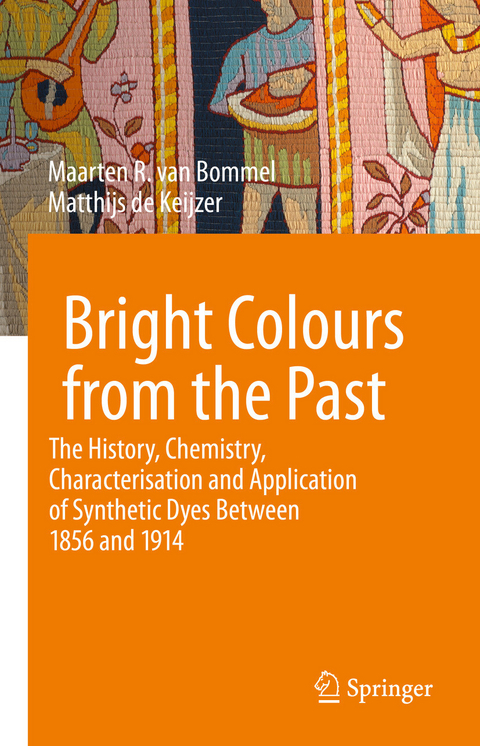
Bright Colours from the Past (eBook)
467 Seiten
Springer (Verlag)
978-3-031-88664-5 (ISBN)
The invention of Mauveine by Perkin in 1856 led to a revolution in the world of textile
dyeing. In the second half of the 19th century, natural dyes were quickly replaced by newly developed synthetic dyes which resulted in a bright palette of colours. The synthetic dyes were not only cheaper to produce, but also easier to apply on textiles due to new dyeing mechanisms. As a result, production costs decreased tremendously and brilliantly dyed textiles became available to the larger public. The introduction of synthetic dyes had a strong impact in fashion; in addition, these colourants were also used as stains on furniture, as inks and in paints.
In this publication, the development of these vivid colourants is presented. It brings together information about the history of synthetic dyes, including the first attempts, the so-called semi-synthetic dyes, and presenting the most relevant dyes and dye classes, such as nitro dyes, tri-arylmethanes, azo dyes, xanthenes, sulfur dyes, synthetic alizarin and synthetic indigo. It contains a wealth of information regarding the numerous synonyms, trade names, manufacturers and patents. International trade and competition, which was fierce, are discussed. The chemistry behind the synthetic dyeing is explained, including new dyeing technologies developed. The application of dyes and their fastness properties are also presented. An overview of analytical techniques used for characterisation is given. Many case studies are included, expressing the importance of the dyes and the creativity of mankind when applying these colourants.
As such, this publication can be seen as a colourful journey through history, relevant for conservators, curators, historians, chemists and all who are interested in the history and development of synthetic dyes.
| Erscheint lt. Verlag | 7.7.2025 |
|---|---|
| Reihe/Serie | Cultural Heritage Science |
| Zusatzinfo | XXII, 467 p. 181 illus., 55 illus. in color. |
| Sprache | englisch |
| Themenwelt | Literatur ► Biografien / Erfahrungsberichte |
| Kunst / Musik / Theater ► Kunstgeschichte / Kunststile | |
| Geisteswissenschaften ► Geschichte | |
| Naturwissenschaften ► Chemie | |
| Technik ► Maschinenbau | |
| Schlagworte | Conservation Science • cultural heritage • Synthetic Dyes • Technical Art History • Textiles, Furniture and Paintings |
| ISBN-10 | 3-031-88664-X / 303188664X |
| ISBN-13 | 978-3-031-88664-5 / 9783031886645 |
| Informationen gemäß Produktsicherheitsverordnung (GPSR) | |
| Haben Sie eine Frage zum Produkt? |
 PDF (Wasserzeichen)
DRM: Digitales Wasserzeichen
Dieses eBook enthält ein digitales Wasserzeichen und ist damit für Sie personalisiert. Bei einer missbräuchlichen Weitergabe des eBooks an Dritte ist eine Rückverfolgung an die Quelle möglich.
Dateiformat: PDF (Portable Document Format)
Mit einem festen Seitenlayout eignet sich die PDF besonders für Fachbücher mit Spalten, Tabellen und Abbildungen. Eine PDF kann auf fast allen Geräten angezeigt werden, ist aber für kleine Displays (Smartphone, eReader) nur eingeschränkt geeignet.
Systemvoraussetzungen:
PC/Mac: Mit einem PC oder Mac können Sie dieses eBook lesen. Sie benötigen dafür einen PDF-Viewer - z.B. den Adobe Reader oder Adobe Digital Editions.
eReader: Dieses eBook kann mit (fast) allen eBook-Readern gelesen werden. Mit dem amazon-Kindle ist es aber nicht kompatibel.
Smartphone/Tablet: Egal ob Apple oder Android, dieses eBook können Sie lesen. Sie benötigen dafür einen PDF-Viewer - z.B. die kostenlose Adobe Digital Editions-App.
Buying eBooks from abroad
For tax law reasons we can sell eBooks just within Germany and Switzerland. Regrettably we cannot fulfill eBook-orders from other countries.
aus dem Bereich


