


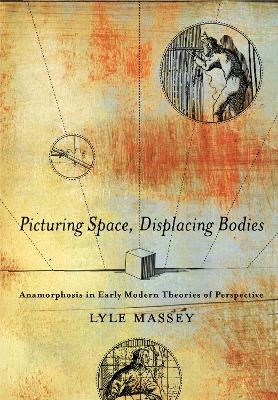
Picturing Space, Displacing Bodies
Anamorphosis in Early Modern Theories of Perspective
Seiten
2007
Pennsylvania State University Press (Verlag)
978-0-271-02980-1 (ISBN)
Pennsylvania State University Press (Verlag)
978-0-271-02980-1 (ISBN)
Massey argues that we can only learn how and why certain kinds of spatial representation prevailed by carefully considering how Renaissance artists and theorists interpreted perspective. This discussion shows that the painter’s geometry did not always conform to the rational Cartesian formula, nor did it unfold according to scientific development.
In Picturing Space, Displacing Bodies, Lyle Massey argues that we can only learn how and why certain kinds of spatial representation prevailed over others by carefully considering how Renaissance artists and theorists interpreted perspective. Combining detailed historical studies with broad theoretical and philosophical investigations, this book challenges basic assumptions about the way early modern artists and theorists represented their relationship to the visible world and how they understood these representations. By analyzing technical feats such as anamorphosis (the perspectival distortion of an object to make it viewable only from a certain angle), drawing machines, and printed diagrams, each chapter highlights the moments when perspective theorists failed to unite a singular, ideal viewpoint with the artist’s or viewer’s viewpoint or were unsuccessful at conjoining fictive and lived space. Showing how these “failures” were subsequently incorporated rather than rejected by perspective theorists, the book presents an important reassessment of the standard view of Renaissance perspective. While many scholars have maintained that perspective rationalized the relationships among optics, space, and painting, Picturing Space, Displacing Bodies asserts instead that Renaissance and early modern theorists often revealed a disjunction between geometrical ideals and practical applications. In some cases, they not only identified but also exploited these discrepancies. This discussion of perspective shows that the painter’s geometry did not always conform to the explicitly rational, Cartesian formula that so many have assumed, nor did it historically unfold according to a standard account of scientific development.
In Picturing Space, Displacing Bodies, Lyle Massey argues that we can only learn how and why certain kinds of spatial representation prevailed over others by carefully considering how Renaissance artists and theorists interpreted perspective. Combining detailed historical studies with broad theoretical and philosophical investigations, this book challenges basic assumptions about the way early modern artists and theorists represented their relationship to the visible world and how they understood these representations. By analyzing technical feats such as anamorphosis (the perspectival distortion of an object to make it viewable only from a certain angle), drawing machines, and printed diagrams, each chapter highlights the moments when perspective theorists failed to unite a singular, ideal viewpoint with the artist’s or viewer’s viewpoint or were unsuccessful at conjoining fictive and lived space. Showing how these “failures” were subsequently incorporated rather than rejected by perspective theorists, the book presents an important reassessment of the standard view of Renaissance perspective. While many scholars have maintained that perspective rationalized the relationships among optics, space, and painting, Picturing Space, Displacing Bodies asserts instead that Renaissance and early modern theorists often revealed a disjunction between geometrical ideals and practical applications. In some cases, they not only identified but also exploited these discrepancies. This discussion of perspective shows that the painter’s geometry did not always conform to the explicitly rational, Cartesian formula that so many have assumed, nor did it historically unfold according to a standard account of scientific development.
Lyle Massey is Assistant Professor in the Department of Art History and Communication Studies at McGill University in Montreal. She is the editor of The Treatise on Perspective: Published and Unpublished, Studies in the History of Art Series, vol. 59 (2003).
Contents
List of Illustrations
Acknowledgments
Introduction
1Corporealizing the Infinite
2Descartes’s Point of View
3Straightening Out Anamorphosis
4The Body and Its Devices
Conclusion: Perspective Split in Two
Notes
Bibliography
Index
| Erscheint lt. Verlag | 27.11.2007 |
|---|---|
| Zusatzinfo | 43 Halftones, black and white |
| Verlagsort | University Park |
| Sprache | englisch |
| Maße | 178 x 254 mm |
| Gewicht | 934 g |
| Themenwelt | Kunst / Musik / Theater ► Kunstgeschichte / Kunststile |
| ISBN-10 | 0-271-02980-3 / 0271029803 |
| ISBN-13 | 978-0-271-02980-1 / 9780271029801 |
| Zustand | Neuware |
| Informationen gemäß Produktsicherheitsverordnung (GPSR) | |
| Haben Sie eine Frage zum Produkt? |
Mehr entdecken
aus dem Bereich



aus dem Bereich
kleine Kulturgeschichte einer brillanten Allianz
Buch | Softcover (2025)
Iudicium (Verlag)
CHF 33,90


