


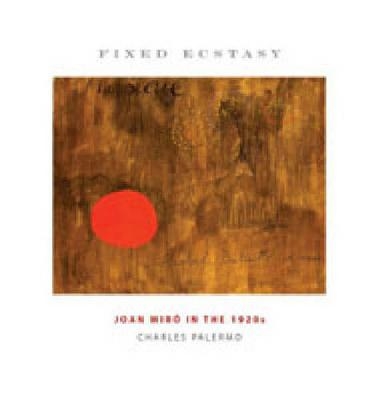
Fixed Ecstasy
Joan Miró in the 1920s
Seiten
2007
Pennsylvania State University Press (Verlag)
978-0-271-02972-6 (ISBN)
Pennsylvania State University Press (Verlag)
978-0-271-02972-6 (ISBN)
Joan Miro (1893-1983) is one of the leading artists of the early twentieth century, to be ranked alongside such artists as Picasso, Matisse, Mondrian, and Pollock in his contributions to Modernist painting. This book advances an understanding of Miro's enterprise in 1920s and of the important works of his career.
Fixed Ecstasy advances a fundamentally new understanding of Miró’s enterprise in the 1920s and of the most important works of his career. Without a doubt, Joan Miró (1893–1983) is one of the leading artists of the early twentieth century, to be ranked alongside such artists as Picasso, Matisse, Mondrian, and Pollock in his contributions to modernist painting. Still, Miró’s work has eluded easy classification. He is best known as a Surrealist, but, as Charles Palermo demonstrates, Miró’s early years in Barcelona and Paris require a revisionist account of Miró’s development and his place in modernism.
Palermo’s arguments are based on new research into Miró’s relations with the rue Blomet group of writers and artists, as well as on close readings of the techniques and formal structures of Miró’s early drawings and paintings. Chapter by chapter, Palermo unfolds a narrative that makes a cogent argument for freeing Miró from long-standing dependence on Surrealism, with its strong emphasis on dreams and the unconscious. Miró, along with associates such as Georges Bataille, Carl Einstein, and Michel Leiris, pressed representation to its limit at the verge of an ecstatic identification with the world.
Fixed Ecstasy advances a fundamentally new understanding of Miró’s enterprise in the 1920s and of the most important works of his career. Without a doubt, Joan Miró (1893–1983) is one of the leading artists of the early twentieth century, to be ranked alongside such artists as Picasso, Matisse, Mondrian, and Pollock in his contributions to modernist painting. Still, Miró’s work has eluded easy classification. He is best known as a Surrealist, but, as Charles Palermo demonstrates, Miró’s early years in Barcelona and Paris require a revisionist account of Miró’s development and his place in modernism.
Palermo’s arguments are based on new research into Miró’s relations with the rue Blomet group of writers and artists, as well as on close readings of the techniques and formal structures of Miró’s early drawings and paintings. Chapter by chapter, Palermo unfolds a narrative that makes a cogent argument for freeing Miró from long-standing dependence on Surrealism, with its strong emphasis on dreams and the unconscious. Miró, along with associates such as Georges Bataille, Carl Einstein, and Michel Leiris, pressed representation to its limit at the verge of an ecstatic identification with the world.
Charles Palermo is Assistant Professor of Art and Art History at the College of William and Mary. He has published articles in such periodicals as October, MLN, and The Art Bulletin.
Contents
Illustrations
Introduction: Silence in Painting
1.Calligraphy: Vine and Sundial
2.Extension: Toys and Rainbows
3.Stroke: Medium and Compass
4.Entering Painting’s Thickness: Translucence and Turning
5.Suicide: Leiris and Siriel
Conclusion: Miró in Silence
Works Cited
Index
| Erscheint lt. Verlag | 25.4.2008 |
|---|---|
| Reihe/Serie | Refiguring Modernism |
| Zusatzinfo | 26 Halftones, color; 37 Halftones, black and white |
| Verlagsort | Pennsylvania |
| Sprache | englisch |
| Maße | 229 x 241 mm |
| Gewicht | 1107 g |
| Themenwelt | Kunst / Musik / Theater ► Kunstgeschichte / Kunststile |
| Kunst / Musik / Theater ► Malerei / Plastik | |
| ISBN-10 | 0-271-02972-2 / 0271029722 |
| ISBN-13 | 978-0-271-02972-6 / 9780271029726 |
| Zustand | Neuware |
| Informationen gemäß Produktsicherheitsverordnung (GPSR) | |
| Haben Sie eine Frage zum Produkt? |
Mehr entdecken
aus dem Bereich

aus dem Bereich
kleine Kulturgeschichte einer brillanten Allianz
Buch | Softcover (2025)
Iudicium (Verlag)
CHF 33,90


