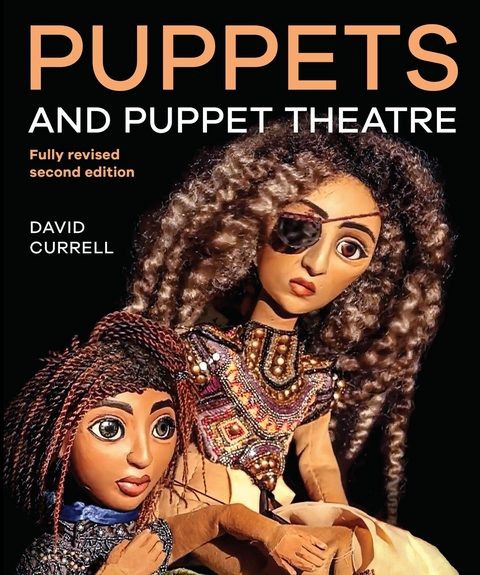
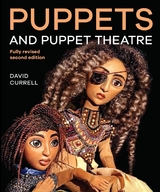
Puppets and Puppet Theatre (eBook)
208 Seiten
The Crowood Press (Verlag)
978-0-7198-4492-8 (ISBN)
David Currell is widely recognized as a leading authority on puppet theatre. He was co-founder of the National Puppet Centre and its chairperson for nearly twenty years. One of the most widely published authors on the subject over a period of forty years.
Puppets & Puppet Theatre is essential reading for everyone interested in making and performing with puppets. It concentrates on designing, making and performing with the main types of puppet, and is extensively illustrated in full colour throughout.
AN INTRODUCTION TO PUPPET THEATRE
Puppet theatre heritage
Puppetry and puppet theatre have a long and fascinating heritage. The origins of this visual and dramatic art are thought to lie mainly in the East, although exactly when or where it originated is not known. It may have been practised in India 4000 years ago: impersonation was forbidden by religious taboo and the leading player in Sanskrit plays is termed sutradhara (‘the holder of strings’), so it is likely that puppets existed before human actors.
Tiny Tim, a Bunraku-style puppet, one metre tall and constructed in fine detail by Raven Kaliana for Dickens’ A Christmas Carol.
In China, marionettes were in use by the eighth century AD and shadow puppets date back well over 1000 years. The Burmese puppet theatre had a significant influence on the development of the human dance drama, and a dancer’s skill is still judged on his or her ability to recreate the movements of a marionette. And Chikamatsu Monzaemon (1653-1725), Japan’s finest dramatist, wrote not for human theatre, but for the Bunraku puppets which once overshadowed the Kabuki in popularity; Bunraku is a blend of the arts of puppet theatre, narration and shamisen music.
In Europe, the puppet drama flourished in the early Mediterranean civilisations and under Roman rule. The Greeks may have used puppets as early as 800 BC, and puppet theatre was a common entertainment – probably with marionettes and glove puppets – in Greece and Rome by 400 BC, according to the writings of the time. In the Middle Ages, puppets were widely used to enact the scriptures until they were banned by the Council of Trent. Since the Renaissance, puppetry in Europe has continued as an unbroken tradition.
Javanese wayang golek rod puppets.
Sicilian puppets – knights one metre (three feet) high, wearing beaten armour and operated from above with rods – have performed the story of Orlando Furioso since the sixteenth century, but this type of puppet was, in fact, in use as long ago as Roman times. In Germany, puppets have performed The History of Doctor Faustus since 1587, and in France marionette operas became so popular that in 1720 live opera attempted to have them restricted by law. The eighteenth-century French Ombres Chinoises shadow puppets were not only a fairground entertainment but were popular among artists and in the fashionable world.
A traditional carved Burmese marionette.
A Chinese shadow puppet created in leather, which is treated to make it translucent and coloured with dyes.
A Sicilian rod-marionette by the Cuticchio family, Palermo.
In England, puppets were certainly known by the fourteenth century and, during the Civil War, when theatres were closed, puppet theatre enjoyed a period of unsurpassed popularity. By the early eighteenth century it was a fashionable entertainment for the wealthy, and in the late nineteenth century England’s marionette troupes, considered to be the best in the world, toured the globe with their elaborate productions.
The ubiquitous Mr Punch originated in Italy. A puppet version of Pulcinella, a buffoon in the Italian Commedia dell’ Arte, was carried throughout Europe by wandering showmen and a similar character – including Petrushka (Russia), Pickle Herring, later Jan Klaassen (Holland), and Polichinelle (France) – became established in many countries. The French version was introduced to England in 1660 with the return of Charles II; it became Punchinello, soon shortened to Punch, and enjoyed such popularity that the character began to be included in all manner of plays. By 1825, Punch was at the height of his popularity, and the story in which he played had taken on its standard basic form.
In the nineteenth century the puppet show was taken to America by emigrants from many European countries, and their various national traditions laid the foundations for the great variety of styles found there today.
Eastern Europe had early traditions of travelling puppet-showmen but, with a few exceptions, puppetry did not develop significantly there until the twentieth century when it was influenced, first between 1925 and 1948, by the work of Professor Richard Teschner. He was an Austrian who developed an intricate form of rod puppet inspired by the Javanese wayang golek puppets. Rod puppetry in Eastern Europe really progressed after 1945 when it was taken up by Russian puppeteers, also inspired by the Javanese puppets and the Japanese Bunraku. Rod puppetry then developed at an impressive rate under the direction of Sergei Obraztsov at the Moscow State Central Puppet Theatre and had a major influence on its use worldwide.
The twentieth century brought new materials and techniques at a time when melodramatic themes and circus-style acts had little place alongside the prevailing artistic Realism, but the symbolism of puppet theatre provided inspiration for sophisticated artists.
Puppet theatre also saw a revival of interest in the art through film and television. Lotte Reiniger’s shadow film, The Adventures of Prince Achmed, was created between 1923 and 1926 and was the first full-length animated film in the history of the cinema. Puppets have a special place in television history; they were involved in John Logie Baird’s early television experiments in 1930, and the first puppet production was broadcast in 1933. Since this time, puppets have featured continuously in children’s television, but there have also been significant programmes aimed at an older audience, for example the satirical Spitting Image.
Jan Klaassen, the Dutch equivalent of Mr Punch, performed by Egon Adel, Poppenkast op de Dam, Amsterdam.
A scene from Lotte Reiniger’s film, The Adventures of Prince Achmed. Note how layers of tissue paper were used to create depth in the scene.
Some programmes, such as the ‘Supermarionation’ programmes of the 1960s (Thunderbirds, Captain Scarlet and the Mysterons, Fireball XL5 and Joe 90), have now attained almost cult status. In the USA, Sesame Street had a major impact and led to The Muppet Show, which was estimated to have been watched by more people in more countries than any other form of entertainment.
By the second half of the century, some solo artists and puppet companies were producing work of a quality that could not be ignored and, in Britain, a few influential permanent puppet theatres were established (Harlequin, Little Angel, Cannon Hill, Polka, Norwich, Biggar) along with major touring companies (Caricature, DaSilva, Playboard, Theatre of Puppets). In the latter part of the century, official recognition of puppetry as a performance art was achieved in Britain, and there is now widespread awareness of all types of puppet from traditional figures to Muppet-type characters, giant processional puppets, and those used in major theatrical productions. Now puppets are seen alongside actors on the professional stage, sometimes with significant roles such as in Life of Pi and War Horse.
A giant skeleton by Bryony McCombie Smith for a production of Paa Joe and the Lion.
Little Monkey & Sue, performed by actress-puppeteer Andrea Sadler in a fast-paced, complex, highly disciplined performance in which the performer constantly switches between performing out to the audience and moving the focus to the puppet.
A royal Bengal tiger, puppet design by Nick Barnes and Finn Caldwell for the award-winning West End and Broadway production of The Life of Pi.
Kevin, operated by actor-puppeteers, in Low Life by Blind Summit Theatre, a darkly humorous series of vignettes inspired by the writings of Charles Bukowski.
The Explorer, an open-stage marionette performance by expert puppeteer Lori Hopkins, dressed in keeping with the theme of the performance.
Sola the Dragon, a ‘costume puppet’ created from soft foam, Plastazote and Worbla by Bryony McCombie Smith, who performs as the baby dragon’s keeper. The Dragon and Her Keeper is a walkabout show in which the public interact with Sola, whose eyes, spine and horns glow: it works as a daytime and evening piece.
There has also been an emergence of the actor-puppeteer and the musician-puppeteer, together with courses in puppet theatre in universities and drama schools, and courses mounted independently by accomplished performers and craftspersons. Actors not only appear alongside puppets but operate puppets themselves, and even switch roles onstage from puppeteer to actor. The rise of the actor-puppeteer has been accompanied by a shift to presentation styles without a booth or proscenium theatre.
While operators in full view have traditionally worn costume in subdued colours to blend into the background, some are now dressing in costumes in keeping with the theme of the performance or in a style similar to the puppet. Another development is the ‘costume puppet’, a puppet carried or worn by the puppeteer dressed in a costume that is either an extension of the puppet or a character in relationship to the puppet.
In the past 40 years, materials and technology have developed perhaps faster than ever before. This is evident in the many possibilities for puppet construction, scale and presentation, while major developments in technology have transformed lighting and sound in puppet theatre, as they have in theatre more widely. Nevertheless, the...
| Erscheint lt. Verlag | 11.3.2025 |
|---|---|
| Zusatzinfo | 120 colour photographs, 280 line drawings |
| Verlagsort | London |
| Sprache | englisch |
| Themenwelt | Kunst / Musik / Theater ► Theater / Ballett |
| ISBN-10 | 0-7198-4492-4 / 0719844924 |
| ISBN-13 | 978-0-7198-4492-8 / 9780719844928 |
| Informationen gemäß Produktsicherheitsverordnung (GPSR) | |
| Haben Sie eine Frage zum Produkt? |
 EPUB (Wasserzeichen)
DRM: Digitales Wasserzeichen
Dieses eBook enthält ein digitales Wasserzeichen und ist damit für Sie personalisiert. Bei einer missbräuchlichen Weitergabe des eBooks an Dritte ist eine Rückverfolgung an die Quelle möglich.
Dateiformat: EPUB (Electronic Publication)
EPUB ist ein offener Standard für eBooks und eignet sich besonders zur Darstellung von Belletristik und Sachbüchern. Der Fließtext wird dynamisch an die Display- und Schriftgröße angepasst. Auch für mobile Lesegeräte ist EPUB daher gut geeignet.
Systemvoraussetzungen:
PC/Mac: Mit einem PC oder Mac können Sie dieses eBook lesen. Sie benötigen dafür die kostenlose Software Adobe Digital Editions.
eReader: Dieses eBook kann mit (fast) allen eBook-Readern gelesen werden. Mit dem amazon-Kindle ist es aber nicht kompatibel.
Smartphone/Tablet: Egal ob Apple oder Android, dieses eBook können Sie lesen. Sie benötigen dafür eine kostenlose App.
Geräteliste und zusätzliche Hinweise
Buying eBooks from abroad
For tax law reasons we can sell eBooks just within Germany and Switzerland. Regrettably we cannot fulfill eBook-orders from other countries.
aus dem Bereich