


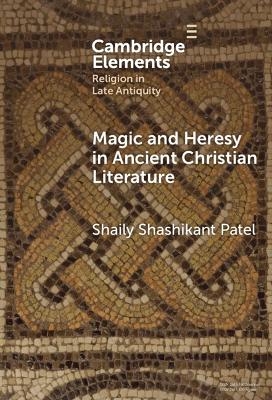
Magic and Heresy in Ancient Christian Literature
Seiten
2025
Cambridge University Press (Verlag)
978-1-009-59841-5 (ISBN)
Cambridge University Press (Verlag)
978-1-009-59841-5 (ISBN)
This Element is a genealogical study of how magic and heresy intersect in early Christian literature across four centuries. It explores when and how magic was seen as heresy and critiques the conceptual conflations constructed by ancient authors and modern scholarship, examining their role in Christian empire.
Magic and Heresy in Ancient Christian Literature is a genealogical study of two parallel but not coequal discursive trajectories: of 'magic' and of 'heresy.' This longue durée analysis charts how these two discursive streams intersect in myriad ways, for myriad ends, across the first four centuries of selected Christian literature. Magic and Heresy attempts to answer in part the question: When and how did early Christian authors start thinking of magic as heresy – that is, as a religious and epistemic system wholly external to their own orthodoxies? Prompted by metacritical concerns about the relationship between magic and heresy, as well as these categories' roles in erecting and maintaining Christian empire, this Element seeks to disrupt tidy conceptual conflations of magic-heresy constructed by ancient authors and replicated in some modern scholarship. Magic and Heresy excavates the cycles of discursive disciplining that eventually resulted in these very conflations.
Magic and Heresy in Ancient Christian Literature is a genealogical study of two parallel but not coequal discursive trajectories: of 'magic' and of 'heresy.' This longue durée analysis charts how these two discursive streams intersect in myriad ways, for myriad ends, across the first four centuries of selected Christian literature. Magic and Heresy attempts to answer in part the question: When and how did early Christian authors start thinking of magic as heresy – that is, as a religious and epistemic system wholly external to their own orthodoxies? Prompted by metacritical concerns about the relationship between magic and heresy, as well as these categories' roles in erecting and maintaining Christian empire, this Element seeks to disrupt tidy conceptual conflations of magic-heresy constructed by ancient authors and replicated in some modern scholarship. Magic and Heresy excavates the cycles of discursive disciplining that eventually resulted in these very conflations.
1. Introduction: Imperial orthodoxy and its enduring épistémè: Toward an undisciplined historiography; 2. From Christ beliefs to Christianity: The first century; 3. The long shadow of emergent heresiology: The second century; 4. Between ascendant orthodoxy and empire: The third century; 5. Totalizing epistemologies and imperial orthodoxy: The fourth century; 6. Coda: Orthodoxies, empires, and an episteme; References.
| Erscheinungsdatum | 26.07.2025 |
|---|---|
| Reihe/Serie | Elements in Religion in Late Antiquity |
| Zusatzinfo | Worked examples or Exercises |
| Verlagsort | Cambridge |
| Sprache | englisch |
| Themenwelt | Kunst / Musik / Theater ► Theater / Ballett |
| Geisteswissenschaften ► Religion / Theologie | |
| Geisteswissenschaften ► Sprach- / Literaturwissenschaft ► Anglistik / Amerikanistik | |
| Geisteswissenschaften ► Sprach- / Literaturwissenschaft ► Literaturwissenschaft | |
| ISBN-10 | 1-009-59841-4 / 1009598414 |
| ISBN-13 | 978-1-009-59841-5 / 9781009598415 |
| Zustand | Neuware |
| Informationen gemäß Produktsicherheitsverordnung (GPSR) | |
| Haben Sie eine Frage zum Produkt? |
Mehr entdecken
aus dem Bereich


aus dem Bereich
Poetik eines sozialen Urteils
Buch | Hardcover (2023)
De Gruyter (Verlag)
CHF 83,90


