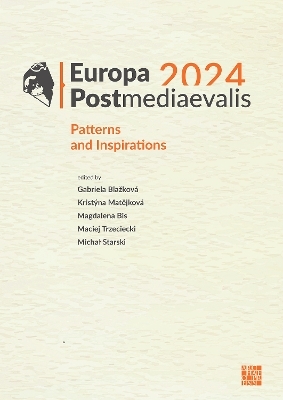
Europa Postmediaevalis 2024
Archaeopress Publishing (Verlag)
978-1-80583-018-4 (ISBN)
The fourth Europa Postmediaevalis conference, entitled Patterns and Inspirations, took place in Warsaw, Poland, in the spring of 2024. The result is this book, containing 27 contributions from a total of eleven European countries. The book is divided into three thematic sections, all of which focus on post-medieval pottery. The editors believe that the diversity and quality of the contributions may answer the question raised in the last paper: does the archaeological study of pottery bring relevant information regarding the human past?
Gabriela Blažková studied archaeology and history at the Faculty of Arts of Charles University in Prague, where she obtained her PhD (in 2011). She works as a researcher at the Institute of Archaeology of the Czech Academy of Sciences in Prague entire professional career, and lectures at Charles University. Her research focuses on late medieval and early modern archaeology with an emphasis on material culture, and social context. She has long been involved in archaeometric research of ceramic and glass finds. She is a member of the editorial boards of several international journals. She coordinates rescue archaeological excavations. Kristýna Matějková studied archaeology at Masaryk University in Brno (Czech Republic) and entered the doctoral programme at Charles University in Prague with the aim processing early modern pottery assemblages. She is the director of the Centre for Processing, Documentation and Recording of Archaeological Finds, which is focused on the evidence, digitization and conservation of objects obtained from archaeological excavations. Her research is currently focused on the popularizing archaeology and interactive childhood education as part of the HistoryPark project. Magdalena Bis is a graduate of the University of Warsaw. Since the beginning of her career, she has been affiliated with the Institute of Archaeology and Ethnology of the Polish Academy of Sciences in Warsaw, where she obtained her PhD (in 2013). Her research interests cover historical archaeology, including material culture and customs, especially late medieval and post-medieval ceramics and glass, as well as defensive architecture, gardens and cemeteries. She has edited numerous publications and is currently editor-in-chief of the journal Archeologia Polski (Archaeology of Poland). Michał Starski is a lecturer at the Faculty of Archaeology at the University of Warsaw. His research focuses on late-medieval and post-medieval archaeology of the Polish and Baltic lands, particularly on material culture (ceramic studies) and small towns. His PhD (2012) was devoted to a monographic study of pottery production in Puck, Gdańsk Pomerania. For many years, he has been conducting archaeological research on the settlement complex in Puck and the Teutonic Castle in Człuchów in Gdańsk Pomerania. Maciej Trzeciecki is an archaeologist at the Institute of Archaeology and Ethnology, Polish Academy of Sciences in Warsaw. From 2023 head of the Centre of Historical Archaeology at this institution. Research interests: urban archaeology, historical archaeology, medieval and postmedieval pottery in social contexts. His PhD (2011) focused on changes in pottery production and consumption in a middle-range Polish town (Płock) in a long-term perspective (11th–19th centuries). During last 30 years he participated and coordinated excavations on medieval and post-medieval sites in Poland, Iceland, Spain, Montenegro, and Egypt. Author or co-author of five monographs and over 90 articles in renowned Polish and foreign journals. Winner of the Prime Minister’s Award for an outstanding doctoral dissertation (2012).
Preface
1. The Spread of Patterns Across Post-Medieval Europe
Traditions and Changes in the Practice of Rouletted Decoration on Late Medieval and Post-
Medieval Pottery in South and West Bohemia – Ladislav Čapek
Early Modern Pottery Decoration Techniques in Bohemia – Gabriela Blažková
Wrocław as an Important Centre for the Production of Slipware in the Modern Period in Silesia – Paweł Duma
Which Came First: Inspiration or Demand? A New Look at the Origin of Slipware in Post-Medieval Poland – Magdalena Bis
Cultural Identity in Post-Medieval Times Based on Earthenware – Frauke Witte
The Influences of Ottoman Rule on Ceramic Finds from 16th–17th–Century Hungary – Adrienn Papp
Decoration – Inspiration – Patterns. On Certain Aspects of the Second Half of 17th- and Early 18th-Century Ceramics from Bohemia – Kristýna Matějková
Tvrdomestice Type of Black Smoked Pottery from the 16th Century – Mário Bielich - Marián Čurný
Stettiner Ware – a Typical Product of a Local Workshop, or Just a Cheap Imitation of Dutch Goods? – Mateusz Szeremeta
Patterns of the Past in the Lands Apart? Early Medieval Pottery Making Traditions in Post-Medieval Northeastern Europe – Maciej Trzeciecki
Decor of Kitchenware from Small Towns of the Cossack Hetmanate from the Second Half of the 17th to the First Quarter of the 18th Century – Oksana Kovalenko
Similarities and Differences in the Decorative Patterns of Pottery on Both Sides of the Outer Western Carpathians – Samuel Španihel
2. Traditional or Innovative. Case Studies from Portugal to Ukraine
Lisbon Pottery and Mudejarism in the Late 15th to Mid-16th Century – Rodrigo Banha da Silva — Sara da Cruz Ferreira — André Bargão — Jorge Branco
Ceramic Material from the Underwater Archaeological Excavation of a Post-Medieval Ballast Heap near Brbinj, Dugi Otok Island, Croatia – Roko Surić — Maja Kaleb — Luka Bekić
Fernand Braudel’s World Economy and Ceramic Markers of Proto-Globalisation from European and Non-European Archaeological Contexts of the 16th Century. The Case Study of Ligurian Majolica – Marco Milanese
Tiny Things. Emotional Cuteness and Miniature Consumption in the 17th Century - Tânia Manuel Casimiro — Ricardo Costeira da Silva
From Coimbra to the World: Early Modern Sgraffito-Painted Redwares – Ricardo Costeira da Silva — Tânia Manuel Casimiro
Gilded and Colourful at the Santana Convent Table (Lisbon, Portugal) – Shanshan Li — Mário Varela Gomes — Huan Xiong — Rosa Varela Gomes — Joana Gonçalves
Well of Finds. An Assortment of Ceramic Vessels from the 17th and 18th Centuries from a Well in Puck (Gdańsk Pomerania, Poland) – Michał Starski
A New Type of Commonware from Poltava – Yuriy Puholovok
Tobacco Clay Pipes Under Baroque Influence. Plant and Floral Motifs on Clay Pipes Discovered in Deva Fortress – Ionuț-Cosmin Codrea
Faience and Porcelain Tableware from the Collections of the Museum of Warsaw in Relation to the Sociotopography of Warsaw in the 17th and 18th Centuries – Preliminary Remarks – Ewelina Więcek-Bonowska
3. Stove Tiles: An Example of the Transfer of Inspiration and Patterns
Some Potters Working only for the Upper Class? – Harald Rosmanitz
Renaissance Stove Tiles from Wawel Royal Castle as an Example of the Transfer and Spread of Patterns – Bartłomiej Makowiecki
European and Local Features in the Decoration of Stove Tiles of the 17th – Early 18th Century from Baturyn, Ukraine – Liudmyla Myronenko
Feasting and Dancing Motifs on Vessels and Tiles from the Late Middle Ages and Early Modern Period as a Source of Knowledge on the Customs of Past Societes – Olga Krukowska
4. What Next?
Where Do We Draw the Line? Post-Medieval Material Culture in a Wider Perspective – Joel Santos — Tânia Manuel Casimiro
List of Reviewers
| Erscheinungsdatum | 17.06.2025 |
|---|---|
| Sprache | englisch |
| Gewicht | 1524 g |
| Themenwelt | Kunst / Musik / Theater ► Kunstgeschichte / Kunststile |
| Geisteswissenschaften ► Archäologie | |
| ISBN-10 | 1-80583-018-X / 180583018X |
| ISBN-13 | 978-1-80583-018-4 / 9781805830184 |
| Zustand | Neuware |
| Informationen gemäß Produktsicherheitsverordnung (GPSR) | |
| Haben Sie eine Frage zum Produkt? |
aus dem Bereich