


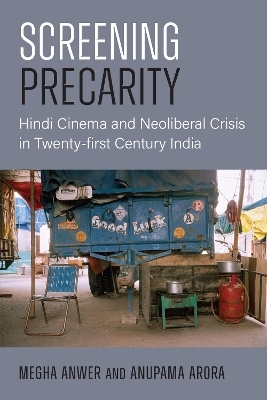
Screening Precarity
Hindi Cinema and Neoliberal Crisis in Twenty-first Century India
Seiten
2025
The University of Michigan Press (Verlag)
978-0-472-07764-9 (ISBN)
The University of Michigan Press (Verlag)
978-0-472-07764-9 (ISBN)
Framing post-millennial Hindi films as cinema of precarity
Screening Precarity explores the role that Hindi films play in how precarity is mediated by film, and what that mediation reveals about both contemporary India and the social life of the movies. This study moves away from the history of Hindi cinema’s articulation of precariousness, focusing instead on filmic renderings of precarity: a distinct and historically contingent condition produced by neoliberalism. The authors argue that post-2010 Hindi films may be thought of as contentious cinematic terrains that record India’s transition from the glee and gusto of liberalization in the 1990s, to a nation contending with the failures and inadequacies of neoliberalism’s promises, and the ascendency of the material-affective redressals offered by Hindu nationalism. Incorporating film and media studies, cultural studies, gender studies, and South Asian studies, Screening Precarity is an intervention in the politics of representation, particularly, of how marginal identities are shaped, scripted, and screened when neoliberalism and authoritarianism enmesh.
Screening Precarity explores the role that Hindi films play in how precarity is mediated by film, and what that mediation reveals about both contemporary India and the social life of the movies. This study moves away from the history of Hindi cinema’s articulation of precariousness, focusing instead on filmic renderings of precarity: a distinct and historically contingent condition produced by neoliberalism. The authors argue that post-2010 Hindi films may be thought of as contentious cinematic terrains that record India’s transition from the glee and gusto of liberalization in the 1990s, to a nation contending with the failures and inadequacies of neoliberalism’s promises, and the ascendency of the material-affective redressals offered by Hindu nationalism. Incorporating film and media studies, cultural studies, gender studies, and South Asian studies, Screening Precarity is an intervention in the politics of representation, particularly, of how marginal identities are shaped, scripted, and screened when neoliberalism and authoritarianism enmesh.
Megha Anwer is Associate Dean for Research and World Readiness and Clinical Associate Professor at the John Martinson Honors College, Purdue University. Anupama Arora is Professor of English and Communication at the University of Massachusetts Dartmouth.
Acknowledgments
Chapter 1: “Our Vulnerable Broken Nation:” Constructing Precarity in Hindi Cinema
Chapter 2: The Crisis of Entrepreneurialism and Hindu Masculinity
Chapter 3: Spatial Precarization of Muslim Men
Chapter 4: Love in the Time of Precarity: Caste and the Collapse of Romantic Love
Chapter 5: Sexual Precarity, Class Divides, and Neoliberal Feminism
Chapter 6: Politics and Political Agency in the Age of Precarity
Epilogue
Notes
Index
| Erscheinungsdatum | 09.09.2025 |
|---|---|
| Verlagsort | Ann Arbor |
| Sprache | englisch |
| Maße | 152 x 229 mm |
| Themenwelt | Kunst / Musik / Theater ► Film / TV |
| Sozialwissenschaften ► Kommunikation / Medien ► Medienwissenschaft | |
| Sozialwissenschaften ► Soziologie ► Makrosoziologie | |
| ISBN-10 | 0-472-07764-3 / 0472077643 |
| ISBN-13 | 978-0-472-07764-9 / 9780472077649 |
| Zustand | Neuware |
| Informationen gemäß Produktsicherheitsverordnung (GPSR) | |
| Haben Sie eine Frage zum Produkt? |
Mehr entdecken
aus dem Bereich



aus dem Bereich


