


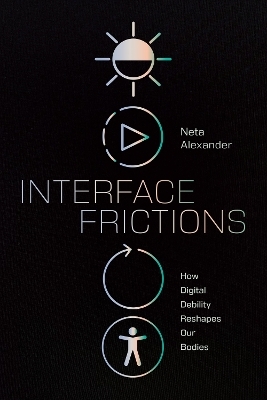
Interface Frictions
How Digital Debility Reshapes Our Bodies
Seiten
2025
Duke University Press (Verlag)
978-1-4780-3216-8 (ISBN)
Duke University Press (Verlag)
978-1-4780-3216-8 (ISBN)
Neta Alexander explores how ubiquitous design features in digital platforms such as playback speed, autoplay, and night mode, reshape, condition, and break our bodies.
In Interface Frictions, Neta Alexander explores how ubiquitous design features in digital platforms reshape, condition, and break our bodies. She shows that while features such as refresh, playback speed, autoplay, and night mode are convenient, they can lead to “digital debility” - the slow and often invisible ways that technologies may harm human bodies. These features all assume an able-bodied user and at the same time push users to ignore their bodily limitations like the need for rest, nourishment, or movement. Building on the lived experiences of people with disabilities, Alexander explores alternative design solutions that arise from a multisensorial approach to communication. She demonstrates what can be gained from centering the nonaverage user, such as blind people who pioneered ways to control the playback speed of media, and Netflix subscribers with invisible disabilities like PTSD who successfully pushed the company to redesign its previews autoplay feature. Drawing on artworks, video games, and creative hacking by users with disabilities, Alexander challenges our understanding of media consumption, the attention economy, and the digital interface.
In Interface Frictions, Neta Alexander explores how ubiquitous design features in digital platforms reshape, condition, and break our bodies. She shows that while features such as refresh, playback speed, autoplay, and night mode are convenient, they can lead to “digital debility” - the slow and often invisible ways that technologies may harm human bodies. These features all assume an able-bodied user and at the same time push users to ignore their bodily limitations like the need for rest, nourishment, or movement. Building on the lived experiences of people with disabilities, Alexander explores alternative design solutions that arise from a multisensorial approach to communication. She demonstrates what can be gained from centering the nonaverage user, such as blind people who pioneered ways to control the playback speed of media, and Netflix subscribers with invisible disabilities like PTSD who successfully pushed the company to redesign its previews autoplay feature. Drawing on artworks, video games, and creative hacking by users with disabilities, Alexander challenges our understanding of media consumption, the attention economy, and the digital interface.
Neta Alexander is Assistant Professor of Film and Media at Yale University and coauthor of Failure.
Introduction. Disabled/Enabled 1
1. Repetition, Reloaded: On Refreshing, Latency, and Frictional Aesthetics 25
2. The Right to Speed Watch (or, When Netflix Discovered Its Blind Users) 55
3. Automating Trauma: On Autoplay and the Unbingeable 85
4. “Log In, Chill Out”: On “Horizontal Media,” Night Modes, and Sleep Apps 118
Coda. On Digital Disability and the Normalization of Fatigue 150
Acknowledgments 165
Notes 169
Bibliography 197
Index
| Erscheinungsdatum | 30.07.2025 |
|---|---|
| Reihe/Serie | Sign, Storage, Transmission |
| Zusatzinfo | 26 illustrations |
| Verlagsort | North Carolina |
| Sprache | englisch |
| Maße | 152 x 229 mm |
| Gewicht | 445 g |
| Themenwelt | Kunst / Musik / Theater ► Film / TV |
| Sozialwissenschaften ► Kommunikation / Medien ► Medienwissenschaft | |
| Sozialwissenschaften ► Soziologie | |
| ISBN-10 | 1-4780-3216-2 / 1478032162 |
| ISBN-13 | 978-1-4780-3216-8 / 9781478032168 |
| Zustand | Neuware |
| Informationen gemäß Produktsicherheitsverordnung (GPSR) | |
| Haben Sie eine Frage zum Produkt? |
Mehr entdecken
aus dem Bereich


aus dem Bereich


