


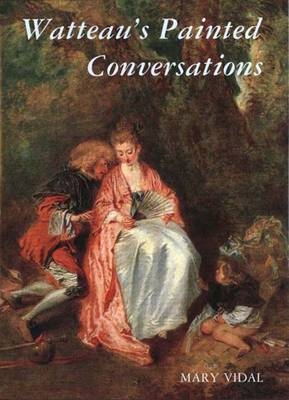
Watteau's Painted Conversations
Art, Literature and Talk in Seventeenth and Eighteenth-century France
Seiten
1992
Yale University Press (Verlag)
978-0-300-05480-4 (ISBN)
Yale University Press (Verlag)
978-0-300-05480-4 (ISBN)
- Titel ist leider vergriffen;
keine Neuauflage - Artikel merken
Vidal shows how conversation was central to Watteau's images of sociability, providing the framework for figural and formal relationships in even his military, mythological, theatrical and religious works. She argues that Watteau's painted conversations represented conversation as an art of living.
Antoine Watteau painted his "fetes galantes" during a period in which the art of polite conversation flourished in France. In this study, Mary Vidal shows that conversation was central to Watteau's images of sociability, providing the framework for figural and formal relationships even in his military, mythological, theatrical and religious works. Vidal argues that Watteau's painted conversations were not mere literal descriptions of social behaviour but repesented conversation as part of an aesthetic, linguistic and ethical system, as an art of living. Vidal shows that Watteau's focus on cnverstion was related to developments in the 17th- and 18th-century France: the rise and elaboration of an art of conversation, the connection between polite discourse and the redefinition of the nobility, the flourishng of women's salons in Paris and the development of the literary genre of the written conversation. Watteau recognised speech as the central sign system in French society and he identified the characteristics of fine conversation in his new manner of painting.
Through this analogy, he presented the artistic process itself as the main concern of the elite artist, in contrast to the scholarly, text-dependent image of the Academy. In choosing conversation as his subject, Watteau associated his art with polite society. In his conversational artmaking, Watteau set up dialogic relationships between spoken words and images, art and society, viewer and painting. Often regarded as merely erotic and decorative, this books shows his painted conversations to be also works of substance, ideas and morals.
Antoine Watteau painted his "fetes galantes" during a period in which the art of polite conversation flourished in France. In this study, Mary Vidal shows that conversation was central to Watteau's images of sociability, providing the framework for figural and formal relationships even in his military, mythological, theatrical and religious works. Vidal argues that Watteau's painted conversations were not mere literal descriptions of social behaviour but repesented conversation as part of an aesthetic, linguistic and ethical system, as an art of living. Vidal shows that Watteau's focus on cnverstion was related to developments in the 17th- and 18th-century France: the rise and elaboration of an art of conversation, the connection between polite discourse and the redefinition of the nobility, the flourishng of women's salons in Paris and the development of the literary genre of the written conversation. Watteau recognised speech as the central sign system in French society and he identified the characteristics of fine conversation in his new manner of painting.
Through this analogy, he presented the artistic process itself as the main concern of the elite artist, in contrast to the scholarly, text-dependent image of the Academy. In choosing conversation as his subject, Watteau associated his art with polite society. In his conversational artmaking, Watteau set up dialogic relationships between spoken words and images, art and society, viewer and painting. Often regarded as merely erotic and decorative, this books shows his painted conversations to be also works of substance, ideas and morals.
Not just talk - the recurring theme of conversation in Watteau's art; the age of conversation - France in the 17th and 18th centuries; the conversational mode; the artist as aristrocrat; "L'Enseigne de Gersaint" and the conversational structure of the artistic sign.
| Erscheint lt. Verlag | 28.10.1992 |
|---|---|
| Zusatzinfo | 133 b&w illustrations, 47 colour plates, bibliography |
| Sprache | englisch |
| Maße | 192 x 256 mm |
| Gewicht | 1060 g |
| Themenwelt | Kunst / Musik / Theater ► Kunstgeschichte / Kunststile |
| Kunst / Musik / Theater ► Malerei / Plastik | |
| ISBN-10 | 0-300-05480-7 / 0300054807 |
| ISBN-13 | 978-0-300-05480-4 / 9780300054804 |
| Zustand | Neuware |
| Informationen gemäß Produktsicherheitsverordnung (GPSR) | |
| Haben Sie eine Frage zum Produkt? |
Mehr entdecken
aus dem Bereich

aus dem Bereich
kleine Kulturgeschichte einer brillanten Allianz
Buch | Softcover (2025)
Iudicium (Verlag)
CHF 33,90


