


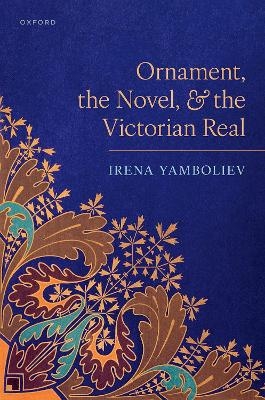
Ornament, the Novel, and the Victorian Real
Seiten
2025
Oxford University Press (Verlag)
978-0-19-895815-4 (ISBN)
Oxford University Press (Verlag)
978-0-19-895815-4 (ISBN)
Ornament, the Novel, and the Victorian Real explores the intersection of literary form with visual culture in the Victorian period. In charting the contributions of decorative design to novelistic realism, it shows how deeply the major genre of the period is indebted to an aesthetic form that tends to get feminized, trivialized, and dismissed.
"All real art," wrote William Morris, "is ornamental." If Morris is right, then ornament is not, as some would have it, a triviality, a sign of "want," or a crime. Instead, Ornament, the Novel, and the Victorian Real argues for the many and varied ways in which the novel is indebted to ornament. Victorians and Victorianist scholars have compared the novel to "fine" arts such as Dutch genre painting or to photography, emphasizing these visual forms' investment in gritty particularity and exhaustive detailing of appearance. But this story loses sight of a key fact that this book recovers: ornament represents a distinct, describable Victorian method of realism, a method for boiling down essentials and making palpable the invisible, fundamental laws that govern form in nature. This book grounds itself historically in Victorian theories and practices of decoration developed in the middle of the nineteenth century, a moment when Victorian designers overhauled the reigning principles of decorative art, and shows the rise of the newly developed theory of ornament to have explanatory power for contemporary novelistic practice too. The compositional principles in ornament—far from trivial, extraneous, or deceptive—furnish a new theory of form, a new concept of the real, and a new method for reading novelistic prose.
Ornament is at work churning away at the heart of the Victorian novel. Wallpaper patterns, hinge-work, stained glass: these visual forms articulate principles of form such contrast, symmetry, flatness, and stylization. And novelists turn these design principles into literary principles, importing them into their narratives as syntax, word by word and phrase by phrase. This book proceeds by way of very close readings that focus on the scale of the sentence and analyzes the rhythm, meter, and repetition of prose. This method allows an appreciation of how, in the hands of George Eliot, Thomas Hardy, A. C. Swinburne, Oscar Wilde, and D. H. Lawrence, ornamental prose opens up representational possibilities not otherwise available. Ornament allows novelists to render the patterning of human minds, the dynamics of relationship, and the intense realities of the more-than-human world.
"All real art," wrote William Morris, "is ornamental." If Morris is right, then ornament is not, as some would have it, a triviality, a sign of "want," or a crime. Instead, Ornament, the Novel, and the Victorian Real argues for the many and varied ways in which the novel is indebted to ornament. Victorians and Victorianist scholars have compared the novel to "fine" arts such as Dutch genre painting or to photography, emphasizing these visual forms' investment in gritty particularity and exhaustive detailing of appearance. But this story loses sight of a key fact that this book recovers: ornament represents a distinct, describable Victorian method of realism, a method for boiling down essentials and making palpable the invisible, fundamental laws that govern form in nature. This book grounds itself historically in Victorian theories and practices of decoration developed in the middle of the nineteenth century, a moment when Victorian designers overhauled the reigning principles of decorative art, and shows the rise of the newly developed theory of ornament to have explanatory power for contemporary novelistic practice too. The compositional principles in ornament—far from trivial, extraneous, or deceptive—furnish a new theory of form, a new concept of the real, and a new method for reading novelistic prose.
Ornament is at work churning away at the heart of the Victorian novel. Wallpaper patterns, hinge-work, stained glass: these visual forms articulate principles of form such contrast, symmetry, flatness, and stylization. And novelists turn these design principles into literary principles, importing them into their narratives as syntax, word by word and phrase by phrase. This book proceeds by way of very close readings that focus on the scale of the sentence and analyzes the rhythm, meter, and repetition of prose. This method allows an appreciation of how, in the hands of George Eliot, Thomas Hardy, A. C. Swinburne, Oscar Wilde, and D. H. Lawrence, ornamental prose opens up representational possibilities not otherwise available. Ornament allows novelists to render the patterning of human minds, the dynamics of relationship, and the intense realities of the more-than-human world.
Irena Yamboliev is Lecturer at Stanford University. She studied biological sciences alongside literature at the University of Nevada, Reno and earned her doctorate at Stanford. An interest in interdisciplinarity informs her focus on nineteenth- and early-twentieth-century British literature, form, and style. Her next book project explores the ecological potential of multigenerational novels.
Introduction: As Nature
1: The Ornamental Real: Visual and Linguistic
2: A. C. Swinburne's Art-Botanical Prose
3: Ardently Adorned Middlemarch
4: Decorating Murder: Oscar Wilde's Wallpaper
5: Becoming Ornate: On the Management of Forces in Jude the Obscure
6: D. H. Lawrence's Stained Glass
Conclusion: Inherently Interdisciplinary
| Erscheinungsdatum | 25.07.2025 |
|---|---|
| Zusatzinfo | 8 colour, 26 b&w |
| Verlagsort | Oxford |
| Sprache | englisch |
| Maße | 165 x 240 mm |
| Gewicht | 578 g |
| Themenwelt | Kunst / Musik / Theater ► Kunstgeschichte / Kunststile |
| Geisteswissenschaften ► Sprach- / Literaturwissenschaft ► Anglistik / Amerikanistik | |
| Geisteswissenschaften ► Sprach- / Literaturwissenschaft ► Literaturgeschichte | |
| Geisteswissenschaften ► Sprach- / Literaturwissenschaft ► Literaturwissenschaft | |
| ISBN-10 | 0-19-895815-3 / 0198958153 |
| ISBN-13 | 978-0-19-895815-4 / 9780198958154 |
| Zustand | Neuware |
| Informationen gemäß Produktsicherheitsverordnung (GPSR) | |
| Haben Sie eine Frage zum Produkt? |
Mehr entdecken
aus dem Bereich


aus dem Bereich
Poetik eines sozialen Urteils
Buch | Hardcover (2023)
De Gruyter (Verlag)
CHF 83,90


