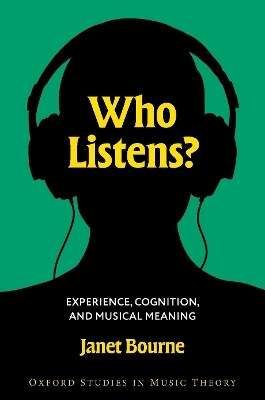
Who Listens?
Oxford University Press Inc (Verlag)
978-0-19-779716-7 (ISBN)
This book shows how listening is an active and creative act, and that many people make sense of music largely by drawing on their previous experiences, particularly experiences with music. According to research in cognitive science, listeners use a musical form of analogy and categorization to relate what they previously heard to what they hear in the moment. To demonstrate that listeners draw on this experience to perceive meaning when listening, Bourne combines music analytic tools, empirical psychological methods, and reception history. Drawing on analogy and categorization, Bourne has designed cognitively-based tools for analyzing music from the perspective of the listener to create different interpretations for different listeners.
While Part 1 outlines the analytical tools, Part 2 analyzes pieces by Beethoven from the perspective of three groups of listeners: Beethoven's early 19th-century contemporaries; late 20th- and 21st-century musicians and music scholars; and 21st-century film-goers. In so doing, this book illuminates how musical meanings change when considering different listeners' backgrounds and ways of listening, giving voice to overlooked reception histories and musical meanings.
Janet Bourne is Assistant Professor of Music Theory at the University of California, Santa Barbara and founder of the UC Santa Barbara Music Cognition Lab. Her research interests include analogy, metaphor and music, cognition behind listening, modes of listening, topic theory, schema theory, narrative and associations, music theory pedagogy and representations of gender and race in film music. She has publications in Music Theory Online, Oxford Handbook of Cinematic Listening, Music Analysis and Film: Studying the Score, Norton Guide to Teaching Music Theory, Frontiers in Neuroscience, among others. She lives in Orcutt, CA with her husband and son.
Introduction: Who's Listening?
1: Analogy and Listening
2: Listener Experience, Modes of Listening, and Conceptual Knowledge
2.1: Interlude: Creating Composite Listeners and Cast of Characters
3: Irony and Happy Endings in Beethoven's String Quartet, Op. 95/iv
Empirical Vignette #1: Experiment on Cinematic Listening and Op. 95/iv
4: A "Woman's Way of Listening" to Beethoven: Perceiving a Lullaby Topic in Op. 90/II and Op. 101/I
Empirical Vignette #2: Experiment on Hearing Orchestral March Topics
5: Beethoven's Darth Vader and Op. 26/iii
Appendix I: Methods and Statistical Results for Empirical Vignette #1
Appendix II: Methods and Statistical Results for Empirical Vignette #2
Appendix III: Cognitive Constraints in Structural Alignment
| Erscheinungsdatum | 16.10.2025 |
|---|---|
| Reihe/Serie | Oxford Studies in Music Theory |
| Zusatzinfo | 42 |
| Verlagsort | New York |
| Sprache | englisch |
| Maße | 156 x 19 mm |
| Gewicht | 568 g |
| Themenwelt | Kunst / Musik / Theater ► Musik ► Musiktheorie / Musiklehre |
| Kunst / Musik / Theater ► Theater / Ballett | |
| ISBN-10 | 0-19-779716-4 / 0197797164 |
| ISBN-13 | 978-0-19-779716-7 / 9780197797167 |
| Zustand | Neuware |
| Informationen gemäß Produktsicherheitsverordnung (GPSR) | |
| Haben Sie eine Frage zum Produkt? |
aus dem Bereich