


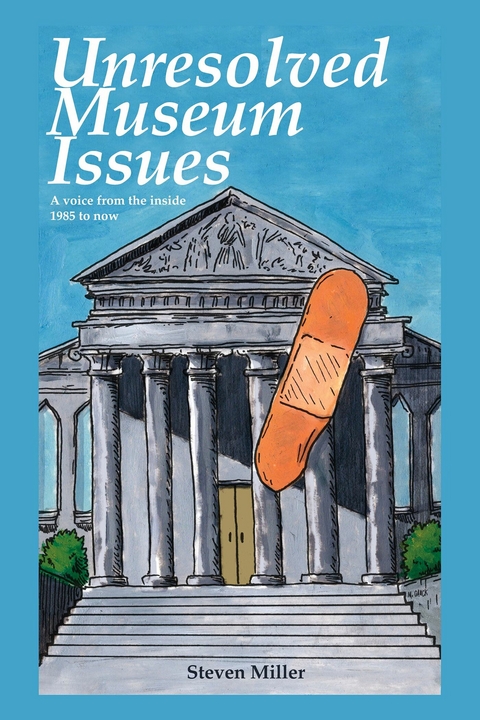
Unresoloved Museum Issues: A Voice from the Inside 1985 to Now (eBook)
248 Seiten
Bookbaby (Verlag)
979-8-3509-9842-9 (ISBN)
Steven Miller began his museum career in 1971. He has served as a curator, administrator, director, trustee, author, consultant, and museum studies educator. Having retired in 2018 he now writes on various museum profession topics. During his career he held leadership positions in six major museums in the northeastern United States. Miller holds a BA in sculpture (with honors) from Bard College, and, an international graduate certificate in the principles of conservation science from the International Centre for the Study of the Conservation and Preservation of Cultural Property, Rome, Italy. For sixteen years he was an adjunct professor with the Seton Hall University MA Program in Museum Professions, South Orange, NJ. He also taught museum studies as the New School for Social Research, NY, NY and Case Western Reserve University, Cleveland, Ohio. He has contributed scores of articles, reviews, editorial comments, and blogs for museum profession publications and the general media. He serves on the board of trustees of the Center for the Conservation of Art and Historic Artifacts, Philadelphia, and the art committee of the Phillips Mill Community Association, New Hope, PA. His books include: The Anatomy of a Museum: An Insider's Text, Wiley Blackwell, Oxford, United Kingdom, 2018; Deaccessioning Today: Theory and Practice, Rowman & Littlefield, Lanham, MD, 2018; How to Get a Museum Job, Rowman & Littlefield, Lanham, MD, 2019; Museum Collection Ethics: Acquisition, Stewardship, and Interpretation, Rowman & Littlefield, Lanham, MD, 2020. Museum Collecting Lessons: Stories From the Inside, Rutledge Press (Taylor & Francis), 2022.
UNRESOLVED MUSEUM ISSUES: a voice from the inside - 1985 to nowWith the astonishing rise in popularity and number, museums globally enjoy unprecedented attention. That notoriety comes from many sources. Some are predictable and include cultural interests. Others are less obvious and include political, social, economic, spiritual sources and national identities. The general public holds museums in hith esteem. However, they know little or nothing about how they operate. Consequently issues museums deal with are mysteries and those within these institutions prefer to keep it that way. Unresolved Museum Issues rebutes that proclivity. The author has deep experience in all aspects of museums. He has never been shy about discussing their strenghts and faults openly. This book presents his opinions on a range of topics that can be controversial. The topics center on ethics and especially how those impact museum collecting and collections. There are no books by insiders that are so frank and blunt. The vast majority of museum critics come from outside them. This means their information is hardly reality based. Museums enjoy considerable media attention these days. Much is pleasant. Examples include creating a new museum, expanding an existing one, hiring a distinguished staff person, acquiring a stellar collection, receiving a major financial contribution, and opening an important exhibition. But press coverage can also be about difficulties. When curiously unresolved, loudly controversial, or, debated ad infinitum, they are referred to as issues. Most are brought to the public's attention by museum outsiders. Insiders with complaints about museums tend to be discrete. This book is a collection of essays I wrote over the past thirty-five years that contradict museum employee reticence to speak up and out about issues.
Chapter 1
Behavior
This essay is a slightly condensed chapter from my museum studies textbook The Anatomy of a Museum: An Insider’s Text (Wiley Blackwell, 2018). pp. 227-239. All I removed are some personal anecdotes. I had thought about changing the title to Manners but that sounds so fusty, as if a spinster aunt has assumed the role of keeping everyone in line. However, in application minding our manners offers a good place to start when addressing behavior as a museum issue. Accusations of poor treatment of a person at work ranks high amongst job irritations. For me, well understood and applied manners comprise a thoughtful, respectful, engaging and understanding way of dealing with people regardless of their age, personal demographic and profile, education, politics, religion or absence thereof, professional standing, economic status, and so on. It is a practical and helpful approach to life that I have found always beneficial even when I would prefer to reject it in certain situations. I did that once when I yelled at a trustee. He was offended and resigned from the board much to the joy of the rest of the board all of whom could not stand him. However, I do not recommend such behavior on the job.
My concern about prevalent bad museum behaviors is caused by more than affronts to inter-person behaviors. I have a thick skin which usually allows me to handle affronts judiciously. However in hearing from others in the field and especially those just starting out, I am angry. My sense is that having to deal with unfortunate affronts only repels potentially excellent new generations so essential to museum futures. I recognize that my racial (white), gender (male), sexual orientation (straight),social profile (Anglo Saxon, Protestant, middle class) makes me ill-equipped to experientially identify with those who have been or are subject to harsh inequities. This does not excuse me or colleagues in my field from fighting back for all.
When I was starting in the museum world and contacted people for advice they responded in a polite and helpful way. In one case an influential person got wind of my hopes and graciously volunteered to help. After college I took a temporary job at Tiffany & Co for a holiday season while considering my next museum career steps. It was at its flagship Manhattan store on Fifth Avenue. The president learned I was interested in museum work. He met with me and offered to write a letter of introduction to his son who was the director of the Metropolitan Museum of Art! I was so appreciative. Meeting the director remains in my mind as if it happened yesterday. Would such an encounter have occurred had I alone requested it, without a father’s initiative? It may have. Times were different then, but today I wager, sadly, it would not. Self-isolation seems to be in a museum leadership job description.
Most people who work in museums do so in a relatively well-behaved manner. At least that has been my experience over the years. This does not mean such emotions as rancor, jealously, discontent, and backbiting re absent. As in any workplace, feelings bubble up in museums, positive and negative, but I have generally found them to be nice places to be employed.
I encourage good behavior and basic manners in museum life for several reasons. Most obviously it is preferable to work in a respectful atmosphere. No matter how fusty certain mores may be, understanding and practicing them can be a great advantage. I recognize people have advanced quite far in the museum world by ignoring basic precepts of etiquette but I have no interest in hanging out with them, nor do others. In the long run, those who are most respected, admired, and loved in my field are – not surprisingly – pleasant to be with. I have also fund tht respectful camaraderie engenders higher productivity, loyalty, and creativity.
The tone for a mannerly workplace starts at the top, in the director’s office. Poor museum leaders set a bad example for employees and create a work atmosphere that limits quality and quantity outcomes. Complaining, pointing fingers, being dishonest, constantly finding fault, relying on excuses, blaming others and criticizing staff and trustees is bad leadership. Showing this sort of management suggests a lack of control and competence. No one is reassured. I can voice gossip and deprecating remarks as much as the next person, but when I became a director I needed to avoid that sort of behavior.…
As a boss, my good feelings about museum atmospheres may be skewed, not to mention that they are a reflection of the fact that I love being in them. I will be the first to recognize that no matter how nice a museum is, there may always be one or two staff who love to whine and complain. These sorts are found in all walks of life, but please leave mine. Change your attitude. Stop belly aching. No judge sentenced you to work in a museum.
We may like codes of conduct to be listed in personnel manuals or other official documents but how they happen on the job and to what extent will vary according to personalities. It’s hard to codify being nice, respectful, thoughtful, supportive, professional, or mindful.
Interviewing for a job provides an ideal start to thinking about clothing on the job. Unless you are applying to work at the Hooters Museum, avoid uncovered cleavage, male or female. No short skirts or shorts. If applying for a management position, a suite is customary for both sexes. If a job is in maintenance or behind the scenes, a sports coat and conservative slacks are permissible for both men and women. I always recommend men wear ties to interviews for most museum jobs. I had a student take that advice when he went to interview for an unpaid internship. He was the successful candidate. I later heard from the museums that in addition to his personality and resume he impressed them by his dress. Men should avoid red socks, as a job applicant I interviewed did not (and did not get the job). Unless you are applying for a position at an avant-garde contemporary art museum, you may want keep tattoos and body piercings to a minimum and out of sight. Be prepared to walk around during an interview or call-back so wear suitable shoes. And be prepared to dine in some way. This is where table manners come into play.
The more executive position you might interview for, the better the chances are you will have at least one meal during the process. That meal could be in a restaurant, a private home, or at the museum itself. It might involve a cocktail reception. Your spouse, partner, or significant other (not all three please) might be invited. In these situations the rubber hits the road insofar as manners are concerned. You will be expected to know what piece of silverware to use and both how and when. At a restaurant, order simple food that can be delivered to your mouth without mishap. As much as I love French onion soup, it is messy, especially for a guy with a beard. Alcohol can be a challenge. Consume very little or avoid it entirely if you can do so without appearing impolite.
Respectful intergenerational relations are helpful in all aspects of life, but especially in museums. I suggest devoting considerable thought and energy to getting along well with colleagues whatever their positions or your opinion of them. From maintenance staff to office workers to curators, educators and directors, not to mention trustees, strive to interface with everyone in a profitable and pleasant way. This workplace approach may seem obvious but how many times to we see situations where a focus on personality undermines a focus on productivity? Being polite also gives you a shield when dealing with stressful, difficult, and annoying circumstances and people. I have never regretted mannerly conduct during times of discomfort. There are a lot of people in and around the museum world who think they know about it but don’t. Their ignorance is their bliss and the rest of us have to deal accordingly. I don’t suffer fools gladly but I try not to disrespect them directly as I don’t want to put myself in their low behavioral level. Manners can guard against that possibility.
I always answer e-mails, letters, phone calls, and personal inquiries in short order and regardless of the source. Unfortunately this is increasingly untrue of my esteemed peers. … We in the museum field work for the public and should be accountable to it, whoever “it” is. Amongst other things, that means responding politely when approached personally through the various technological communications used these days. I know we are all busy, but that is no excuse for ignoring inquiries. A simple response is often sufficient, even if it is along the lines of “thanks but no thanks. If an e-mail, letter, phone message, or other communication, is ignored by someone in my field, I am offended.
Cautions and caveats about social relations on the job extend to the written word. This includes not only hard copy communications but electronic communications. Anything done with pencil and pen on paper, a computer, Smart Phone, tablet, whatever, is subject to retention in some manner. Whenever I write or put pictures or graphics on or into a device I do so with others in mind. How will what I say be perceived by those for whom it is intended? I am not by nature paranoid and I rarely entangle myself in dicey situations online. I might do so on paper but only if I can engineer anonymity or, documentation is required, as will happen with personal...
| Erscheint lt. Verlag | 11.4.2025 |
|---|---|
| Sprache | englisch |
| Themenwelt | Kunst / Musik / Theater ► Malerei / Plastik |
| ISBN-13 | 979-8-3509-9842-9 / 9798350998429 |
| Informationen gemäß Produktsicherheitsverordnung (GPSR) | |
| Haben Sie eine Frage zum Produkt? |
 EPUB (Ohne DRM)
Digital Rights Management: ohne DRM
Dieses eBook enthält kein DRM oder Kopierschutz. Eine Weitergabe an Dritte ist jedoch rechtlich nicht zulässig, weil Sie beim Kauf nur die Rechte an der persönlichen Nutzung erwerben.
Dateiformat: EPUB (Electronic Publication)
EPUB ist ein offener Standard für eBooks und eignet sich besonders zur Darstellung von Belletristik und Sachbüchern. Der Fließtext wird dynamisch an die Display- und Schriftgröße angepasst. Auch für mobile Lesegeräte ist EPUB daher gut geeignet.
Systemvoraussetzungen:
PC/Mac: Mit einem PC oder Mac können Sie dieses eBook lesen. Sie benötigen dafür die kostenlose Software Adobe Digital Editions.
eReader: Dieses eBook kann mit (fast) allen eBook-Readern gelesen werden. Mit dem amazon-Kindle ist es aber nicht kompatibel.
Smartphone/Tablet: Egal ob Apple oder Android, dieses eBook können Sie lesen. Sie benötigen dafür eine kostenlose App.
Geräteliste und zusätzliche Hinweise
Buying eBooks from abroad
For tax law reasons we can sell eBooks just within Germany and Switzerland. Regrettably we cannot fulfill eBook-orders from other countries.
aus dem Bereich


