


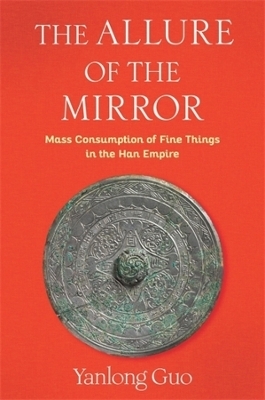
The Allure of the Mirror
Mass Consumption of Fine Things in the Han Empire
Seiten
2025
Columbia University Press (Verlag)
978-0-231-21778-1 (ISBN)
Columbia University Press (Verlag)
978-0-231-21778-1 (ISBN)
In Han China, few luxury objects were as widely coveted as bronze mirrors. Yanlong Guo explores how and why these objects became so beloved throughout early imperial China, uncovering the varied ways these seemingly trivial objects took on social and cultural significance.
In Han China (202 BCE–220 CE), few luxury objects were as widely coveted as bronze mirrors. Typically circular and ranging from seven to thirty centimeters in diameter, these mirrors were crafted from high-tin bronze, with highly reflective surfaces on the front and intricate designs and auspicious inscriptions on the reverse.
The Allure of the Mirror explores how and why these objects, historically known as haowu (“fine things”), became so beloved throughout early imperial China. Tracing their production and consumption—from manufacture in imperial, princely, and private workshops to their roles in life and death—Yanlong Guo uncovers the varied ways these seemingly trivial objects took on social and cultural significance. Across social classes, mirrors had a wide range of uses as status symbols, personal tools, romantic tokens, family heirlooms, auspicious amulets, treasured gifts, and funeral offerings. Guo demonstrates how these “fine things,” once exclusive to elites, gradually became accessible to a wider segment of society. Mirrors, he argues, connected people across the empire, fostering a shared cultural community of aesthetic tastes and social values from royal courts to rural households.
Interdisciplinary and comprehensive, The Allure of the Mirror offers fresh insights into the relationship among art, society, and ideology in the Han Empire, revealing how decorative objects could bridge social divides and shape cultural identity.
In Han China (202 BCE–220 CE), few luxury objects were as widely coveted as bronze mirrors. Typically circular and ranging from seven to thirty centimeters in diameter, these mirrors were crafted from high-tin bronze, with highly reflective surfaces on the front and intricate designs and auspicious inscriptions on the reverse.
The Allure of the Mirror explores how and why these objects, historically known as haowu (“fine things”), became so beloved throughout early imperial China. Tracing their production and consumption—from manufacture in imperial, princely, and private workshops to their roles in life and death—Yanlong Guo uncovers the varied ways these seemingly trivial objects took on social and cultural significance. Across social classes, mirrors had a wide range of uses as status symbols, personal tools, romantic tokens, family heirlooms, auspicious amulets, treasured gifts, and funeral offerings. Guo demonstrates how these “fine things,” once exclusive to elites, gradually became accessible to a wider segment of society. Mirrors, he argues, connected people across the empire, fostering a shared cultural community of aesthetic tastes and social values from royal courts to rural households.
Interdisciplinary and comprehensive, The Allure of the Mirror offers fresh insights into the relationship among art, society, and ideology in the Han Empire, revealing how decorative objects could bridge social divides and shape cultural identity.
Yanlong Guo is assistant professor of art history at Smith College.
Introduction
1. Making Mirrors
2. Distributing Mirrors
3. Handling Intimate Mirrors
4. Seeing in Bright Mirrors
5. Inscribing Auspicious Mirrors
6. Gifting Precious Mirrors
7. Burying Familiar Mirrors
Coda
Appendix: Typology and Chronology of Han Mirrors
Notes
Bibliography
Index
| Erscheinungsdatum | 17.09.2025 |
|---|---|
| Reihe/Serie | Tang Center Series in Early China |
| Zusatzinfo | 70 photographs and drawings |
| Verlagsort | New York |
| Sprache | englisch |
| Maße | 156 x 235 mm |
| Themenwelt | Kunst / Musik / Theater ► Kunstgeschichte / Kunststile |
| Geschichte ► Allgemeine Geschichte ► Vor- und Frühgeschichte | |
| Geisteswissenschaften ► Geschichte ► Regional- / Ländergeschichte | |
| ISBN-10 | 0-231-21778-1 / 0231217781 |
| ISBN-13 | 978-0-231-21778-1 / 9780231217781 |
| Zustand | Neuware |
| Informationen gemäß Produktsicherheitsverordnung (GPSR) | |
| Haben Sie eine Frage zum Produkt? |
Mehr entdecken
aus dem Bereich
aus dem Bereich
auf den Spuren der frühen Zivilisationen
Buch | Hardcover (2023)
C.H.Beck (Verlag)
CHF 27,95
Konzepte – Methoden – Theorien
Buch | Softcover (2024)
UTB (Verlag)
CHF 55,85


