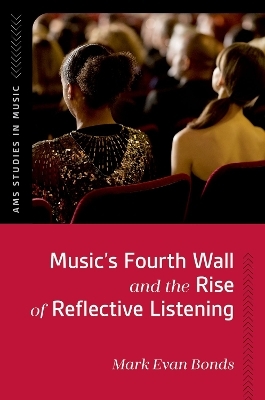
Music's Fourth Wall and the Rise of Reflective Listening
Oxford University Press Inc (Verlag)
9780197806371 (ISBN)
Like the theater, the concert hall has its own fourth wall, an imagined barrier that allows audiences to forget that what they are experiencing is a carefully crafted artifice, which in turn allows them to lose themselves in the music and resonate with it in a way that is immediate and direct. But when composers like Joseph Haydn began to violate music's fourth wall--most spectacularly in the finale of the "Joke" String Quartet (1782), with its repeated false endings--lay listeners were compelled to listen reflectively. They could not lose themselves in what they were hearing when it kept reminding them that they were listening to a work of music.
Author Mark Evan Bonds uses the concepts of resonant and reflective listening as coordinates for tracing this important change in the history of concert-hall listening. By 1850, reflective listening--once limited largely to professional musicians and connoisseurs--had become the aspirational norm for lay listeners. Contemporary developments in the philosophy of art accelerated the growing status of instrumental music by promoting a mode of perception that went beyond the merely sensory to incorporate the intellectual as well: Beethoven famously thought of himself as a "tone poet," someone who not only moved listeners but also challenged them to think and reflect.
Lay audiences thus gradually accepted the idea of listening as a skill that could be learned and cultivated. Bonds shows how music appreciation texts, composer biographies, program notes, and pre-concert lectures, all new during this period, helped reinforce a growing distinction between classical and popular repertories. For better or worse, the ideal of reflective listening has prevailed ever since.
Mark Evan Bonds is the Cary C. Boshamer Distinguished Professor of Music Emeritus at the University of North Carolina, Chapel Hill. A former editor-in-chief of Beethoven Forum, he has written widely on the music of Haydn, Mozart, and Beethoven, with a special interest in the intersections of music and philosophy. He has received grants from the National Endowment for the Humanities, the American Council of Learned Societies, the National Humanities Center, the American Academy in Berlin, the Institute for Advanced Study-Princeton, and the Austrian Science Foundation (FWF). His most recent books are The Beethoven Syndrome: Hearing Music as Autobiography and Beethoven: Variations on a Life.
Introduction
1: The Pleasure of Resonance
2: Resonance Subverted
3: The Pleasure of Reflection
4: The Prestige of Reflection
Epilogue: The Resilience of Resonance
| Erscheinungsdatum | 01.07.2025 |
|---|---|
| Reihe/Serie | AMS Studies in Music |
| Verlagsort | New York |
| Sprache | englisch |
| Maße | 169 x 237 mm |
| Gewicht | 485 g |
| Themenwelt | Kunst / Musik / Theater ► Musik ► Klassik / Oper / Musical |
| ISBN-13 | 9780197806371 / 9780197806371 |
| Zustand | Neuware |
| Informationen gemäß Produktsicherheitsverordnung (GPSR) | |
| Haben Sie eine Frage zum Produkt? |
aus dem Bereich